
Alulim, the First King
Sovereign Chronicles: The True Royal Bloodline of An and Ki — Sumer
Sovereign Chronicles Editorial Staff
Series lens: This series traces royal bloodlines from the sky to the earth, working from primary texts alongside the archaeological record, with the Holy Tablets of Dr. Malachi Z. York as the interpretive lens. What the documents say and what the lens says are kept distinct throughout.
Everything the clay tells us about Alulim fits in a single sentence.
"In Eridu, Alulim became king; he ruled 28,800 years."
That is the whole documentary record. One line on the King List, copied around 1800 BCE onto the prism in Oxford. No tomb. No seal. No statue. Just a name, a city, and a number so large it stops being a reign and becomes a geological era.
But a single sentence can carry weight, if you set down what surrounds it.
First, the city. Eridu — the oldest city in southern Mesopotamia, its temples stacked eighteen layers deep back to around 5400 BCE, the city the Eridu Genesis assigns to Nudimmud, the god the Tablets call Enqi. Alulim is not king of some nowhere. He is king of the first city, the city the record itself says was founded when kingship descended from heaven. To be the first king of Eridu is to be the first king, full stop.
Second, the number. 28,800 years is eight sars — eight units of 3,600, the sacred number of the Sumerian cosmos. The scribes were not estimating. They were inscribing a mathematical perfection: the first reign, measured in the gods' own arithmetic. Whatever Alulim was, the people who wrote him down believed his kingship belonged to a different order of time than ours.
Third, the second witness. Three centuries before Christ, the Babylonian priest Berossus — a priest of Bel-Marduk who wrote his Babyloniaca in Greek for King Antiochus I, around 290 BCE — wrote his own history of the kings before the flood. His first king is Aloros of Babylon — the Greek rendering of Alulim — and Berossus gives him ten sari where the King List gives eight, the kind of small disagreement that tells you two traditions were remembering the same man. And Berossus adds one detail the King List does not: Aloros took the title of shepherd. The shepherd's crook, the staff that guides and guards the flock, would become the oldest royal metaphor on Earth. Thousands of years later, kings from Sumer to Israel would still be called shepherds. Alulim wore the title first.
Follow that title forward and watch how far it travels. Hammurabi of Babylon, the lawgiver, calls himself the shepherd of his people in the prologue to his famous law code. The pharaohs of Egypt carried the crook and the flail — the shepherd's tools, gilded into regalia — across three thousand years of dynasties. And in the psalms of Israel, the metaphor completes its journey from palace to prayer: "The Lord is my shepherd." Every one of those shepherds is downstream of Alulim. The first king did not just take a throne. He took a job description — guide the flock, guard the flock, answer for the flock — and five thousand years of rulers have been filling it in ever since.
And what was the world this first king ruled? The black-headed people — sag-gig-ga, as they called themselves — were building something no one had built before: a civilization of canals and temples in the marshes between the rivers. Irrigation meant survival, and survival meant organization. The temple at Eridu was not just a shrine; it was the granary, the workshop, and the court. The challenges were water and hunger and the rival settlements rising on every horizon. Alulim's throne sat at the center of all of it — the first answer to the first political question ever asked: who keeps the water flowing, the grain stored, and the peace?
Picture the city he would have known. Eridu in its early days was not the great walled metropolis Uruk would become — it was a cluster of mud-brick houses and reed huts around a temple platform that had already been rebuilt a dozen times, each layer a generation's act of faith. The Ubaid people, as archaeologists call them, painted their pottery with geometric precision and buried their dead with care. They were not primitives awaiting civilization. They were civilization, learning its first steps — and Alulim, if the List is right, was the man who taught it to walk upright.
Here is the honest boundary, and this series will never cross it: we do not know Alulim's accomplishments in the way we know a modern president's. We do not know his failures, his wars, his laws, the name of his queen. The clay gives us one sentence, and everything else is the world around the sentence. But notice what that means. Four thousand years ago, scribes copying a list that was already ancient put this name first — ahead of conquerors, ahead of lawgivers, ahead of men whose palaces we can walk through. Whatever Alulim did, the people who remembered him believed nothing mattered more than that he was first.
Now open the lens. The Holy Tablets say kingship was never a human invention — it was a delegation from the court of ANU, and Enqi, the firstborn, came down to found Eridu and build the Abzu. The Tablets add their own shadow to the story: Enqi was the firstborn but displaced, Enlil the legal heir — the first succession crisis, in heaven before it ever happened on earth. Set Alulim inside that frame and his single sentence ignites: he is the first human being to hold a delegated throne. The first man to sit where a god had stood. Every king who ever claimed to rule by divine right — every pharaoh, every anointed monarch, every emperor under heaven — is, knowingly or not, imitating Alulim of Eridu.
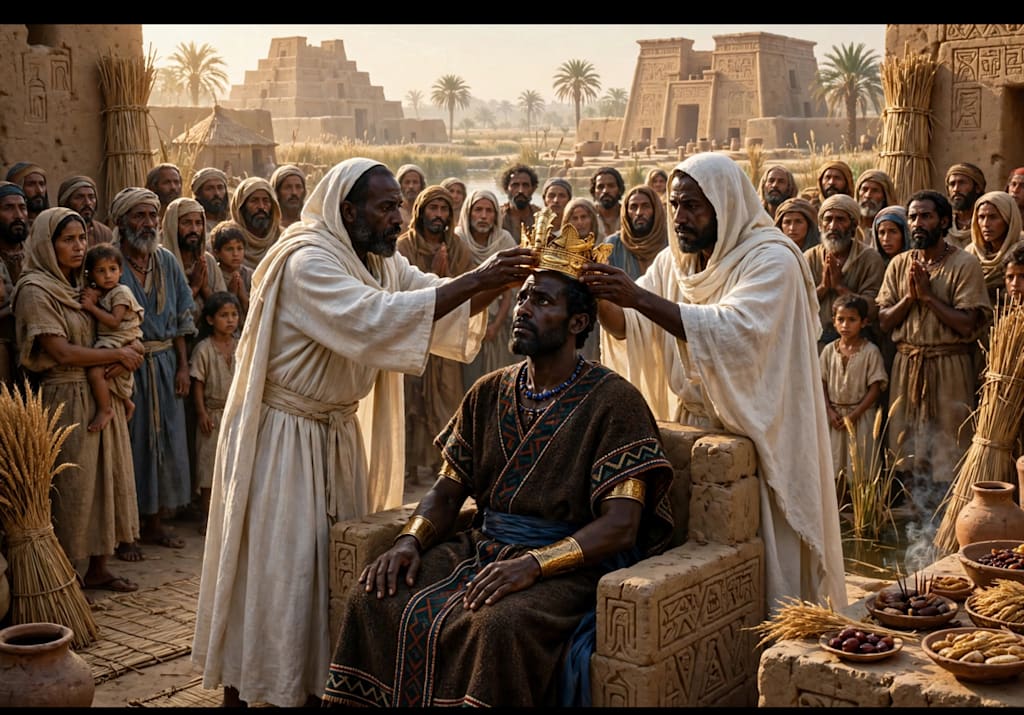
Imagine the first coronation — and mark this as imagination, because the clay does not describe it. The temple court at Eridu, the priests of the Abzu, the elders of the black-headed people gathered where no king had ever stood before. A crown — perhaps just a band of gold — lifted and set down. And in that moment, an idea entered the world that has never left it: that one person's head can carry the weight of everyone's survival. Every coronation since, from Thebes to Westminster, is a copy of a ceremony no one recorded.
That is why the first king matters more than his one sentence suggests. The second king proves kingship can continue. The tenth king proves it can endure. But the first king proves it can begin — that the distance between heaven and earth can be crossed, and a man can sit in the crossing-place.
Alulim ruled 28,800 years. Then, the list says, Alalgar ruled. The throne did not go empty. The delegation held.
Four thousand years later, we still begin the story of kingship with his name — because the scribes did. That is the final lesson of the first king: being first is the one achievement no successor can ever take from you.
Next in the series: Alalgar, the second king — the man with the hardest job in history.
Sources: The Sumerian King List (WB 444, Ashmolean Museum, Oxford; Jacobsen translation: "Alulim became king and reigned 8 sars") · Berossus via Apollodorus (Aloros of Babylon, first king, ten sari; the shepherd title) · Eridu (Tell Abu Shahrein): the E-abzu temple sequence · The Eridu Genesis (the city assigned to Nudimmud/Enqi) · The series' interpretive lens: The Holy Tablets by Dr. Malachi Z. York (kingship as delegation from ANU's court; Enqi founding Eridu).
About the Creator
Enjoyed the story? Support the Creator.
Subscribe for free to receive all their stories in your feed.
Comments
There are no comments for this story
Be the first to respond and start the conversation.