
ALAN WATTS
The story of Alan W. Watts: Since I'm a huge fan of Watts, I had a great time writing his story. Enjoy.

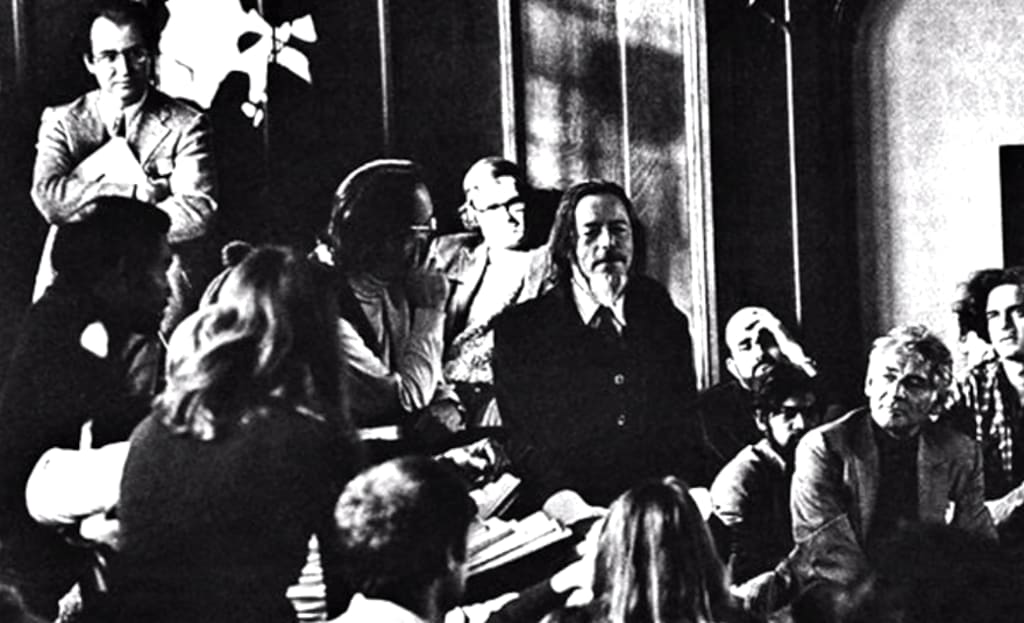
Alan Watts was not a man who wanted to be followed; he was a man who wanted you to wake up to the sheer, unadulterated absurdity of being alive. If you’ve ever stumbled across a clip of a crackling British voice, punctuated by a deep, infectious belly laugh, talking about how you are "the universe experiencing itself," you’ve met the man who spent his life translating the profound silence of the East for the noisy, anxious ears of the West. To understand Watts is to understand that life is not a problem to be solved, but a song to be sung.
Born in England and eventually settling in the foggy hills of Sausalito, California, Watts lived a life that was as messy and human as the philosophies he preached. He was an Episcopal priest who became a counter-culture icon, a scholar who preferred the company of poets to academics, and a man who loved fine wine and good conversation as much as he loved the "Void." He didn't sit on a mountaintop; he sat in a houseboat, often with a glass in hand, trying to explain that we have spent our entire lives under a grand, collective hallucination.
The core of his message was simple: you are not a "stranger in a strange land." You are not a lonely ego trapped inside a bag of skin, fighting against a hostile universe. Instead, Watts used the imagery of the ocean. He would say that as the ocean "waves," the universe "peoples." You are a function of the total cosmic process in the same way that a wave is a function of the sea. When we realize this, the crushing weight of "trying to be someone" begins to evaporate.
To see how this philosophy breathes in the real world, consider the story of Julian. Julian was a high-powered architect in a city made of glass and steel. He lived by the clock, his life a series of deadlines, spreadsheets, and the constant, nagging fear that he was falling behind. He felt like a mouse in a maze, convinced that at the end of the maze, there was a prize that would finally make him feel "complete."
One rainy Tuesday, Julian found himself stuck in a massive traffic jam. The air was thick with the smell of exhaust and the sound of angry horns. Usually, this would send Julian into a spiral of stress. But that morning, a recording of Watts was playing through his speakers. Watts was talking about music. He said, "In music, one doesn’t make the end of a composition the point of the composition. If that were so, the best conductors would be those who played fastest."
Julian looked out at the rain streaking across his windshield. He watched the way the droplets merged and raced down the glass, illuminated by the red glow of brake lights. For the first time in a decade, he stopped trying to "get" somewhere. He realized he was already there. The traffic, the rain, the hum of the engine—it wasn't an obstacle to his life; it was his life. He started to laugh, a genuine, chest-shaking laugh that mirrored the one in the recording. He wasn't an architect trying to build a legacy; he was just the universe sitting in a sedan, watching the rain.
Watts’ greatest gift was his ability to strip away the "holier-than-thou" pretension of spirituality. He spoke of "The Wisdom of Insecurity," arguing that the more we try to grab hold of life, the faster it slips through our fingers. He compared existence to a dance. You don't dance to reach a specific spot on the floor; you dance for the sake of the movement itself. By embracing the fact that everything is temporary—including our own identities—we find a strange, paradoxical freedom.
In the end, Watts reminds us that we are the "big bang" still happening. We are the aperture through which the cosmos looks at itself. He didn't want us to become "Buddhists" or "spiritual seekers." He wanted us to realize that we are already "It." He wanted us to stop taking ourselves so damn seriously and join in the cosmic play. As he often said, "The secret of life is just to be completely engaged with what you are doing in the here and now. And instead of calling it work, realize it is play." If you can learn to hear the music while you’re still in the middle of the dance, you’ve understood everything Alan Watts ever had to say.
About the Creator
Jeff koli
Pure Facts in Life!
Enjoyed the story? Support the Creator.
Subscribe for free to receive all their stories in your feed.
Comments
There are no comments for this story
Be the first to respond and start the conversation.