
Alalgar, the Second King
Ancient Royal History Series
Sovereign Chronicles Editorial Staff
Series lens: This series traces royal bloodlines from the sky to the earth, working from primary texts alongside the archaeological record, with the Holy Tablets of Dr. Malachi Z. York as the interpretive lens. What the documents say and what the lens says are kept distinct throughout.
The first king proves kingship can begin. The second king has the harder job: proving it wasn't a miracle.
His name was Alalgar. His city was Eridu, same as Alulim's. His sentence on the King List is one line long: he ruled 36,000 years — ten sars, ten units of the sacred 3,600. Together, the two kings of Eridu account for eighteen sars, 64,800 years. Then the list says the kingship was carried to Bad-tibira, and Eridu's chapter closes.
Like Alulim, Alalgar has a second witness. Berossus, the Babylonian priest, names him Alaparos — and in the Armenian version of the chronicles that preserve Berossus, Alaparos is given as the son of Aloros. The first succession. Whether that father-to-son link was history or the later scribes' tidying, notice what it claims: kingship could be handed down. It had become an institution. The throne of Eridu did not die with its first occupant.
That is Alalgar's story, and it is larger than his single sentence. Every dynasty in human history — every "the king is dead, long live the king" — is a repetition of what happened in Eridu when Alalgar took the throne from Alulim. The French still cry it at every succession: le roi est mort, vive le roi!* — the king is dead, long live the king. The formula is a thousand years old in France and five thousand in Sumer, and it has never once failed to mean the same thing: the man dies, the office lives. Alalgar is the first man who proved it true.
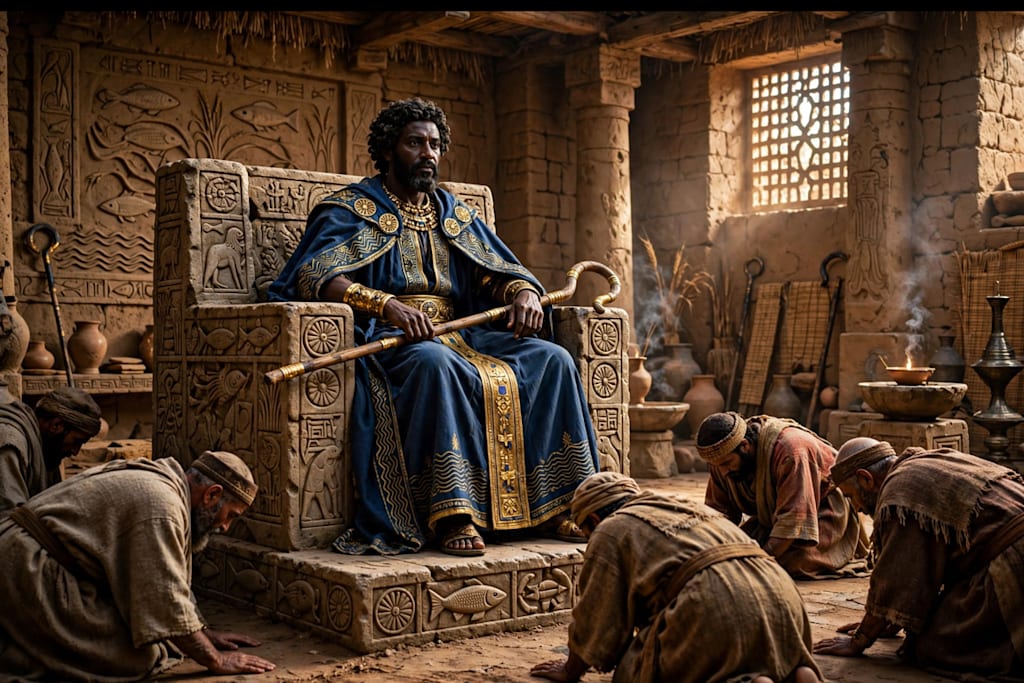
Picture the moment — marked as imagination, because the clay does not describe it. The court of Eridu assembled where Alulim once stood alone. The crown lifted from the dead king's brow and set on the living one's. And every person watching understood that something unprecedented had happened: power had changed hands without the world ending. Every peaceful transfer since — every coronation, every inauguration, every oath of office — is a descendant of that morning.
And consider the number. Ten sars — longer than Alulim's eight. The second reign is greater than the first, at least in the scribes' arithmetic. Together the two kings of Eridu account for eighteen sars, 64,800 years — the whole opening chapter of the List, the entire Eridu age, sealed in sacred numbers. Whatever the numbers meant — sacred mathematics, astronomical encoding, or the memory of an order of time we no longer understand — the record refuses to diminish the second king. He is not a footnote to Alulim. He is the proof that the first king's throne was real enough to inherit.
Alalgar inherited more than a crown — he inherited the problems. The black-headed people's cities were growing, and growth meant friction: canals to maintain, harvests to divide, neighbors to watch. The temple economy that fed Eridu demanded administration, and administration demanded a king who could do more than wear the shepherd's title. If Alulim invented kingship, Alalgar had to make it work — the first ruler to face the ordinary, grinding challenges of power: keeping the peace, keeping the grain, keeping the gods' house standing. The list gives him ten sars. The city gave him its troubles.
And here, as with Alulim, the honest boundary holds: we do not know his wars, his laws, his queen, or the sound of his voice. No seal of Alalgar has been found, no tomb, no inscription beyond the List and Berossus. What we know is structural, not personal — that after him, the kingship moved on, which means the institution he inherited was strong enough to leave its birthplace. A throne that can travel is a throne that has been proven. Alalgar proved it, and the proof is the only biography he needs.
And then the list does something curious: it moves the kingship away. After Alalgar, the throne goes to Bad-tibira — and Eridu, the first city, never holds it again. The record does not say why. Perhaps the marshes shifted. Perhaps a stronger city demanded the honor. Perhaps the priests of the Abzu lost a struggle we will never read about. Here is the honest unknown, and the series will not fill it with invention: the first capital fell silent, and no tablet tells us why. What we know is that the institution Alalgar proved — the throne that outlives its occupant — was strong enough to travel. It did not need Eridu anymore. It never would again.
Now open the lens. The Holy Tablets describe kingship as a delegation from ANU's court, passed down through the divine house — Enqi the displaced firstborn, Enlil the legal heir, Ninti whose seed carries the human line. Delegation, in that telling, is never a single event. It is a chain. Alalgar is the second link: the moment the Tablets' theology becomes a working institution, a throne that outlives the man who first sat on it.
What the stones establish is simpler, and it is enough: in Eridu, the oldest city, two kings ruled in succession before the kingship ever moved elsewhere. The first throne on Earth was not occupied once. It was inherited.
History keeps repeating Alalgar's assignment. David founded the kingdom; Solomon — the second king of the united monarchy — built the temple and proved the kingdom could be governed, not just won. Every founder's dream has faced the same test: does it survive its founder? The startups, the movements, the dynasties — all of them meet Alalgar's question sooner or later. The Sumerians answered it first, in a single line of clay: the throne continued. That was his invention, and it never stopped working.
After Alalgar, the list moves on — to Bad-tibira, to Larak, to Sippar, to Shuruppak, and then the flood. The List's own verb is worth noticing: the kingship was carried to Bad-tibira — ba-de6, lifted and borne, like a vessel. Not seized, not conquered. Carried. The institution Alalgar proved had become portable. It could travel now, from city to city, from hand to hand, the way a torch travels.
But the pattern Alalgar proved would follow the kingship everywhere it went: Kish, Uruk, Ur, Akkad. The throne continues. That was his invention, and it never stopped working.
And there is a shadow over his whole story that the List states without comment. Alalgar was the second king — and the flood was coming. Everything he inherited, everything he proved, everything the shepherd's son held together at Eridu: the waters would take it. The List does not mourn. It simply writes, after eight kings: the flood swept over. Then it begins again — kingship descending from heaven a second time, at Kish. Alalgar's invention survived even that. The throne continued past the end of the world.
Next in the series: Gilgamesh of Uruk — the king who heard that even kings die, and went looking for the one thing no king list can give.
Sources: The Sumerian King List (WB 444, Ashmolean Museum, Oxford; Jacobsen translation: "Alagar reigned 10 sars. Two kings reigned 18 sars") · Berossus via Apollodorus and the Armenian Eusebius (Alaparos, second king; given as son of Aloros) · Eridu (Tell Abu Shahrein) · The series' interpretive lens: The Holy Tablets by Dr. Malachi Z. York (kingship as delegation; the divine house of ANU).
About the Creator
Enjoyed the story? Support the Creator.
Subscribe for free to receive all their stories in your feed.
Comments
There are no comments for this story
Be the first to respond and start the conversation.