
A Historic Victory
A Historic Victory That Changed the Course of the World
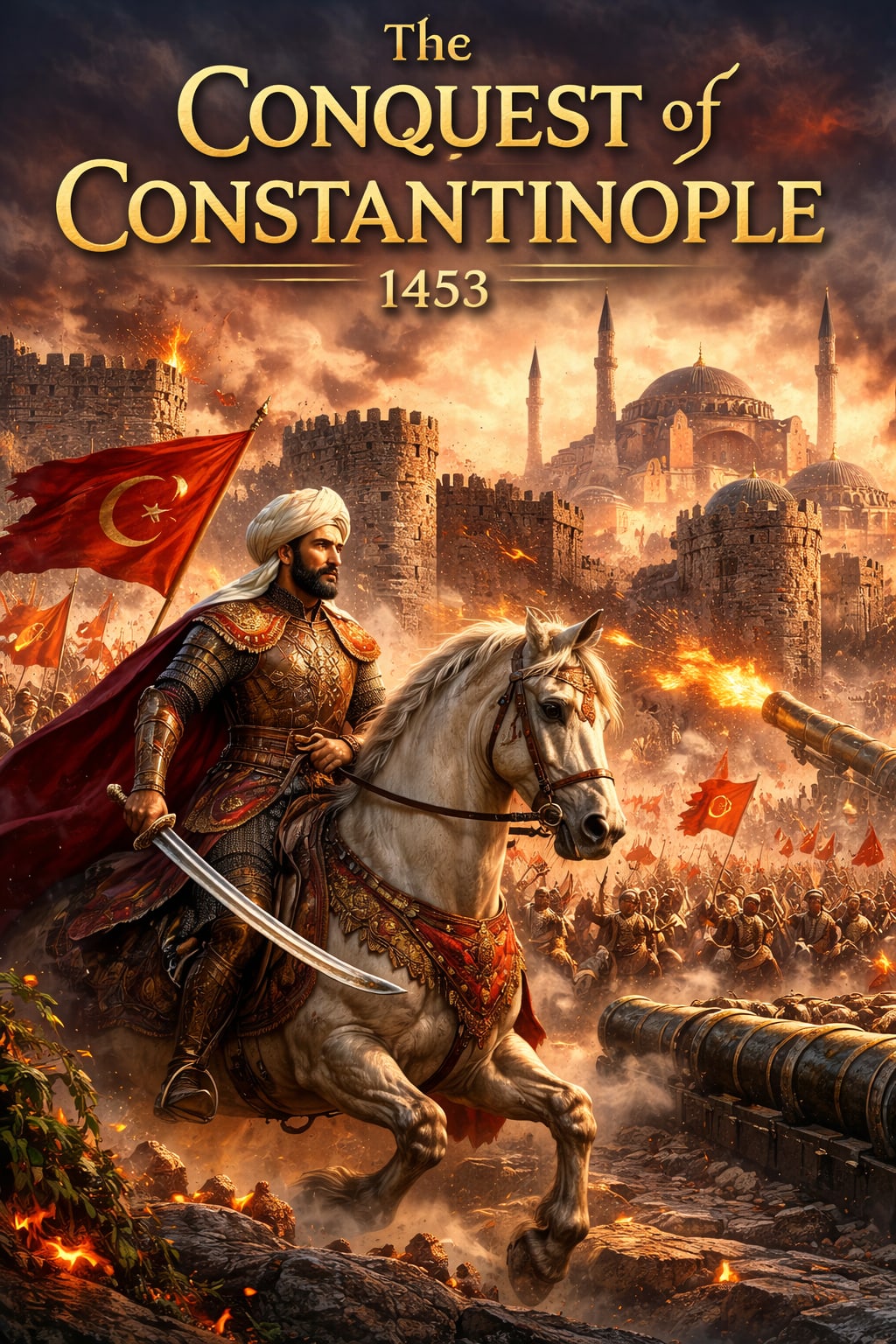
The conquest of Constantinople is one of the most remarkable and influential events in world history. It took place in the year 1453 and was led by the young and determined Ottoman ruler Mehmed II, also widely known as Mehmed the Conqueror or Sultan Muhammad al-Fatih. This historic victory fulfilled a well-known prophecy in Islamic tradition and marked a major turning point that reshaped politics, trade, and culture across Europe, Asia, and the Middle East. The fall of Constantinople did not only end an empire but also began a new chapter in world civilization.
For many centuries, Constantinople was considered the strongest and most important city in the world. It served as the capital of the powerful Byzantine Empire, which lasted for more than a thousand years. The city was famous for its wealth, strategic location, and advanced defenses. It was protected by massive stone fortifications known as the Theodosian Walls, which stretched for miles and were nearly impossible to break. These walls had successfully defended the city against countless attacks from enemy armies. Because of its strong defenses and its position between Europe and Asia, Constantinople became known as the “gateway to the world,” controlling important trade routes and connecting different cultures and civilizations.
When Mehmed II became Sultan of the Ottoman Empire at the young age of 21, many people doubted his ability to lead such a powerful state. However, he had a clear vision and a strong desire to achieve greatness. From an early age, he had been educated in military strategy, science, languages, and religion. He believed deeply that conquering Constantinople was his destiny and that success would come through careful planning, strong faith, and determination. Instead of rushing into battle, he spent years preparing his army and strengthening his resources.
One of Mehmed II’s most important preparations was the development of advanced military technology. He ordered the construction of massive cannons capable of firing huge stone balls at the city’s walls. These cannons were among the largest ever built at that time and played a key role in weakening Constantinople’s defenses. In addition to building powerful weapons, the Sultan trained his soldiers, improved military discipline, and expanded his navy. He also built a strong fortress called Rumeli Hisarı along the Bosphorus Strait to control sea traffic and prevent reinforcements from reaching the city.
In April 1453, the Ottoman army finally surrounded Constantinople and began a long and difficult siege. Thousands of soldiers set up camps outside the city walls, while warships blocked access from the sea. Inside the city, the defenders prepared to protect their homeland with courage and determination. The battle that followed was intense and challenging for both sides. For several weeks, the massive walls continued to resist the attacks, and many attempts to break through were unsuccessful. The situation became a test of patience, strategy, and endurance.
Despite these challenges, Mehmed II demonstrated remarkable leadership and creativity. One of his most famous strategies involved transporting ships over land to enter the Golden Horn, a natural harbor that was protected by a heavy iron chain preventing enemy ships from entering. Using wooden logs and strong manpower, Ottoman engineers carefully moved dozens of ships across land and launched them into the water behind the chain. This unexpected and brilliant move shocked the defenders and gave the Ottoman army a powerful advantage, allowing them to attack the city from multiple directions.
After weeks of continuous fighting, the final and decisive attack began on the morning of May 29, 1453. Ottoman soldiers advanced toward the walls with great courage and determination. Cannons thundered loudly, soldiers climbed ladders, and fierce battles took place at the city gates. Eventually, the defenses weakened, and the great walls of Constantinople were finally broken. The Ottoman army entered the city, marking the end of the Byzantine Empire and the beginning of a new era in world history.
After the conquest, Sultan Mehmed II entered the city in a calm and respectful manner. Rather than destroying the city, he focused on restoring order and protecting its people. He announced that citizens would be allowed to continue their daily lives and practice their religions freely. He encouraged scholars, merchants, and craftsmen to settle in the city, helping it recover and grow once again. His leadership transformed Constantinople into a thriving center of culture, learning, and trade.
One of the most significant changes after the conquest was the conversion of the famous Hagia Sophia into a mosque. This magnificent building became a symbol of the new Ottoman era and remained one of the most important religious and architectural landmarks in the world. Over time, the city itself became known as Istanbul, and it developed into one of the largest and most influential cities on Earth.
The conquest of Constantinople had far-reaching effects beyond the Ottoman Empire. It changed international trade routes, encouraged exploration by European nations, and played a role in the beginning of the Renaissance and the Age of Discovery. Historians often consider this event as the end of the Middle Ages and the start of the modern era. It demonstrated how leadership, innovation, and determination could overcome even the strongest obstacles.
Today, the story of the conquest continues to inspire people across the world. It teaches valuable lessons about patience, planning, courage, and faith in achieving great goals. The victory of Mehmed II remains one of the most significant turning points in history and is studied in schools, universities, books, and documentaries everywhere. 🌍
About the Creator
Enjoyed the story? Support the Creator.
Subscribe for free to receive all their stories in your feed.
Comments
There are no comments for this story
Be the first to respond and start the conversation.