
A Doctor Who Killed 500 Patients! Caught by One Mistake
A Doctor Who Killed 500

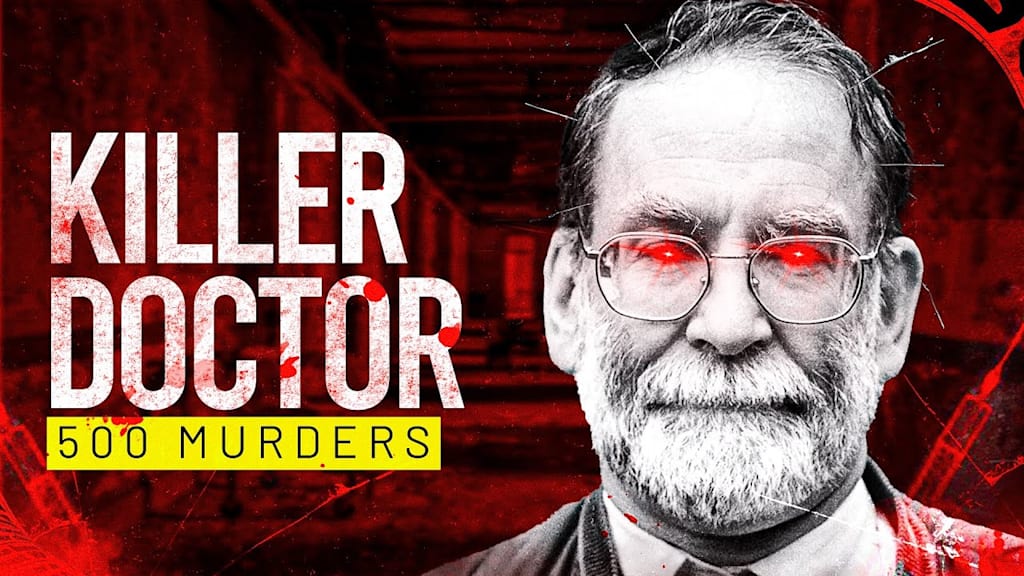
# Harold Shipman: The Doctor Who Became Britain's Deadliest Serial Killer
The world's most prolific serial killer might never have been caught if he had known a little more about computers.
Imagine a serial killer who was also a trusted doctor, a respected member of the community, and even a friend to many of his victims. This is the chilling story of **Dr. Harold Shipman**, a man who used his medical practice not to save lives, but to take them.
For more than 23 years in the small English town of Hyde, Shipman murdered hundreds of people right under everyone's nose. Even after the deaths of more than 250 victims, almost nobody suspected him. He may have gotten away with it forever if he had not made one crucial mistake.
Shipman mainly targeted elderly patients who lived alone. He spent a great deal of time with them, listening to their problems and earning their trust. Many of his patients trusted him so completely that they even gave him keys to their homes.
Because of his caring personality, Shipman became one of the most respected doctors in town. However, behind this friendly image, he was secretly gathering information about his patients—their wealth, their families, their daily routines, and when they would be alone.
Once he was confident he could act without being caught, he would administer a fatal overdose of medication. Since most of his victims were over 80 years old, their deaths rarely attracted suspicion.
Before arriving in Hyde, Shipman worked in Pontefract and later in Todmorden. During this period, he developed an addiction to the painkiller pethidine. He often prescribed the drug unnecessarily, making patients feel better while unknowingly exposing them to an addictive substance.
Although he was eventually caught abusing medication, Shipman avoided losing his medical license. After rehabilitation, he returned to medical practice and eventually established his own clinic in Hyde, where the number of suspicious deaths increased dramatically.
The first serious concerns emerged in March 1998. Dr. Linda Reynolds noticed that Shipman's patients were dying at an unusually high rate. During a three-month period, 16 of Shipman's patients died, while another nearby practice with three times as many patients recorded only 14 deaths.
The situation became even more suspicious when investigators realized that all 16 of Shipman's deceased patients had been cremated rather than buried. Most were elderly women who had died at home, and in many cases Shipman had either been present at the time of death or had been the first person to discover the body.
Despite these alarming patterns, an initial investigation failed to find enough evidence, and the case was closed.
Shipman was able to hide his crimes because he controlled much of the paperwork surrounding his patients' deaths. He signed death certificates himself and often persuaded other doctors to approve cremations without questioning his conclusions. As a result, many deaths were never properly investigated.
His downfall came with the death of **Kathleen Grundy**, an 81-year-old former mayor of Hyde. After her death in June 1998, Shipman declared that she had died of old age.
However, Kathleen's daughter, Angela Woodruff, a lawyer, became suspicious when she discovered a will that supposedly left her mother's estate to Shipman. The document contained several inconsistencies and appeared fraudulent.
Police ordered an exhumation of Kathleen Grundy's body. Toxicology tests revealed extremely high levels of diamorphine (medical heroin) in her system.
When questioned, Shipman claimed that Grundy had been addicted to heroin and that he had documented this in her medical records. Unfortunately for him, he had recently begun keeping computerized records. Although he changed the information, he did not realize that the computer automatically recorded the date of the last edit.
Investigators quickly discovered that the records had been altered after Grundy's death.
Police also found the typewriter used to create the fake will. The machine had distinctive defects, and the same missing characters appeared in the forged document.
On September 7, 1998, Harold Shipman was arrested.
As the investigation expanded, police uncovered a disturbing pattern. Victims were given lethal doses of diamorphine, death certificates were falsified, and cremation was recommended to destroy evidence.
A major public inquiry reviewed medical records, death certificates, and witness statements. Bodies were exhumed and re-examined by forensic experts.
The inquiry concluded that Shipman had definitely murdered at least **218 patients**, although some experts believe the true number may have exceeded **250**, making him one of the deadliest serial killers in modern history.
Shipman was convicted and sentenced to life imprisonment. In 2004, he hanged himself in his prison cell before revealing the full truth about his crimes.
Even today, the exact reason behind his murders remains a mystery. Some experts believe he was a psychopath who enjoyed exercising power over life and death. Others think financial motives played a role. Another theory suggests that the prolonged illness and death of his mother, who received morphine for cancer pain, may have influenced his obsession with administering powerful drugs to patients.
Whatever the reason, Harold Shipman's crimes shocked the world and permanently changed the way deaths are investigated within the British healthcare system.
His story remains one of the most disturbing examples of how trust can be exploited by someone who appears caring, respected, and dedicated to helping others.
About the Creator
Imran Ali Shah
🌍 Vical Midea | Imran
🎥 Turning ideas into viral content
✨ Watch • Share • Enjoy
Enjoyed the story? Support the Creator.
Subscribe for free to receive all their stories in your feed.
Comments
There are no comments for this story
Be the first to respond and start the conversation.