
72 Days of Survival Against Extreme Conditions
72 Days of Survival

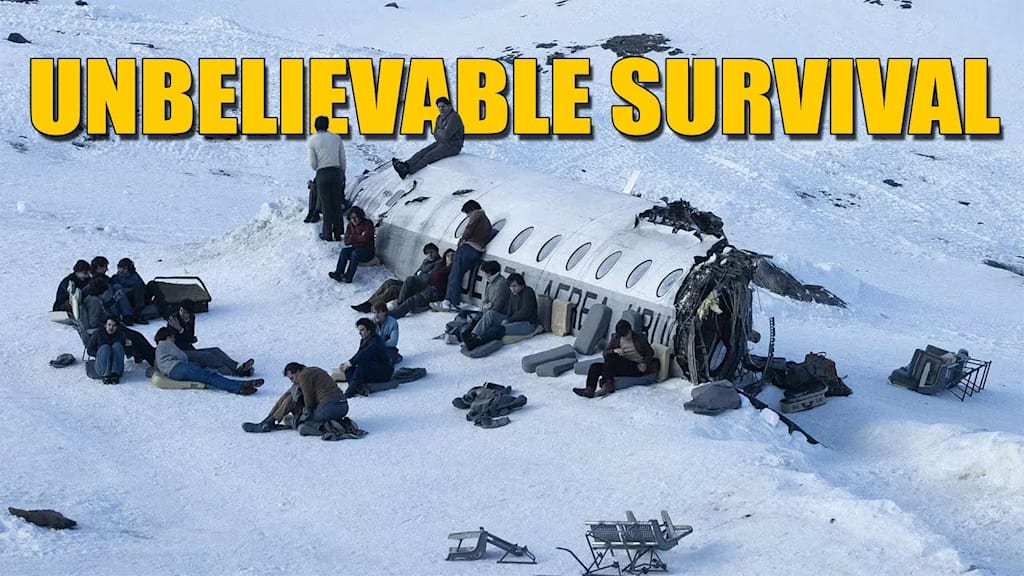
Exactly 52 years ago, at this point in the world’s longest mountain range, a plane crashed straight into a mountain. The shocking part was that right after the crash, the aircraft seemed to disappear completely. This was the 8,900-kilometer-long Andes Mountains in South America, where there is nothing but 15,000-foot-high peaks, unbearable cold, and complete silence.
For many days, neither the wreckage nor any dead bodies were found, so authorities concluded that no passengers could have survived. As a result, they officially ended the search operation. News channels talked about the crash for a few days, and then slowly everything returned to normal. People had almost forgotten about the tragedy.
But around two and a half months later — exactly 72 days after the crash — authorities suddenly received a message from the missing plane.
Welcome once again to Jam TV videos. This was Uruguayan Air Force Flight 571 crash, a real-life miracle that forever secured its place in history.
On October 12, 1972, the flight departed from Montevideo, the capital of Uruguay. On board were rugby players traveling to Santiago for a match. Including the players, there were 40 passengers and 5 crew members on the aircraft.
Soon after takeoff, while flying over Argentina, bad weather forced the pilots to land in the city of Mendoza. The captain made this decision because the Andes Mountains between Argentina and Chile are among the highest and most dangerous mountain ranges in the world. Crossing them during severe weather was extremely risky.
The pilot planned to spend the night in Mendoza and continue the journey the next day once the weather improved. But nobody on board knew the disaster waiting ahead.
The next day, Friday the 13th, Flight 571 took off from Mendoza again. Although the distance between Mendoza and Santiago was only around 180 kilometers, those kilometers were filled with towering 15,000-foot peaks.
The flight plan was to first head south to gain altitude, then turn toward the Andes through the Planchón Pass, cross the mountains, and finally land in Santiago through the Chilean city of Curicó. The pilot had already completed around 50 flights on this route, so he was very confident.
After takeoff, thick clouds completely covered the landscape below. In these conditions, the pilots depended on air traffic control for navigation. They also used a method called dead reckoning, where a pilot estimates current position using speed, time, and the aircraft’s last known location.
Once Flight 571 reached the Planchón Pass, it turned toward the Andes at 18,000 feet. Above them was clear blue sky, and below was a sea of clouds. Soon after, the aircraft disappeared from radar because mountain signals interfered with the system — something considered normal in the area.
The co-pilot used dead reckoning and mistakenly calculated that they had already crossed the mountains near Curicó. He radioed Santiago air traffic control and requested permission to descend.
Normally, reaching Curicó from the pass took 11 minutes, but according to their calculations they had done it in just 3 minutes. Since the plane wasn’t visible on radar, the control tower accepted the report and gave permission to descend.
But the co-pilot’s calculations were fatally wrong.
The pilots believed they had already crossed the Andes, when in reality they were still directly inside the mountains.
As the plane descended through the clouds, the pilots suddenly saw a gigantic mountain directly ahead. At that moment they realized the horrifying truth — they were still in the Andes.
The pilot desperately tried to climb again, pulling the nose of the plane upward with full power. But it was too late.
The tail of the aircraft struck a mountain peak and ripped off completely. The mountain was covered in snow, and without its tail and wings, the fuselage slid down the snowy slope before finally stopping.
Twelve passengers died instantly, especially those seated near the rear of the plane. Miraculously, 33 people survived, though many were badly injured.
The crash site was at an altitude of 11,500 feet in freezing conditions reaching -30°C. Survivors looked around and saw nothing but endless snow-covered mountains.
They buried the dead in the snow. Meanwhile, Chilean authorities launched a massive search operation. However, they mistakenly believed the crash occurred in Chile, while it had actually happened in Argentina.
Search planes repeatedly flew over the survivors, but the white snow reflected sunlight so strongly that the wreckage blended into the mountains. The survivors wrote “SOS” on the fuselage with lipstick and made large signs in the snow, but nobody saw them.
After eight days, on October 21, 1972, the search operation was officially ended. The passengers were declared dead.
On the 11th day after the crash, survivors found a radio in the cockpit and heard the heartbreaking news themselves: the search had been called off.
At first they still had small amounts of food — chocolate bars, jam, dried fruits, and a few bottles of water. But soon everything ran out. Desperate hunger pushed them to eat cotton and pieces of leather, which only made them sicker.
Eventually, with no food anywhere in the frozen mountains, the survivors made an impossible decision: they began eating the bodies of those who had died. It was a horrifying choice, but starvation and freezing temperatures left them with no alternative.
Seventeen days after the crash, an avalanche slammed into the fuselage during the night, filling it with snow and killing nine more survivors.
Days turned into weeks. More people died from injuries, starvation, and cold. By December 1972, only 16 survivors remained.
At that point, they realized they had only two options: wait to die, or attempt to cross the mountains themselves.
On December 12, three rugby players — Nando Parrado, Roberto Canessa, and Antonio Vizintín — began climbing a massive western peak, hoping to find civilization beyond it.
They had no proper equipment, no climbing experience, and temperatures remained near -30°C. They created sleeping bags from airplane insulation and made warm clothing from seat covers.
After three exhausting days, they finally reached the summit — only to discover even more endless snowy mountains ahead.
One of the three returned to the crash site to save food, while Parrado and Canessa continued on foot.
For ten more days, they hiked through the mountains, covering around 61 kilometers. Eventually, they reached a green valley with rivers, animals, and signs of life.
There, across a river, they spotted a local man on horseback. Because the river was too loud to shout across, the man threw them a paper and pencil wrapped around a stone.
Parrado and Canessa wrote down everything that had happened and threw the note back.
The horseman rushed the message to Chilean authorities. At first, nobody could believe that survivors were still alive after 72 days in the Andes.
But rescue teams acted immediately.
On December 22, 1972 — 72 days after the crash — helicopters finally reached the crash site and rescued the remaining survivors.
The pilots themselves were shocked that two exhausted rugby players had crossed those deadly mountains without professional gear or training.
The dead passengers were buried together in a mass grave near the site, where a memorial still stands today in the Andes Mountains.
That memorial reminds the world that human determination can overcome even the most impossible situations.
About the Creator
Imran Ali Shah
🌍 Vical Midea | Imran
🎥 Turning ideas into viral content
✨ Watch • Share • Enjoy
Enjoyed the story? Support the Creator.
Subscribe for free to receive all their stories in your feed.
Comments
There are no comments for this story
Be the first to respond and start the conversation.