
100+ Fun Trivia Facts About West Virginia
This quick read presents a mix of fun facts and trivia about the state of West Virginia.
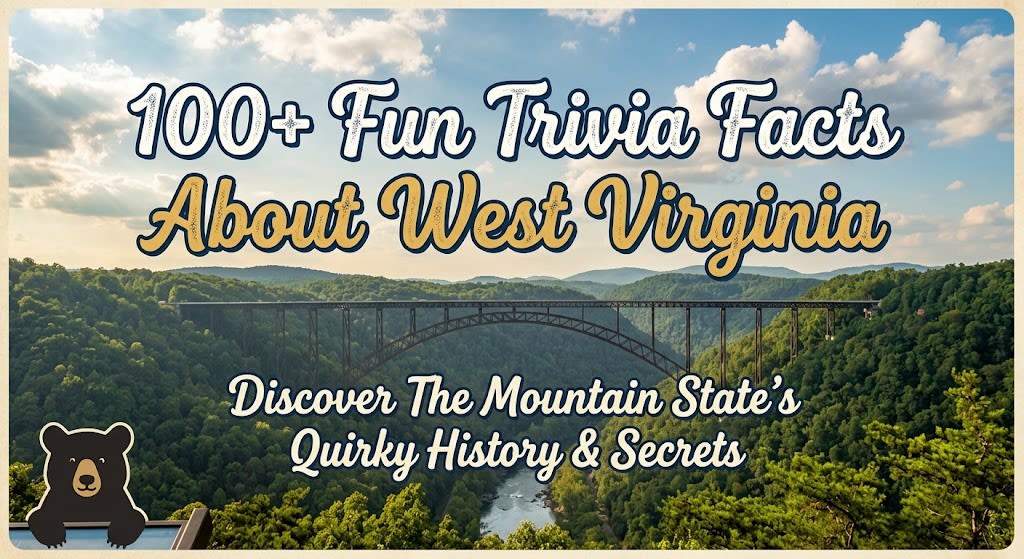
This quick read presents a mix of fun facts and trivia about the state of West Virginia. Discover West Virginia’s nickname, geography, folklore, state colors, state songs, state bird, state flower, state motto, major cities, demographics, well-known residents, famous bridges, forests and rivers, economic data, historic firsts, and much more. If you’re a West Virginia trivia enthusiast, these fun facts are tailored just for you.
Here is a sneak preview of what this article is all about:
Quick Fun Facts About West Virginia
West Virginia’s Residents
WV’s Homeownership and Rental Market
WV’s Counties and ZIP Codes
Historical Timeline of West Virginia
West Virginia’s Historic Firsts
WV’s State Bird, State Flower, State Motto, etc.
West Virginia’s Average Elevation, Highest Point, and Terrain
Famous People Born or Raised in West Virginia
Famous Bridges, Buildings, Forests, and Rivers
West Virginia’s Cities and Towns
Industry in the Mountain State
Major Grocery Store Chains
Colleges and Universities
Miscellaneous Fun Facts and Trivia About West Virginia
Take a fun journey through West Virginia’s history in just minutes.
Quick Fun Facts About West Virginia
On June 20, 1863, West Virginia became the 35th U.S. state during the American Civil War. It’s worth noting that the American Civil War was a four-year conflict fought from 1861 to 1865 between the Union (the North) and the 11 Southern states that seceded to create the Confederate States of America (the South). According to PBS.org, the American Civil War was caused by “deep, uncompromised divisions” over slavery, westward expansion, and states’ rights.
Nickname: Mountain State
West Virginia is known as the “Mountain State” because it is the only U.S. state located entirely within the Appalachian Mountain region.
Abbreviation: WV
West Virginia is bordered by Maryland, Ohio, and Pennsylvania to the north; Maryland and Virginia to the east; Virginia and Kentucky to the south; and Kentucky and Ohio to the west.
West Virginia is often considered “the southernmost northern state and the northernmost southern state.”
Wheeling became West Virginia’s first capital in 1863. On April 1, 1870, the capital moved to Charleston.
West Virginia’s Residents
Population: 1,766,147 (as of July 2025)
39th-most-populated state in the U.S.
About 75 people live per square mile.
Aged 65 and older: 22.5% of the total population
Under 18 years of age: 19.5% of the total population
Gender breakdown: 50.4% female and 49.6% male
Race and ethnicity: 90.7% White, 4.0% African American, and 2.6% Hispanic, with the remainder identifying as American Indian, Asian, or multiracial.
Veterans: 104,941
Foreign-born residents: 1.8%
Residents living in poverty: 16.7%
Residents without health insurance who are under 65 years of age: 7.3%
Residents who graduated from high school: 89.3%
Residents who have a bachelor’s degree or higher: 24.1%
West Virginia is 70% Protestant, 18% unaffiliated, 6% Roman Catholic, 2% Mormon, 1% Jewish, and 1% Muslim, with the remainder identifying as “other faiths.”
WV’s Homeownership and Rental Market
Housing units: 871,879
Nearly 150,000 WV households spend more than 30% of their net monthly income on housing costs.
Homeownership rate: 78.1%, which is about 13% above the national average
Median rent: About $1,297 per month
Households with a computer: More than 90%
Households with an Internet subscription: 86.1%
WV’s Counties and ZIP Codes
West Virginia has 55 counties.
Hancock County is the northernmost county in West Virginia.
McDowell County is the southernmost county in West Virginia.
Kanawha County is the most populous county in West Virginia.
Other counties in WV with large populations include Berkeley County, Monongalia County, Cabell County, and Wood County.
Wirt County is the least populous county in West Virginia.
Other WV counties with low populations include Pendleton County, Tucker County, and Gilmer County.
Thurmond is West Virginia’s least-populated municipality, with a population of just five people.
ZIP codes: West Virginia ZIP codes range numerically from 24701 to 26886.
West Virginia’s wealthiest ZIP code, based on average household income, is 26590 (Wana), while 25442 (Shenandoah Junction) and 25443 (Shepherdstown) rank among “the top areas for median household income and real estate value.”
Jefferson County is recognized as the wealthiest county in West Virginia.
West Virginia’s poorest ZIP code, based on median household income, is 24815 (Berwind) in McDowell County.
McDowell County is recognized as the poorest county in West Virginia. According to WSAZ.com, “McDowell County is consistently ranked as the worst county to live in West Virginia due to severe economic decline, low life expectancy, and a high poverty rate.”
Historical Timeline of West Virginia
From 12,000 BCE to 1000 CE, various Indigenous cultures, including Adena, Fort Ancient, Hopewell, and Paleo-Indian societies, inhabited what is now West Virginia.
In 1669, explorer John Lederer became “the first recorded European to enter present-day West Virginia, reaching the Blue Ridge Mountains.”
In 1742, coal was discovered along the Coal River.
In 1849, one of the world’s first suspension bridges opened to traffic in Wheeling.
West Virginia is home to the first land battle of the Civil War—the Battle of Philippi in 1861.
West Virginia is the only U.S. state that was created by breaking away from a Confederate state. WVExplorer.com tells us, “While many states entered the Union as territories or colonies, the Mountain State emerged from a national crisis. When Virginia voted to secede from the United States in 1861, many residents of the state’s western counties, now West Virginia, opposed the decision. Delegates from western Virginia counties met in Wheeling to organize a pro-Union government after Virginia joined the Confederacy. These gatherings, known as the Wheeling Conventions, laid the groundwork for statehood. After a series of votes and political negotiations, President Abraham Lincoln approved legislation admitting West Virginia to the Union.”
West Virginia was originally going to be named “Kanawha” after a Native American tribe. WVNews.com explains that “after seceding from Virginia, officials wanted to keep the name Virginia in honor of its heritage.”
On June 20, 1863, West Virginia became the 35th U.S. state.
The Hatfields and McCoys: The “legendary feud” between the Hatfields and McCoys lasted from the Civil War period until the early 1890s, taking place along the Tug Fork of the Big Sandy River, which separates West Virginia and Kentucky. The root causes of the feud included “lingering animosities” from the Civil War era—the Hatfields leaned toward the Confederacy, while the McCoys sided with the Union—along with “a contentious hog ownership trial in 1878 and a forbidden love affair between the daughter of the McCoy family and a son from the Hatfield clan.”
On October 1, 1896, the first official Rural Free Delivery (RFD) service in the United States began in West Virginia, serving the rural communities of Charles Town, Halltown, and Uvilla.
Around 1900, Bramwell, West Virginia—the center of an unprecedented American coal boom—was known as the “Town of Millionaires.” WVTourism.com tells us that “Wealthy coal barons built grand Victorian and Tudor-style mansions along the Bluestone River, giving the tiny town more millionaires per capita than anywhere else in the United States.”
In 1905, the Golden Delicious apple originated in Clay County, West Virginia.
On May 10, 1908, Mother’s Day was first celebrated at Andrews Church in Grafton, West Virginia. (Mother’s Day became a national holiday in 1914.)
Fairmont, West Virginia, was the location of the “first official Father’s Day service.” The Central United Methodist Church on Fairmont Avenue “hosted the very first church service dedicated to honoring fathers on July 5, 1908.” Time magazine tells us that “President Richard Nixon signed a congressional measure in 1972 making the third Sunday in June a permanent national holiday honoring fathers, more than 50 years after Mother's Day was established.”
In 1909, industrialist Ernest Tener Weir purchased 105 acres of farmland in Weirton to establish the Weirton Steel Corporation, which grew to become the fifth-largest steel manufacturer in the United States.
On July 1, 1921, West Virginia became the first state to implement a sales tax, set at a rate of 0.4%.
Cecil Underwood made history as WV’s youngest governor at age 34 in 1956 and again at age 74 in 1996, when he became the state’s oldest governor after being reelected.
West Virginia’s Historic Firsts
West Virginia is the only U.S. state that was created by breaking away from a Confederate state.
West Virginia is home to the first land battle of the Civil War—the Battle of Philippi in 1861.
In 1849, one of the world’s first suspension bridges opened to traffic in Wheeling.
On October 1, 1896, the first official Rural Free Delivery (RFD) service in the United States began in West Virginia, serving the rural communities of Charles Town, Halltown, and Uvilla.
On May 10, 1908, Mother’s Day was first celebrated at Andrews Church in Grafton, West Virginia. (Mother’s Day became a national holiday in 1914.)
Fairmont, West Virginia, was the location of the “first official Father’s Day service.” The Central United Methodist Church on Fairmont Avenue “hosted the very first church service dedicated to honoring fathers on July 5, 1908.”
On July 1, 1921, West Virginia became the first state to implement a sales tax, set at a rate of 0.4%.
Cecil Underwood made history as WV’s youngest governor at age 34 in 1956 and again at age 74 in 1996, when he became the state’s oldest governor after being reelected.
Fairmont, West Virginia, is known as “the birthplace of the pepperoni roll.”
Outdoor advertising began in Wheeling when the Bloch Brothers Tobacco Company began promoting Mail Pouch chewing tobacco on barns and bridges.
Berdine’s Five and Dime, located in Harrisville, West Virginia, is America’s oldest five-and-dime store. It has been operating continuously since 1908.
The world’s first brick street was Summers Street, located in Charleston.
WV’s State Bird, State Flower, State Motto, etc.
State animal: Black bear
State beverage: West Virginia does not have an official state beverage. However, moonshine is often considered the state’s “iconic unofficial spirit.”
State bird: Cardinal
State colors: Old gold and blue
State flower: Rhododendron
State food: WV’s state food is the pepperoni roll, a “baked yeast roll filled with pepperoni that was originally created for coal miners.”
State fruit: Golden Delicious apple
State motto: Montani Semper Liberi (Latin for “Mountaineers Are Always Free”)
State songs: West Virginia, My Home Sweet Home; The West Virginia Hills; This Is My West Virginia; and Take Me Home, Country Roads.
State tree: Sugar maple
West Virginia’s Average Elevation, Highest Point, and Terrain
Average elevation: About 1,654 feet, making West Virginia the highest state east of the Mississippi River.
Highest point: Spruce Knob, located in eastern West Virginia, is 4,862 feet above sea level.
Terrain: Approximately 80% to 90% of West Virginia’s landscape is characterized by rugged hills and dense forests. WV is also America’s third-most-forested state.
Famous People Born or Raised in West Virginia
Bill Withers (singer and songwriter)
Booker T. Washington (educator and civil rights activist)
Brad Paisley (country music star)
Chuck Yeager (pioneering U.S. Air Force test pilot)
Conchata Ferrell (actress)
Don Knotts (actor)
Jennifer Garner (actress)
Jerry West (NBA legend)
John Corbett (actor and singer)
Joyce DeWitt (actress)
Katherine Johnson (NASA mathematician)
Kathy Mattea (country and bluegrass singer)
Mary Lou Retton (Olympic gold medal-winning gymnast)
Michael W. Smith (Christian music singer)
Nick Saban (football coach)
O. J. Mayo (professional basketball player)
Pearl S. Buck (Nobel and Pulitzer Prize-winning author)
Randy Moss (NFL player)
Steve Harvey (comedian)
Thomas “Stonewall” Jackson (Confederate military leader)
Famous Bridges, Buildings, Forests, and Rivers
WV’s state capitol dome in Charleston stands at an impressive height of 292 feet, surpassing the dome of the U.S. Capitol in Washington, D.C., which stands at 288 feet.
The Phil G. McDonald Bridge in Beckley is among the 10 tallest bridges in the United States.
Despite its name, West Virginia’s New River is believed to be the oldest river in North America and one of the five oldest rivers in the world.
West Virginia has an estimated 10,000 named rivers and streams, including the Cheat River, Elk River, Gauley River, Kanawha River, Monongahela River, New River, and Ohio River.
West Virginia’s Cities and Towns
Largest city: Charleston
Capital: Charleston
Other large cities in the state include Huntington, Morgantown, Parkersburg, and Wheeling.
WV’s oldest town is Shepherdstown, founded in 1730 by German settlers. It is located in West Virginia’s Eastern Panhandle.
West Virginia holds a U.S. record for towns named after international cities, including Athens, Berlin, Cairo, Calcutta, Geneva, London, Moscow, Rome, Shanghai, and Vienna.
Charleston (50,000) is West Virginia’s capital and largest city.
The state capital dome in Charleston stands at an impressive height of 292 feet, surpassing the dome of the U.S. Capitol in Washington, D.C., which stands at 288 feet.
In the early 19th century, Malden, the area now adjacent to Charleston, became “the world's top producer of salt from underground brine wells.”
In 1815, the first natural gas well in the U.S. was struck in Charleston while workers were drilling for salt.
Clarksburg was the birthplace of Thomas Jonathan “Stonewall” Jackson, a Confederate general during the American Civil War.
Clarksburg also boasts “a rich Italian heritage, thanks to the influx of Italian immigrants who settled in the area in the late 19th and early 20th centuries.”
Fairmont is known as “the birthplace of the pepperoni roll.” Giuseppe “Joe” Argiro invented the portable pepperoni roll “at the Country Club Bakery in 1927, baking pepperoni right inside a soft bread roll to feed local coal miners.”
Fairmont was also the location of the “first official Father’s Day service.” The Central United Methodist Church on Fairmont Avenue “hosted the very first church service dedicated to honoring fathers on July 5, 1908.”
Huntington was founded “as a planned community in 1871 and named after railroad tycoon Collis P. Huntington.”
Huntington has the second-busiest inland port in the entire United States.
Because Huntington sits along the Ohio River, “it is protected by an 11-mile concrete floodwall built to guard against historical high waters.”
Morgantown (31,000) is the third-most-populous city in the state after Charleston (50,000) and Huntington (48,000). However, Morgantown’s population swells to over 70,000 residents when West Virginia University (WVU) is in session.
Famous people from Morgantown include television and film actor David Selby, actor Don Knotts, and broadcast journalist Hoda Kotb.
Webster Springs was home “to the biggest sycamore tree on Earth until it fell down in 2010 at over 500 years old.”
Weirton spans both Hancock and Brooke counties and “is one of only three U.S. cities completely within one state while directly bordering two others (Ohio and Pennsylvania).” According to Atlas Obscura, “You can cross into Ohio or Pennsylvania from Weirton in minutes without passing through any other West Virginia towns.”
Weirton’s “distinct industrial landscape” served as a filming location for several Hollywood movies, including The Deer Hunter (1978), Reckless (1984), and Steven Spielberg’s Super 8 (2011).
Wheeling served as West Virginia’s first state capital from 1863 to 1870, when the capital was moved to Charleston.
During the late 19th century, Wheeling “led the United States in nail production” and was known as the “Nail Capital of the World.”
The Wheeling Suspension Bridge, completed in 1849, “is the oldest operational vehicle suspension bridge in the United States and was the longest suspension bridge in the world when it was built.”
Outdoor advertising began in Wheeling when the Bloch Brothers Tobacco Company began promoting Mail Pouch chewing tobacco on barns and bridges. WVNews.com tells us that the iconic phrase, “Treat Yourself to the Best, Chew Mail Pouch,” was painted on barns and bridges throughout West Virginia and eventually in more than 20 other states, including Indiana, Iowa, Kentucky, Maryland, Michigan, New Jersey, New York, Ohio, Pennsylvania, and Tennessee.
Industry in the Mountain State
Today, West Virginia remains a “major national producer of underground coal, interstate electricity exports, and natural gas.”
According to IBISWorld, healthcare is one of West Virginia’s “largest and most stable employers, anchored by networks like WVU Medicine.”
West Virginia still produces about 15% of the coal in the U.S., ranking second behind Wyoming. In 1924, WV produced about 79.5 million short tons of coal.
The Mountain State also holds an estimated 15% to 16% of the nation’s “recoverable coal reserves.”
Coal generates about 86% to 87% of West Virginia’s electricity.
Major Grocery Store Chains
Aldi, Kroger, and Walmart are West Virginia's major supermarket chains. Kroger is the dominant grocery store chain throughout the state, with dozens of stores in the Charleston, Huntington, Morgantown, Parkersburg, and Wheeling metropolitan areas.
Colleges and Universities
Appalachian Bible College (Mount Hope)
Bethany College (Bethany)
Bluefield State University (Bluefield)
Concord University (Athens)
Fairmont State University (Fairmont)
Glenville State University (Glenville)
Marshall University (Huntington)
Shepherd University (Shepherdstown)
University of Charleston (Charleston)
West Virginia University (Morgantown)
West Virginia Wesleyan College (Buckhannon)
Wheeling University (Wheeling)
Miscellaneous Fun Facts and Trivia About West Virginia
Berdine’s Five and Dime, located in Harrisville, West Virginia, is America’s oldest five-and-dime store. It has been operating continuously since 1908.
The world’s first brick street was Summers Street, located in Charleston.
The renowned Greenbrier Hotel and Resort in White Sulphur Springs served as an army hospital during World War II and is also known for its springs, which are believed to cure various medical issues.
The Charleston Gazette-Mail is WV’s largest daily newspaper by circulation, with an estimated circulation of around 35,000.
According to Kids.NationalGeographic.com, “At least 70 kinds of mammals inhabit West Virginia, including Virginia big-eared bats, West Virginia northern flying squirrels, raccoons, skunks, and black bears, the state animal. Wild turkeys, ruffed grouse, barred owls, bald eagles, cerulean warblers, and ruby-throated hummingbirds are among the 300 species of birds that live in the state.”
West Virginia’s Monongahela National Forest encompasses nearly a million acres and extends across 10 counties. The Mountain State also boasts 1,500 miles of hiking trails, 10 national parks, and 45 state parks or forests.
Thousands of black bears (the state animal) live across WV’s 55 counties.
There are more than 4,000 hidden caves underneath the state’s mountains, including Friar’s Hole, one of the “longest cave systems” in the United States.
The pawpaw, North America’s largest native fruit, grows in West Virginia’s forests and has a tropical flavor that blends banana, mango, and vanilla.
According to the West Virginia Culture Center, Moundsville “holds the Grave Creek Mound, which is the largest conical earthen burial mound in North America, built by the ancient Adena culture over 2,000 years ago.”
References:
https://kids.nationalgeographic.com/geography/states/article/west-virginia
https://industry.travelsouthusa.com/10-facts-you-didnt-know-about-west-virginia/
https://www.wvlegislature.gov/Educational/Kids_Page/fun_facts.cfm
https://wvculture.org/stories/7-surprising-facts-you-may-not-know-about-west-virginia/
https://wvhumanities.org/programs/history-alive/history-alive-roster/
https://www.funtrivia.com/en/Geography/West-Virginia-3977.html
Disclaimer: In writing and editing this article, Gregory DeVictor has made every effort to ensure historical accuracy and not to mislead his audience. In addition, the contents of this article, including text, graphics, and captions, are for general informational purposes only.
© 2026 Gregory DeVictor
About the Creator
Gregory DeVictor
Gregory DeVictor is a trivia enthusiast who likes to write articles about American history and nostalgia. Each of his articles presents a mix of fun facts, trivia, and historic events about a specific calendar year, decade, or century.
Enjoyed the story? Support the Creator.
Subscribe for free to receive all their stories in your feed.
Comments