
Why Cyberpunk 2077’s Dogtown Boss Feels Like a Pushover
Kurt Hansen has every trapping of a final boss—except the fight. Here’s why the “King of Dogtown” crumbles the moment you step into his arena.
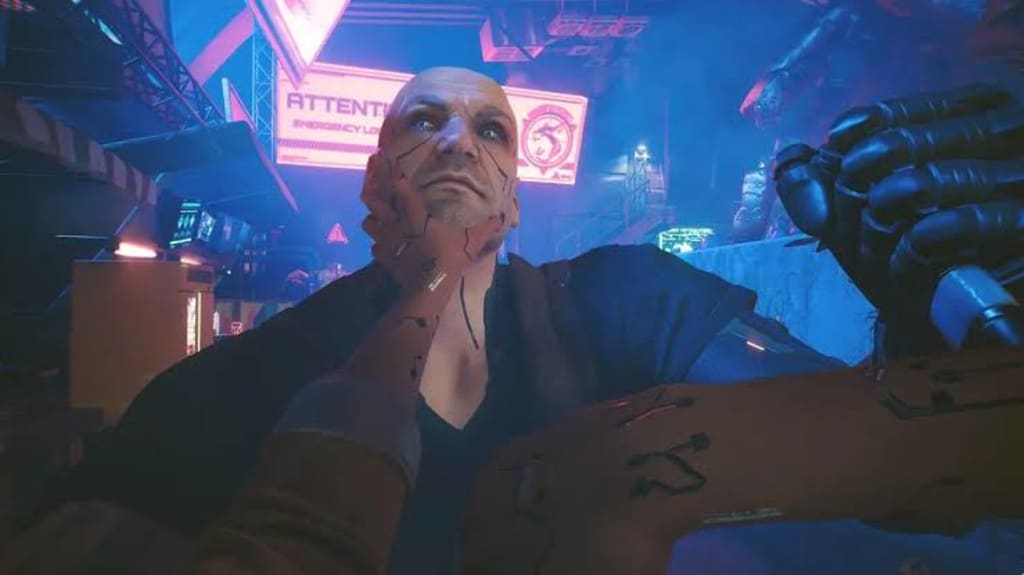
The first time Hansen truly feels intimidating is not when he draws a gun. It is when he appears in disguise, takes control of the room, pulls Night City’s various big names into the same party, and makes even the NCPD commissioner leave him some face. Dogtown’s boss, ruler of Barghest, former NUSA colonel—stack those identities together and he does look like a final boss the player should look up to.
Then you fight him. Either he gets stabbed to death in the story, or you kick him to the curb in some corner of Dogtown like a stray dog.
That contrast is not an illusion. Hansen’s “weakness” is built from three layers stacked on top of each other: the narrative designs him as the target of a decapitation strike, the numbers let a fully built V treat him like an elite mob, and the boss fight itself does not give him enough mechanical presence. Stack all three, and a crack opens between the title “King of Dogtown” and the experience of “a stray dog on the street.”
1. His strength was never “dueling strength”
Hansen’s initial pressure comes from power, not from personal combat ability. He commands an organized Barghest force, a militarized organization, political protection, and the right to collect rent from Dogtown’s gray economy. He can bring politicians, corporate executives, gangsters, and intelligence agents to the same table, which shows he plays the game of “order provider”: whoever keeps Dogtown stable gets a cut from the cracks in Night City.
That kind of strength is systemic. He does not need to step into the arena like Adam Smasher to prove he is the strongest killing machine. His power comes from organization, intelligence, territory, and political relationships. The problem is that players expect a “final boss” to be strong in personal combat. The narrative gives them a warlord shell; players measure him with the ruler of a duelist. That is the first mismatch.
Hansen’s rule is built on cyberware. Former NUSA colonel, militarized cyberware, Sandevistan, reinforced skeleton, combat assistance systems: these are the physical basis of his “iron-fisted strongman” image. And the cruel rule of the cyberpunk world is that the stronger the cyberware, the more vulnerable it is to hacking. Hansen’s strength rests on a premise that can be deleted with one click by a higher-tier hacker.
2. Narrative kill: his failure is designed as a decapitation, not a duel
Hansen’s two endings in Phantom Liberty both say the same thing: he is not defeated in a fair fight, but dismantled in an information war and a decapitation operation.
On Songbird’s route, Songbird directly hacks and paralyzes Hansen’s cyberware. For a warlord who relies on Sandevistan and cyberware enhancement to maintain combat power, this is like being disarmed before the fight begins. Then Alex activates her own Sandevistan and finishes the backstab. You feel “the fight ended before anyone even drew a weapon,” because this scene was never designed as a fair duel. It is a precise cyberware paralysis plus an agent assassination. Once the premise of Hansen’s strength is removed, the “iron-fisted strongman” façade collapses immediately.
On Reed’s route, the situation reverses: Songbird’s Blackwall AI paralyzes Alex’s disguise cyberware, the assassination fails, and Alex is killed by Hansen. This shows indirectly that Hansen, with his cyberware online, does have the ability to instantly finish an agent. So his “weakness” in the story is conditional: he is not without combat power; his combat power depends extremely heavily on the system running normally. Once the opponent is an information-warfare entity on Songbird’s level, his personal martial power as a warlord becomes a switch that can be turned off remotely.
Phantom Liberty does something here: Hansen is not defeated by a stronger “person,” but by a higher-level cyber power. He thinks he is the king of Dogtown, but before hackers, AIs, and agent networks, he is just a cyberware node.
3. Numerical kill: by the time you fight Hansen, V is no longer “human”
What really turns Hansen into “a stray dog” in the player experience is the growth curve.
Many players play through Judy, River, Panam, and Rogue’s questlines, clear at least three districts’ gigs and NCPD activities, and only then enter Dogtown. By that stage, V is often level 50–60, with multiple attributes at 20, and several pieces of legendary-tier cyberware slotted in. At that configuration, a netrunner, blade, or blunt-weapon V can all instantly kill Adam Smasher; tech-weapon and throwing-knife builds are relatively more miserable, but Hansen is still not in their league.
Hansen is not facing a rookie mercenary. He is facing a cyber monster who has already turned Night City into a backyard. In the base game, Smasher has full-body cyberware, self-ICE, and absolute protection, and still cannot last many moves against V. Hansen’s setup at best includes alloy bones, artificial lungs, Sandevistan, tendon reinforcement, and Gorilla Arms. In Dogtown’s elite mob pool, that is luxurious. In front of a fully built V, it is just “an elite with more HP.”
What makes it more awkward is his weapon setup. Hansen runs a tranquilizer-style pistol plus throwing-knife build: the legendary revolver “Bald Eagle” and the throwing knife “Fang.” “Fang” applies Cripple on hit, which is basically slow; “Bald Eagle” can lock the legs of a target crippled by “Fang” and instantly recover the knife. In a player’s hands, this combo might have tactical value, but the problem is it lacks linked damage: the knife does not apply poison, so you cannot stack poison; without poison you cannot stack bleed; without bleed you cannot play the poison-burst loop. Throwing-knife builds already have low margin for error, and you need a pistol with plenty of ammo as a backup. Hansen only carries one knife, and his main weapon is a revolver that depends on a specific condition to recover it. This setup is annoying even against elite mobs. Against a fully built V, it is indeed painfully clunky.
The “fragility” players feel is essentially numerical oppression. It is not that Hansen is not trying; it is that V’s growth curve is absurd. The DLC does not compress levels, nor does it scale the boss to the player’s strength, so a warlord who should feel intimidating in the story becomes an elite mob that can be instantly killed in mechanics.
4. Boss design: missing phases, missing mechanics, missing “epicness”
Beyond the numbers, Hansen’s boss fight itself is not enough of a “final boss.”
Smasher’s fight has clear phase changes, fire suppression, arena pressure, and dialogue performance. Players feel they are fighting a cyberpunk killing machine. Hansen’s fight is relatively flat: the mechanics are not complex enough, there are not enough phase transitions or arena interactions, and some players report bugs such as invincibility at specific health thresholds, making the fight feel more like a damage-sponge elite than a warlord who commands from behind.
Behind this is the DLC’s structure. Phantom Liberty focuses on spy thriller, choices, and information warfare. Hansen is more a node on that narrative line than a pure combat endpoint. His death is designed as two branches of a scripted kill, not an epic duel the player must grind out with skill. So players see him “stabbed in the back” in the narrative and “instantly killed” in mechanics. Stack the two experiences, and the impression “the boss of Dogtown is nothing special” gets welded shut.
5. Compared with Smasher: one is a combat machine, the other is a political warlord
Put Hansen and Smasher side by side, and it becomes clear they are not the same kind of boss at all.
Smasher is Arasaka’s ultimate weapon; his reason for existing is combat. His pressure comes from pure force, full-body cyberware, and the mechanical design of “you cannot beat him.” Hansen is Dogtown’s political warlord; his pressure comes from power, organization, and territory. Making Hansen duel Smasher is like making a mayor fight a special forces soldier—the setup is unfair from the start.
But players do not care about that. What they see is: Smasher has final-boss presentation, Hansen also has final-boss presentation, so Hansen should be at least as hard as Smasher. Instead, Hansen not only lacks Smasher’s mechanical intensity, but also gets paralyzed by a hacker in the story and instantly killed by a fully built V in combat. The contrast between the title “boss of Dogtown” and the experience of “a stray dog” emerges.
6. Thematic irony: the King of Dogtown dies by Dogtown logic
From a writing perspective, Hansen’s “fragility” can be distilled into a strong theme: in the cyberpunk world, power is not personal force; it is system privilege.
Hansen thinks he is the king of Dogtown, but his rule rests on cyberware, a militarized organization, and political protection. When a higher-tier hacker cuts off his cyberware, when a higher-level agent network infiltrates his inner circle, his “kingship” instantly goes to zero. He is not defeated by a stronger fist; he is defeated by a higher-level system.
This is also why he is most intimidating when he is in disguise: in that moment he displays control—control over information, identity, and the situation. Once he enters direct conflict, he is reduced to a warrior dependent on cyberware. The King of Dogtown ultimately dies by Dogtown logic—in a world where hackers, AIs, and transhuman mercenaries run rampant, a warlord who sustains himself through cyberware and organization was never as invincible as he imagined.
Conclusion: He is not weak; the definition of “strong” is wrong
Why is Hansen so fragile?
Because he is placed in the wrong position. The narrative packages him as a warlord who should be looked up to, but players measure him with the combat standard of a final boss. The story designs him as the target of an information-warfare decapitation, while the mechanics let a fully built V instantly kill him like an elite mob. His “weakness” is not a failure of character design; it is the result of a three-way mismatch between narrative expectation, numerical growth, and boss design.
If you want to write about this subject, the core argument can be placed here: Hansen’s tragedy is not that he is not strong enough. It is that in the cyberpunk world, the definition of “strong” has changed. Personal force is fragile before system privilege, and a warlord’s power can be deleted with one click by hackers and AIs. The boss of Dogtown was not kicked to the curb by V; he was kicked out of the game by the world’s logic of power.
About the Creator
Jin
Writer of reamstories
https://reamstories.com/jin
Enjoyed the story? Support the Creator.
Subscribe for free to receive all their stories in your feed. You could also become a paid subscriber, letting them know you appreciate their work.
Comments
There are no comments for this story
Be the first to respond and start the conversation.