
What to Watch This Week: Nine Stories About People Who Keep Going
Slow Horses has no payroll. River runs into his father at a funeral. Kanako takes another job. Guardiola says he has always been in the desert.
I started the week with a funeral. River Cartwright stands in the rain, burying his grandfather, and who shows up but his father—a mercenary, a ghost, a man who should not be there. That scene from Slow Horses Season 6 set the tone for everything else I watched over the next few days. Not because the shows were all grim, but because they all circled the same question: what do you do when the system has erased you, when the past will not stay buried, when the only way forward is to keep moving even though you have no idea where you are going?
Slough House has no payroll. No record in the system. A real estate agent walks through the office, measuring rooms for an appraisal. Former colleagues are being killed by professionals, their deaths written off as natural causes. The next name on the list is River. Season 6, adapted from the sixth and seventh novels in Mick Herron’s series, gives us six episodes of the usual mix: betrayal, bureaucracy, and a surprising amount of laughter. Diana is now a minister, but she does not know her old department is being liquidated. The creators have called this season darker, more violent, more emotional. They are not wrong. But the jokes are still there, and so is the sense that these people—the failures, the drunks, the ones nobody wants—are the only ones paying attention.
That same feeling runs through Marble Hall Murders, the new British mystery series streaming on Bilibili. Susan returns to London from Crete and takes a job editing a new Atticus Pünd novel. In the manuscript, Pünd goes to Corfu and meets a woman who will be poisoned before the summer ends. In the real world, the ghostwriter is the grandson of a famous children’s author, a man who hates his family and may have killed his grandmother twenty years ago. Anthony Horowitz writes both layers, and the same cast plays different characters in each. The transitions are smooth, the visual textures distinct. At one point a character asks, “Can you guess the killer after sixty pages?” You are holding the manuscript too. It is a puzzle box, and you are inside it.
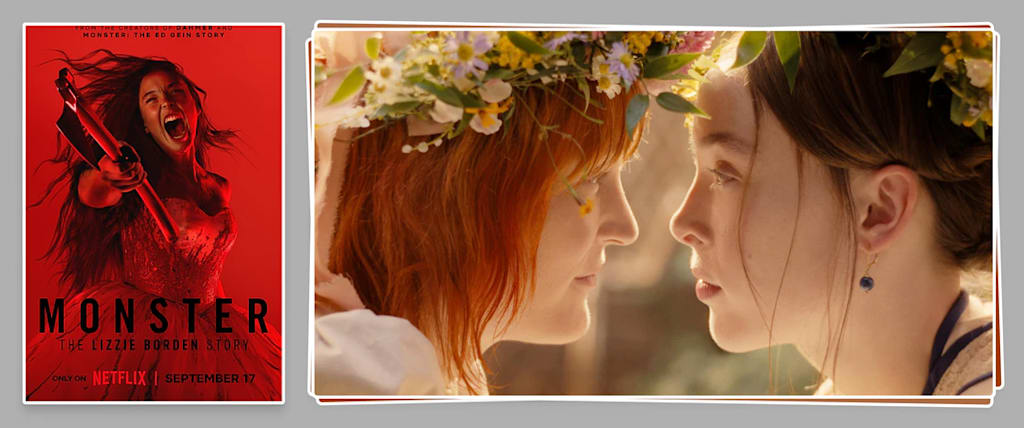
Then there is Monster: The Lizzie Borden Story. The nursery rhyme says she gave her mother forty whacks, her father forty-one. In 1892, it happened. The new Netflix season shows us Lizzie as a girl: motherless at two, ignored by her coffin-shop father, humiliated by her stepmother, treated as an outsider by the town. She likes birds. She likes being outside. She looks like a fairy in a painting. Then the maid Bridget arrives—well-traveled, progressive, firm—and Lizzie starts to think about fighting back. The cinematography is gorgeous and unsettling, cutting between fairy-tale beauty and bloody violence, set to rock music. Sarah Paulson plays Lizzie and also a modern-day version, tying the past to the present. Two eras, the same trap.
The trap is different in Last Seen, an Australian series about a father who refuses to believe his daughter is dead. A storm washes out a child’s skeleton. Ian used to be a detective. Eleven years ago his daughter Maggie disappeared. He divorced, drank, left the force, became a dispatcher. The DNA does not match him or his ex-wife. Then a teenage girl calls and says, “I think I’m Maggie.” Directed by Christian Schwochow, adapted from Ryan David Jahn’s award-winning novel The Dispatcher, the show takes place in a coastal town in Victoria—cold, gray, vast. It looks calm. Everyone is hiding something.
Calm surfaces hiding rot is also the engine of Babylon Berlin Season 5. Greve goes to see Dr. Foster. At the office door, the doctor hurries away. Greve walks in and finds the assistant’s body. He makes an anonymous call. Charlotte takes the case and thinks it is routine. Then she learns Foster specialized in psychiatry. During World War I, he treated a soldier with hysterical blindness using psychological suggestion and filmed the session. The soldier’s name is Hitler. He has just been appointed Chancellor of the German Reich. Season 5 enters through this case and widens out: smug politicians, communists ready to sacrifice themselves, ordinary Germans who think Hitler will make life better. Greve makes an anonymous call. Charlotte takes the case. The soldier’s name is Hitler. The personal and the historical are the same thing.
After all that darkness, I needed something lighter. Happy Kanako’s Killer Life Season 2 delivered. Kanako quit a black company and joined a killer company. She thrives. The name Killer K echoes through the underworld. This time she targets a bullying boss and runs into freelance killer Ado. They target the same person, fight, and become friends. Later she joins a killer women’s association and has a fun mixer. At the mixer she meets killer Nana, who is looking for her brother’s killer—K. After a year and a half off, K returns. The original creative team is mostly back. The absurd turns keep coming. The pun-loving little animals show up. With Rena Nōnen, everything becomes cute. Episode 1’s casino rampage lets the women’s group show off. The manga is supplemented with original scenes, making the transitions smoother. New characters have secrets. Old friends still get screen time.
The workplace comedy gets a twist in The Ordinary Jackpot. Kong Eun-tae graduated from a top school, works at a famous company, and is the youngest team leader. He has health problems and is quietly ostracized by colleagues. On an ordinary day of swallowing his pride, the clerk has no change, so he buys a lottery ticket. He wins 1.9 billion won. His decision: keep going to work as usual. Episode 1 spends a lot of time on his daily life—the yielding, the fear of anger, the pressure he carries. The point of the jackpot is the confidence to stop swallowing his pride. With a fallback, he stands up to unfair arrangements and risks failure. It is not just an office worker fantasy. It is about changing the company from within.
Then I switched to documentaries. Fate and People is the third episode in Shi Pin Dao’s Chernobyl series, and it takes place mainly in Belarus. Uncle Bing walks into a residential building and interviews a kind, silver-haired grandmother. She lived through the nuclear leak, was forced to leave her hometown, and misses it. You can feel her grief and regret, but also a kind of energy. They find a kindergarten director who was responsible for evacuating children from the radiation zone. Her own child was in the evacuation group. She had no time to look after her own. They also go to the Polesia State Radiation and Ecological Reserve. It is full of greenery. Another kind of life, quiet. The people here—Russians, Ukrainians, Belarusians—as long as they can still tell the story, they can keep living.
And then A Beautiful Obsession, a four-part documentary about Pep Guardiola. In 23–24, Manchester City won four in a row. Haaland won the Golden Boot again. In 24–25, November and December were called the darkest low of Guardiola’s time at City. BAFTA-winning director Kevin Macdonald does not simply praise his record. He tells the behind-the-scenes story of his last two seasons. Guardiola believes competitive sport can have artistic beauty. He studies ball control, positioning, every position in detail. He jokes about his own marriage to players to explain his love of football. The stubbornness of not wanting to lose. A lifetime of it. At one point he says, “I have always been in the desert.” That line stayed with me.
There were other things I watched or noted. The Counterfeit King tells the true story of a Polish Jew who survived WWII by making fake documents, then became known as “the Cézanne of counterfeiters.” Bad Detective Decker Season 2 returns with private detective work and South Florida sunshine, one case per episode. Aang: The Last Airbender picks up thirteen years after the Hundred Year War, with Aang grown and facing what it means to be the last of his kind. The plot is old-fashioned, but the animation is excellent.
The trailers this week offered more promise. Doraemon: Nobita’s Steam Time Train arrives in Japan in March 2027, set in 19th-century London. Wildwood, from Laika and director Travis Knight, sends a girl into a forest after her brother is taken by crows. Prime Time, starring Robert Pattinson, follows a TV host who uses people to pose as minors online and lure pedophiles into a studio. How to Pull Off a Big One has Nicholas Hoult and Zoë Kravitz livestreaming a robbery tutorial. There is also a new Ranma 1/2 season, a Netflix film called Sacrifice with Chris Evans and Anya Taylor-Joy, Guy Ritchie’s The Gentlemen: Dark War, a horror film called Another Mother with Jessica Chastain, and a Chinese film Alive and Beautiful.
In the news, Resident Evil: Night of the Outbreak has been confirmed for mainland China, date TBD. The Egyptian film Happy Birthday opens there on October 23. And a new poster dropped for Clayface, coming to North American theaters the same day.
I ended the week where I started: with people who keep going. Slough House has no payroll. River runs into his father at a funeral. Kanako takes another job. Guardiola says he has always been in the desert. The desert, the funeral, the lottery ticket—they are all the same story. People trying to find a way to keep going when the map is gone. That is what I watched this week. That is what stayed.
About the Creator
Jin
Writer of reamstories
https://reamstories.com/jin
Enjoyed the story? Support the Creator.
Subscribe for free to receive all their stories in your feed. You could also become a paid subscriber, letting them know you appreciate their work.
Comments
There are no comments for this story
Be the first to respond and start the conversation.