
The Trojan Horse Wasn't a War Crime. It Was Population Control.
Christopher Nolan's new film makes Odysseus a guilty liar. Homer's version is much darker—and much less moral.
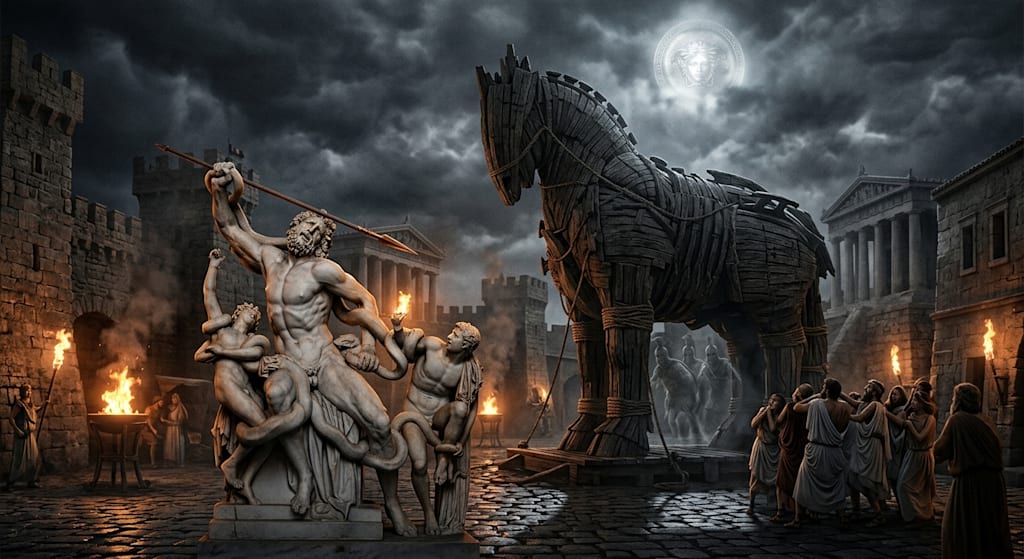
Christopher Nolan wants you to feel guilty about the Trojan Horse.
In his new film The Odyssey, the wooden horse isn't a stroke of genius. It's a moral collapse. Odysseus isn't a hero. He's a traumatized war criminal who weaponized trust itself. The Greeks hid murder inside a "peace offering," exploiting the Trojans' sacred belief in hospitality—the so-called "Law of Zeus."
For that, Odysseus spends ten years being punished by the gods.
It makes sense. It feels right. Deception destroys civilizations. Trust, once broken, can never be fully repaired.
There's just one problem.
That's not what the actual story says.
Laocoön Tried to Warn Them
You remember Laocoön? The Trojan priest who warned everyone the horse was a trap? The guy who said, "I fear the Greeks even when they bring gifts"?
In Virgil's Aeneid, Laocoön doesn't just suspect the horse. He knows. He throws a spear at it. He begs his people to burn it down.
Then two massive sea serpents rise from the ocean. They crush Laocoön and his sons to death. The serpents then swim to Athena's temple and hide under her shield.
The message couldn't be clearer: The gods wanted this.
The Trojans weren't fools. They weren't naive. They were terrified. A man just got divinely executed for opposing the horse. What would you do? You're a believer. The gods have spoken. You haul that horse into the city and pray you're on the right side.
Follow the Thread Backward
Why did the Trojan War happen in the first place?
Paris kidnapped Helen because Aphrodite promised him the most beautiful woman. Aphrodite made that promise because Paris gave her a golden apple. Paris judged the apple contest because Zeus told him to.
Keep going.
The apple contest happened because Eris wasn't invited to a wedding. That wedding was Peleus and Thetis. Zeus arranged that wedding because he learned a prophecy: Thetis's son would surpass his father. Zeus wanted Thetis. Instead, he gave her to a mortal. To protect himself.
And the real reason?
According to ancient sources like the Cypria, Zeus was trying to reduce the human population. Humanity had overpopulated the earth. The Trojan War was divine population control.
Every death—every Greek, every Trojan, every innocent civilian—was practicing Zeus's will.
The Iliad opens by telling us the whole war was "the will of Zeus" being carried out.
Odysseus: The Divine Middleman
Now look at Odysseus.
He's a descendant of Zeus. The epics call him "godlike" and "divine." Athena—Zeus's daughter—guides him constantly. Hermes—Zeus's personal messenger—shows up to help him.
Odysseus didn't want to go to war. He tried to fake madness to avoid it. But he was dragged in anyway.
Because he was Zeus's instrument.
The wooden horse wasn't Odysseus's clever idea. It was Athena's idea, placed into his mind. In Homer's world, mêtis (cunning intelligence) wasn't a vice. It was the highest form of wisdom, a gift from the gods themselves.
So when Nolan frames the horse as a crime against civilization, he's applying modern ethics to an ancient universe where the gods wanted Troy destroyed.
This isn't a war crime. It's a divine mission.
The East Knows This Story Too
Think of the Chinese classic Investiture of the Gods (Fengshen Yanyi).
Heaven has decided the Shang dynasty must fall. No matter how many brilliant generals or powerful sorcerers the Shang have, they will lose. The mandate of heaven is absolute.
Same logic. Same cosmic structure.
"The tide of history is vast and mighty; those who follow it prosper, those who oppose it perish."
In a universe ruled by fate, "morality" is whatever the gods decide it is. Laocoön wasn't wrong about the horse. He was wrong about which side the gods were on.
So What Does This Mean for Us?
Nolan's version is powerful. It speaks to our modern anxieties about trust, surveillance, and the weaponization of good faith. In a world where a private conversation can be secretly recorded and posted online, the Trojan Horse feels uncomfortably familiar.
But let's not pretend Homer shared our concerns.
In the ancient worldview, humans were playthings of the gods. Morality wasn't universal. It was positional. What was "wise" for Odysseus was "treachery" for the Trojans. Both were correct within their own frameworks.
The real tragedy of the Trojan Horse isn't that it was immoral.
It's that morality didn't matter.
The gods had decided. Troy was going to burn. Laocoön's warning, Odysseus's guilt, the thousands of corpses—none of it changed the outcome.
That's the real horror.
We didn't choose to destroy trust.
We never had a choice at all.
About the Creator
Jin
Writer of reamstories
https://reamstories.com/jin
Enjoyed the story? Support the Creator.
Subscribe for free to receive all their stories in your feed. You could also become a paid subscriber, letting them know you appreciate their work.
Comments
There are no comments for this story
Be the first to respond and start the conversation.