
The Sound of Oars
How one man's journey home broke the ancient world's most sacred law—and turned the hero into the very monster everyone feared.
I. The Unseen Enemy
In Christopher Nolan's reading of the Odyssey, a single narrative device does all the work: the "People from the Sea" are never shown.
Across the Greek world, cities speak of them in whispers. They come from the water. They burn, they take, they vanish. No one knows their names. No one knows their home. The only certainty is that they are coming — and when they arrive, nothing remains.
In Homer, the "people from the sea" are no more than passing pirates. A threat, yes. Ordinary. Odysseus faces them the way he faces storms and monsters. But Nolan takes the phrase and stretches it until it snaps. The twist lands in a single moment, when Penelope describes these nameless raiders to her husband, and Odysseus understands:
She is describing Troy. She is describing his men. She is describing him.
He is the thing she fears.
This reversal turns the Odyssey inside out. It is no longer a story about getting home. It is a story about how home became a place that locks its doors.
II. The Historical Ground
Between 1200 and 1150 BCE, the eastern Mediterranean collapsed.
The Hittite Empire fell. The Mycenaean palaces burned. Egyptian records under Ramesses III name the attackers:
"The foreign peoples from the sea conspired in their islands. They attacked every land at once. No land could stand before their arms."
Their identity is still debated. Refugees? Migrants? Pirate coalitions? The Egyptians called them nꜣ ḫꜣswt nwy — "the foreign lands of the sea." They left no cities, no inscriptions, no kings. Only ash.
The Trojan War, dated roughly to 1180 BCE, sits exactly at this fracture. It is the last gasp of the Bronze Age. Odysseus's ten-year war and ten-year return together span the entire collapse. By the time he reaches Ithaca, the world he left is already dead.
Nolan maps this historical rupture onto his narrative. The "People from the Sea" in his film are not a separate invading force. They are the Greeks themselves — the same men who sacked Troy, now doing elsewhere what they did at Troy. The historical mystery of the Sea Peoples, in this reading, has a specific face. It is Odysseus's face.
III. The Broken Law
The ancient Mediterranean ran on a single unwritten rule: Xenia — guest-friendship.
It was not politeness. It was a sacred contract enforced by Zeus himself. A stranger arrives at your door. You feed him. You bathe him. You give him a place to sleep. Only after three days do you ask his name. In return, the stranger harms no one in your house. This system made travel possible across a world with no police, no treaties, no embassies. Without Xenia, every foreigner was a potential enemy.
Troy broke that.
Nolan's script emphasizes what the wooden horse cost. It was not just a military stratagem. It was a lie — a false offering that smuggled armed men inside sacred walls. Worse, Odysseus allows the desecration of Athena's statue. The message is unmistakable: the gods will not stop us.
Once that line is crossed, Xenia becomes useless. If even the gods cannot guarantee safety, then no one can. The Mediterranean enters a prisoner's dilemma:
I do not know if the stranger at my gate follows the old law.
If I let him in and he is false, I die.
Therefore, I strike first.
Every city arms itself. Every harbor becomes a checkpoint. Every ship is a potential invasion. Odysseus's raids on his way home — the Cicones, the Cyclops, the cattle of Helios — are no longer isolated adventures. They are proof of the new rule: trust is extinct. Each act of violence confirms the fear; each confirmation drives more violence.
This is why Penelope, even after recognizing her husband, does not relax. She loves him. But she knows what he did to come back to her. The same hands that touched her face burned cities. The fear is not personal. It is structural. She is safe because he protects her. She is terrified because he protects her by destroying everyone else.
IV. The Invisible Horror
Nolan never shows a Sea People raid.
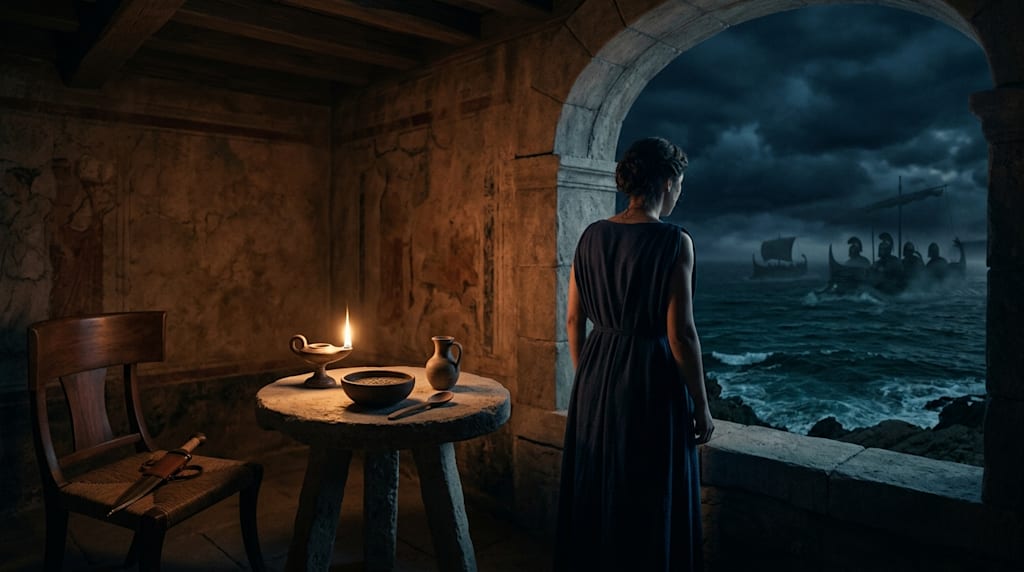
We hear about them. A messenger. A refugee. A report from a neighboring island. Smoke on the horizon. Penelope in her chamber, awake at night, listening to the sea. Her handmaid sits by the door with a dagger — something she never did before.
This technique makes the Sea Peoples into a psychological phenomenon. They are not an army. They are a collective projection. Every city fears its neighbor. Every traveler fears the next harbor. No one knows who is a raider and who is a victim, because after a certain point, the two are indistinguishable.
The turning point comes when Odysseus says, "It was me." Not "I did it." "It was me." He identifies himself as the category. He is not confessing to a crime. He is confessing to being the thing itself.
Penelope's response is not shock. It is recognition. She has already guessed. She has been guessing for three years, every time she heard a sound and could not tell if it was waves or oars.
Her hand goes to his face. She finds a new scar on his jaw. She does not ask how he got it. She knows. She says: "You came from across the sea."
Not a question. A conclusion.
Then she says: "The dinner is cold."
That is the moment. Not a scream. Not tears. Cold soup. The ordinary ruined by the unbearable.
V. The Contemporary Echo
The allegory does not stay in antiquity.
A refugee arrives on a shore. A city locks its gates. A neighbor armors itself against a threat it cannot name. The fear feeds on itself. Every defensive move looks like aggression to the other side.
Odysseus stands on the harbor steps at dawn. His hand is in the water. He does not move for a long time. He is not praying. He is not weeping. He is simply there, feeling the cold, knowing that he is the reason no one opens their door anymore.
He says to Penelope: "They are not afraid of me. They are afraid of the next one. The next one will be worse."
He is not wrong. He started it, but he cannot stop it. Once the law is broken, it stays broken. A single betrayal is enough to end a thousand years of trust. You cannot rebuild what you did not build alone.
VI. The Window and the Bowl
At dusk, he comes back inside.
She reheats the soup. He drinks it. The light is normal. The lamp is new. They sit across the table like any husband and wife.
He says he has to leave.
She asks why.
He says: "I'm afraid."
She has never heard him say that. Not at Troy. Not at sea. Not when he faced giants or the dead. He is afraid.
"Afraid that if I stay, the next one from the sea will be me."
She understands. She does not argue.
She asks: "If you leave, will the next one not come?"
He looks at her. The lamp lights his face. The new scar is very white. He says: "No. He will still come. I already started it."
That is the worst part. He has accepted it. He is not bargaining. He is not hoping. He knows he is the one who turned the world from a place where you knock and enter to a place where you first slide a knife through the crack.
She walks to the window. The sea is black. No moon. The wind carries every sound and no sound at all.
He says: "My son."
She turns.
"Telemachus. He is still young. He does not know about locking doors. Teach him not to lock."
She says: "If I don't lock, others will come in."
He says: "I know. But teach him."
She says nothing. She looks at the sea. She cannot tell if it is waves or oars. Perhaps she will never tell again.
She thinks of Telemachus, who asked her that afternoon: "Mother, why do we close the windows at night?"
She said: "The sea wind is cold."
He said: "I'm not afraid of cold."
She said: "Then leave it open."
He pushed it open. She watched his back — small shoulders, narrow frame. He does not know what "People from the Sea" means. He cannot tell waves from oars. To him, the wind is just wind.
And she understands why Odysseus asked her to teach him not to lock. Not because leaving the door open keeps strangers away. But because she cannot let her son begin his life by learning to lock.
VII. No Summary
She does not say "I forgive you."
She does not say "I hate you."
She says: "The soup is cold."
She turns to reheat it.
The fire flares. She hears him sit back down. The chair scrapes. The bowl touches the table. He sits and waits. Like any ordinary night.
The sea sounds through the open window. She does not turn to look. She watches the flame. Her shadow moves on the wall. At this moment, she thinks she ought to think about great things — war, morality, the death of an age. But she does not.
She only thinks: the soup should not be too hot. It will burn his mouth. He will not be able to drink it.
She carries the bowl back. He takes it. He says: "Thank you."
She says: "Mm."
They say no more.
The sea keeps sounding.
The window stays open.
The steam rises.
The soup goes from hot to cold.
About the Creator
Jin
Writer of reamstories
https://reamstories.com/jin
Enjoyed the story? Support the Creator.
Subscribe for free to receive all their stories in your feed. You could also become a paid subscriber, letting them know you appreciate their work.
Comments
There are no comments for this story
Be the first to respond and start the conversation.