
The Rose That Outlived the Gilded Age: Benjamin Guggenheim's Final Performance on the Titanic
He pushed women into lifeboats, straightened his bow tie, and lit a cigar as the deck tilted. This isn’t a story about survival — it’s about how a man chose to leave the table.
The steward held out the lifebelt. Benjamin Guggenheim pushed the hand away.
The deck was tilting. He could feel it. The slope of the wood beneath his feet was slowly, stubbornly sending everything toward the bow: an overturned chair, a stepped‑off high heel, an unclaimed leather suitcase. Screams drifted up from below, flattened into something that no longer sounded human. He turned and walked back toward his stateroom. Someone called his name from behind. He raised a hand without looking back.
The lights were still on in the cabin. The details of his battle with his clothing were recorded in the testimonies of two survivors, pieced together later, and they read something like this:
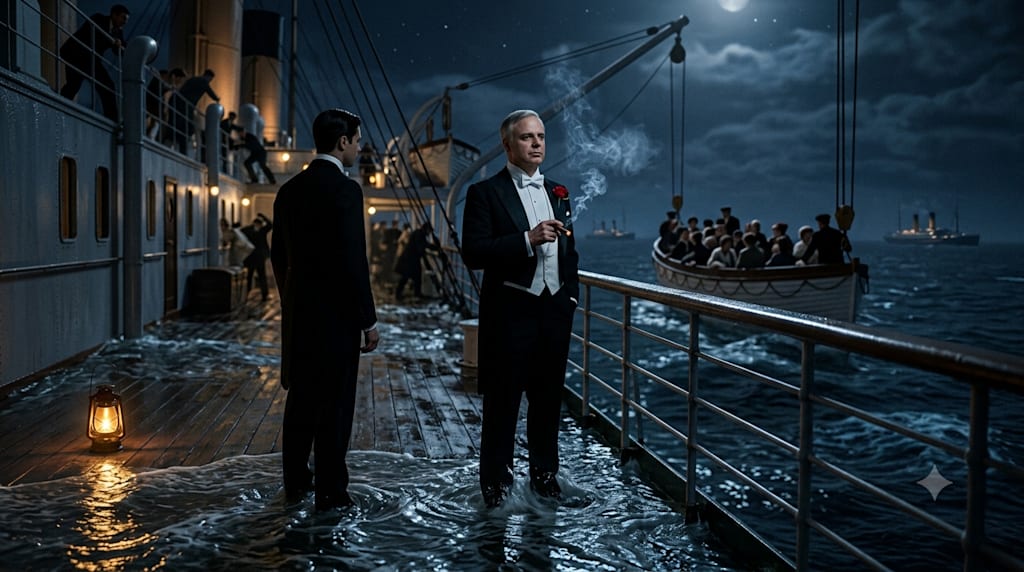
He took off the heavy sweater he had worn against the cold. This was not something a man who feared the chill would do. He told his valet—the young man who always followed him—to open the wardrobe and bring out the tailcoat. Black. On the lapel, his initials were embroidered in the finest silk thread. No one on that ship, in that deep of night, would have been able to read them, but he insisted on putting it on anyway. The bow tie was tied by hand. His shoes were polished three times; the valet wiped the last speck of dust away with his thumb. One final thing: he reached for the silver vase on the table, pulled out a red rose, and fixed it in his buttonhole.
A surviving female passenger, Rose Amelie Icard, later wrote in a letter: "The millionaire Benjamin Guggenheim after having helped the rescue of women and children, got dressed and put a rose at his buttonhole, to die."
She was right. The weight of that sentence falls on the phrase "got dressed."
When he returned to the deck, Lifeboat No. 5 was being lowered. He walked over and picked out, from the crowd, the women who had been pushed to the edges. One of them had her shawl slipping off her shoulder. He reached up, drew it back into place, pressed his palm flat against her back, and pushed her forward. He told the crew, "More over here." He said it many times.
The steward Etches later recalled that Guggenheim and another man moved back and forth between Boats No. 7 and No. 5, repeatedly shouting "Women first." In the order of that moment, those words were not rhetoric. They were a command. He was executing that command. He bent down, locked his hands under a woman's arms, lifted her over the rail, and passed her into the lowering boat. His bow tie came askew once; the valet, standing three steps behind him, reached up and straightened it again.
Before dawn, he stopped a steward. He said, "Take a message to my wife." He meant the wife waiting in New York. The first message was: "I have done my best in doing my duty." The steward nodded and was about to leave. Then he added another line. This time he spoke more slowly, as if making sure that every word would survive:
"Tell her that I played the game straight to the end and that no woman was left on board this ship because Ben Guggenheim was a coward."
The word "game" in English is "play." A card game, a gamble, a table. He had spent his whole life sitting at that table. Not far behind him, his secretary, Victor Giglio, stood by the ship's rail, wearing another tailcoat just as impeccably pressed.
There is very little on record about Giglio. He is not on the survivor lists. He is on the missing list—Victor Giglio, born 1888, twenty‑four years old that year. His position: secretary. When Guggenheim told the steward that "he and his secretary were prepared to go down like gentlemen," Giglio was standing right there. The historical record does not say whether he nodded. No one knows.
A twenty‑four‑year‑old young man, wearing the evening dress his employer had told him to put on, standing on a deck where he had no choice.
That is not romance. That is class honour backed by pressure, a command wrapped in the language of decency. Guggenheim's heroism was a mirror that cast a light so strong that anyone standing beside it was swallowed up—no voice, no choice, only a line buried in the archives: "he was there too."
When the water reached the second deck, Guggenheim took a cigar from his pocket. Someone handed him a light. The flame lasted only a second. It caught his white bow tie, the rose that was already starting to wilt, and the side of Giglio's face, turned toward the sea.
The lifeboats had been launched. The streaks of their oars glowed white in the moonlight. There were still more than a thousand people on the ship. Guggenheim bit down on the cigar and drew in the smoke. It rose and was scattered by the night wind. He looked down at his shoes. The leather was still gleaming. When the seawater crept over, it touched the soles first, then wrapped itself around the uppers.
The last thing to disappear was the rose.
His body was never recovered.
The Atlantic took him, but it left his words behind: "played the game straight to the end." He made a great deal of money, but what people remember is not how much. They remember the way he put on his evening dress. A man intelligent enough to know that, when he could no longer change the outcome, the only thing left to control was his own bearing.
Secretary Giglio stayed in the sea too, voiceless, without a last word. Whether he hesitated for even a second that night, no one will ever know.
Today, when people walk into the Guggenheim Museum and look up at those spiralling white walls and the light falling through the rotunda, they rarely think of Benjamin standing on that tilting deck. What comes to mind is the rose, the cigar, the white bow tie, and a man who turned his own death into one final negotiation.
He wasn't trying to win his life.
He was trying to win the grace of leaving the table.
About the Creator
Jin
Writer of reamstories
https://reamstories.com/jin
Enjoyed the story? Support the Creator.
Subscribe for free to receive all their stories in your feed. You could also become a paid subscriber, letting them know you appreciate their work.
Comments
There are no comments for this story
Be the first to respond and start the conversation.