
The Perfect Order to Watch Every Studio Ghibli Movie
A curated emotional journey through the world's most beautiful animation studio

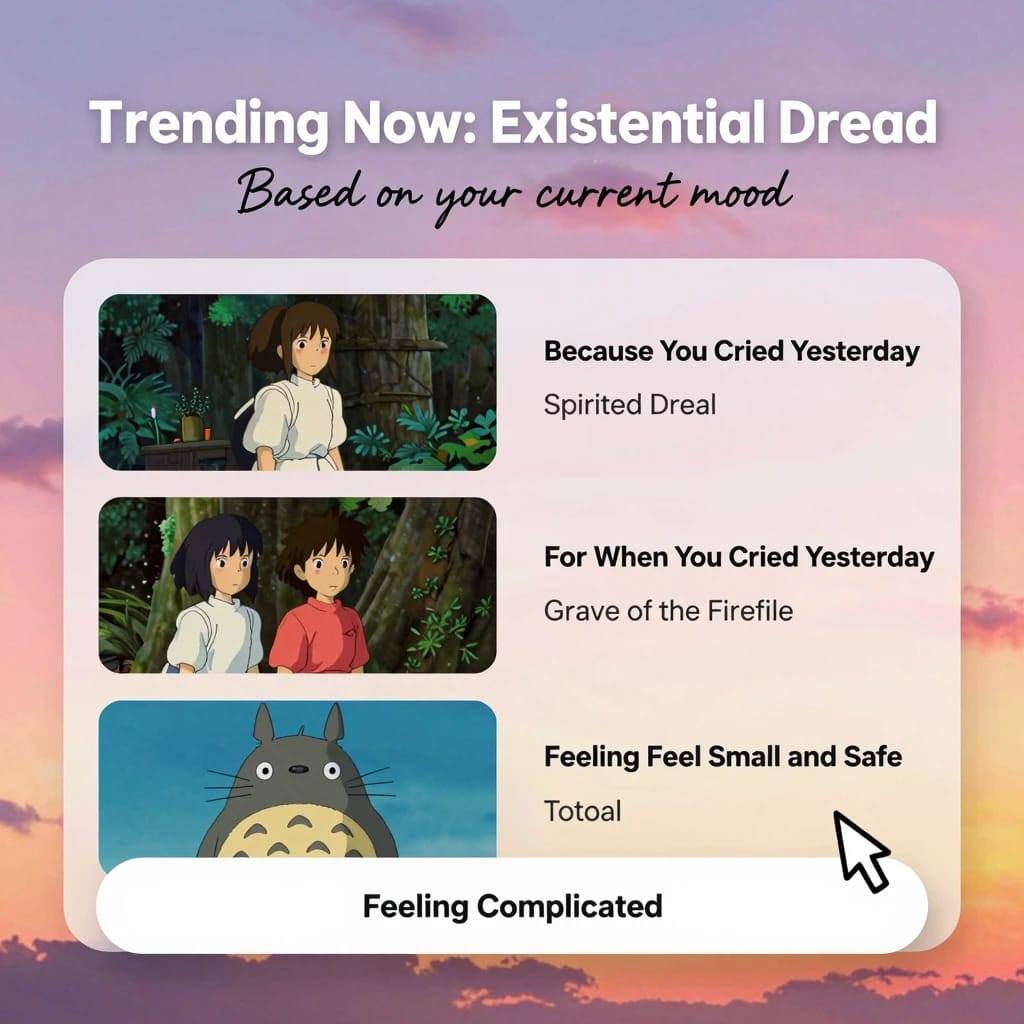
There are twenty-three Studio Ghibli films. You have a couch. You have a screen. You have feelings—complicated, contradictory, probably hungry for something you can't name. You don't need a chronological list. You need a prescription.
Here's the perfect order to watch every Studio Ghibli movie, based not on release dates or critical consensus, but on what your heart is doing right now.
When You're Grieving Something You Can't Explain: Start with Spirited Away (2001)
Chihiro doesn't know she's lost when the movie begins. She's just annoyed—about moving, about leaving friends, about her parents being embarrassing in a way that only parents can be. Then the world tilts. Her parents become pigs. She signs away her name. She works in a bathhouse for spirits because that's what survival looks like when you're too young to understand what you're surviving.
Spirited Away understands that grief doesn't always arrive as a funeral. Sometimes it's a door you walk through because you have no choice, and suddenly you're in a world where nothing makes sense and everyone wants something from you. Chihiro's journey isn't about defeating a villain. It's about remembering who you are when everything familiar has been stripped away.
Watch this first because Ghibli's greatest lesson is embedded here: you are allowed to be small, and scared, and still become brave in increments.
When You're Nostalgic for a Childhood That Might Not Have Existed: My Neighbor Totoro (1988)
After Spirited Away has broken you open, let Totoro gently rebuild you. This is the film Hayao Miyazaki made for his own daughters, and it shows in every frame—the way the rain sounds on an umbrella, the way a forest feels when you're small enough to believe it contains secrets.
Satsuki and Mei aren't on a quest. They're waiting. Their mother is sick. Their father is distracted. The world is vast and slightly dangerous, but also generous. Totoro himself doesn't speak. He simply is—a presence of uncomplicated goodness in a story that knows children worry about things they can't articulate.
The nostalgia here isn't for a specific memory. It's for a feeling—the conviction that the world was once larger, more magical, more forgiving. Watch this and remember that it wasn't entirely imagination. Some of that magic was real because you were capable of seeing it.
When You're Angry at the World and Want to Burn It Down: Princess Mononoke (1997)
Now you're soft. Now you're vulnerable. Perfect. Time to get angry.
Princess Mononoke is Ghibli's most furious film, and it's furious at everyone. The industrialists destroying the forest. The gods defending it with violence that borders on cruelty. The humans caught between. San, raised by wolves, wants human blood. Lady Eboshi, building a refuge for outcasts and lepers, wants progress at any cost. Ashitaka, cursed and traveling between worlds, wants peace and finds that peace might be impossible.
There are no villains here, only competing tragedies. The film doesn't let you choose a side comfortably. It demands you sit with the complexity of a world where every solution creates a new wound.
Watch this when you're angry because it validates that anger without letting you off the hook. The forest spirit's transformation is one of cinema's most devastating sequences—not because it's sad, but because it's fair. Nature doesn't care about your outrage. It simply endures, or doesn't.
When You're Falling in Love and Terrified of It: Howl's Moving Castle (2004)
Sophie is eighteen and thinks she's already old. Howl is a wizard who eats the hearts of beautiful women, or so the rumor goes. Their love story shouldn't work—she's cursed into the body of a ninety-year-old woman, he's a coward disguised as a narcissist—but it does, because Miyazaki understands that love is less about perfection and more about choosing to stay.
The castle itself is a character: ramshackle, absurd, held together by magic and compromise. It moves because it has to. So do Sophie and Howl. She cleans his chaos. He protects her softness. Neither is fully transformed by the other—they're simply more together than apart.
Watch this when you're scared of what you're feeling. The film knows that love is a kind of curse, a vulnerability you can't armor against. It also knows that the only way through is to let someone see you—really see you, including the parts you've calcified into old age out of fear.
When You're Restless and Want to Fly: Kiki's Delivery Service (1989)
Kiki is thirteen. She has a broom, a black cat, and a city that doesn't know it needs her yet. What she doesn't have is a plan, a mentor, or any guarantee that her one marketable skill—flying—will be enough.
This is Ghibli's quietest coming-of-age story. No villains. No world-ending stakes. Just a girl learning that talent isn't enough, that independence is lonelier than advertised, that you can lose your magic and have to find it again through work and connection rather than willpower.
The flying sequences are still breathtaking thirty years later. But the real magic is in the small deliveries: a toy for a boy, a pie for a party, a message that someone cares enough to send. Watch this when you're restless because it reminds you that purpose isn't something you find in a grand gesture. It's something you build, delivery by delivery, until the city recognizes you and you recognize yourself.
When You're Contemplating Mortality at 2 AM: The Wind Rises (2013)
Miyazaki's final film before his first retirement is a biopic of Jiro Horikoshi, the engineer who designed the Zero fighter plane. It's about dreams and their consequences. About beauty that serves destruction. About a man who wanted to build something perfect and watched the world use it for war.
The love story between Jiro and Nahoko, who has tuberculosis, is devastating in its quietness. They marry knowing she will die. They live together anyway, because the alternative—waiting for a future that might never arrive—is worse than any grief.
The Wind Rises asks the hardest question: Is it worth creating something beautiful if the world will corrupt it? Miyazaki doesn't answer. He simply shows Jiro's dreams, rendered in the same lush detail as his flying machines, and lets you sit with the weight.
Watch this last. Watch it when you're ready to understand that Ghibli's greatest gift isn't escapism. It's the courage to look at the world—its beauty, its cruelty, its impossible complexity—and still choose to build, to love, to dream.
The Complete Emotional Prescription
Your Mood: Lost, nameless grief
Your Film: Spirited Away
Your Mood: Longing for lost magic
Your Film: My Neighbor Totoro
Your Mood: Righteous, complicated anger
Your Film: Princess Mononoke
Your Mood: Terrified of vulnerability
Your Film: Howl's Moving Castle
Your Mood: Restless, searching for purpose
Your Film: Kiki's Delivery Service
Your Mood: Contemplating endings
Your Film: The Wind Rises
The remaining seventeen films? They're for the moods between moods. Porco Rosso for when you're a cynic who secretly believes in honor. Ponyo for when you need to believe the world can be simple again. Grave of the Fireflies for when you need to cry until you're empty, then find a way to fill yourself back up.
Ghibli doesn't have a "best" film. It has a right film, for the exact person you are at the exact moment you press play. The studio's magic isn't in the animation—though the animation is unparalleled. It's in the recognition. The sense that someone, somewhere, understood exactly what you were feeling and spent years hand-drawing a response.
Start with your mood. Trust the order. Let the films do what they've always done: remind you that you're not alone in the strange, specific, beautiful complexity of being human.
The screen is warm. The couch is waiting. Your heart already knows where to begin.
About the Creator
Muhammad Sabeel
I write not for silence, but for the echo—where mystery lingers, hearts awaken, and every story dares to leave a mark
Enjoyed the story? Support the Creator.
Subscribe for free to receive all their stories in your feed.
Comments
There are no comments for this story
Be the first to respond and start the conversation.