
The Missing South — Why Martial Arts Games Forgot Guangdong, Guangxi, and Hainan
From the Sung Dynasty to the Salt Trade: One Fisherman, One Iron Rod, and the Real Kung Fu That Never Made It Into the Scrolls
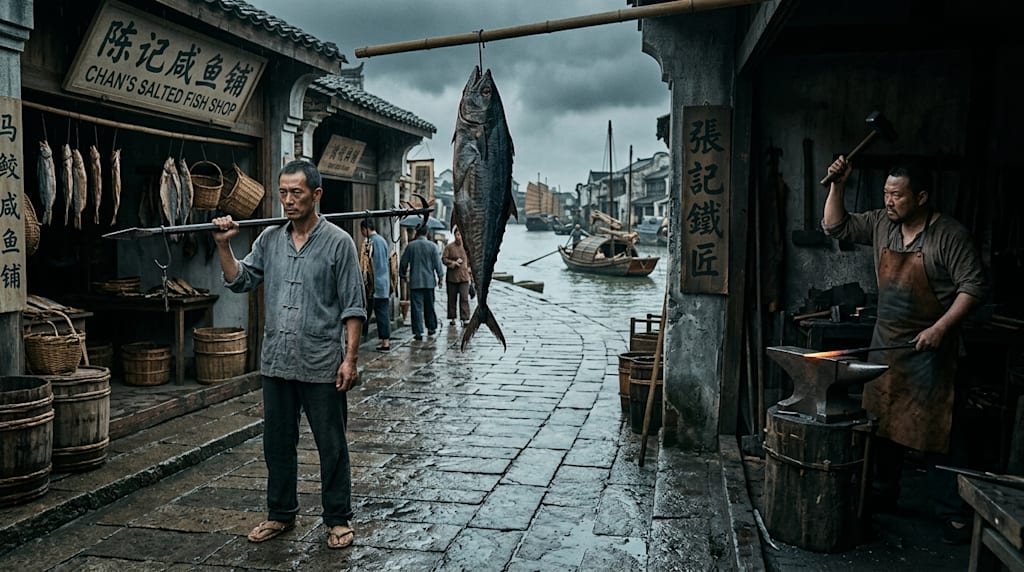
The fish on the chopping board had its eyes open.
A-Man slid the knife in from the tail, flat against the spine, and pushed through. The sound of flesh separating from bone was dull. The blade wasn't sharp. His hand was steady—the meat peeled back in clean edges, no ragged shreds. He scaled the left side, then the right. Scales flicked onto his apron. A few stuck to the fine hairs on his forearm. He didn't brush them off.
Across the street, the hammering from the iron shop stopped. His ear twitched. He kept scaling.
The hammering started again. Someone came through the door. The threshold was low, but the visitor lifted his foot anyway—the sole was caked with black mud from the riverbank, leaving half a print on the beam. A-Man didn't turn around.
"A-Man."
"Mm."
"Go collect that account on the next street?"
"Has the Wuzhou crew arrived?"
"They're here. Third shed at the dock. Been waiting two days."
A-Man flipped the scaled fish over. It was a barracuda, two and a half feet long, its silver-grey skin catching a thin oily sheen in the afternoon light. He reached under the chopping board and pulled out an iron rod, as thick as an adult's index finger, with four pairs of inch-long barbed prongs welded to both sides—it looked like a fish skeleton. He shoved the rod into the barracuda's abdominal cavity, pushed it all the way through the bone channel, spread the fish open, and hung it on the horizontal bamboo pole behind the door.
He didn't say a word. After hanging it, he stepped back, studied the fish's orientation, and reached out to straighten the tail by an inch.
The man at the door was called A-Cai—short, round-faced, with a mole on his chin. A-Cai stared at the fish. "That thing's been hanging seven days. You're not taking it down?"
"Two more days in the sun."
"Drying it to jerky. Who's gonna eat that?"
"Not you."
A-Man untied his apron, folded it twice, and laid it over the edge of the board. He wore a grey-blue short jacket, sleeves rolled to the elbows. The muscles on his forearms ran in long cords—not exaggerated, but veins floated just beneath the skin like tree roots under river mud. He washed his hands in a basin, slowly. Between fingers. Under nails. The web of his thumb. The water went murky. He changed it and washed again.
A-Cai leaned against the doorframe, waiting.
"Whose account?" A-Man asked.
"Third son of the Liu rice mill. Last month's shipment through Wuzhou—agreed to pay thirty percent on arrival. Haven't seen a single coin. Old Liu says he doesn't recognize the debt, claims the goods were moved privately by the son."
"Where's Third Son now?"
"Sitting in the tea stall. Waiting for you."
A-Man shook the water off his hands. He didn't dry them—just left them wet, reached behind the door, and pulled the rod out of the fish's belly again. The barracuda swayed twice on the bamboo pole. He tucked the rod under his armpit, walked to the door, and bent down to tie his shoelaces. The prongs on the rod caught a glint of light, then dulled.
"Let's go."
The tea stall was at the street corner. Two tables under an eave. One empty. One had a man sitting at it.
The man was in his early thirties, wearing a silk-lined long robe in a faded indigo, the cuffs frayed. Beside his hand sat a cup of tea, untouched—the leaves had settled at the bottom, a film of dust on the surface. He saw A-Man approaching. He didn't stand, but he leaned back in his chair. As he leaned, his right hand dropped below the table's edge.
A-Man saw it. He didn't look at the hand. He looked at the teacup.
"Third Son."
"Brother Man."
"Drink your tea."
"Not thirsty."
"You come to a tea stall and don't drink—you here to fight?"
Third Son's mouth twitched. Not a smile—just a tightening of the lips, then a release. He brought his right hand back up to the tabletop. Nothing in it. But along the crossbar beneath the table, a short knife was taped, handle facing out, only two inches of it visible.
A-Man sat down. He laid the rod across his knees, prongs facing down against his pant leg. There was nothing else on the table, so he picked up the cold tea and took a sip. The leaves got in his mouth. He chewed them, then spat them back into the cup.
"Last month's shipment," A-Man said. "You left from Wuzhou, passed through Datan Gorge, offloaded at Jiangmen. Seventy percent to the buyer. Thirty percent due on arrival. The buyer's paid. Where's your thirty?"
"The goods got wet."
"What?"
"Caught rain passing the gorge. Tarp wasn't sealed. The lower hold took water—two hundred catties ruined. The buyer docked the payment. I only got forty percent."
A-Man didn't respond. He set the cup down. As the base touched the table, he turned it—a half twist—and the chip on the rim aligned with Third Son.
"Whose boat did you take out of Wuzhou?"
"The Chen family's."
"The Chen family's boat has holes in the tarp?"
Third Son went quiet.
Outside the tea stall, someone pushed a cart past—wheels catching the gaps between stone slabs, clattering. The hammering from the iron shop stopped again. This time it stayed stopped.
A-Man looked down at the rod on his knees. His right thumb ran from one end to the other. When it reached the prongs, he paused, pressing the pad against the tip of a barb.
"Third Son."
"Yeah."
"What you owe isn't my money."
Third Son stared at the rod. His eyes didn't move, but his throat shifted.
"You owe the Wuzhou passage toll. The Wuzhou crew sent me to collect because this route's mine. You don't pay, they won't let your boats through next time. You can't move goods. And if you can't move goods, your brother won't cover for you a second time."
"Brother Man, I have nothing."
"That silk robe you're wearing—worth thirty coppers."
Third Son looked down at his sleeve. The fray at the cuff was from wear, not washing. He'd worn this robe many times. But it was the only one.
A-Man stood. The rod was still under his arm.
"You're coming with me."
"Where?"
"The dock. You're telling the Wuzhou crew face to face—goods got wet, money's short, what's your plan."
Third Son didn't move. His hand dropped below the table again. This time it found the knife handle.
A-Man stepped forward. The rod came out from under his arm, slid between them, its ends braced against the table's edges. The four pairs of prongs wedged Third Son's arm away from the tabletop. Third Son's fingers were wrapped around the knife handle—but he couldn't draw it. The prongs had pinned his wrist, exactly in the gap between his radius and ulna.
No sound. The iron against flesh was a dull press.
Third Son's face went pale.
A-Man looked down at the trapped hand. "You pull now, that wrist's gone. Don't pull—let go—and you come with me."
Third Son's fingers opened. A-Man withdrew the rod in one motion, stepped back half a pace. No blood on the prongs.
He turned and walked out. At the door he paused, glanced sideways. "You're paying for the tea."
Third Son stayed in his seat, hands flat on the table. On his wrist was a ring of marks—four lines pressed in by the prongs. He stared at them. Didn't move.
A-Man crossed the intersection. The hammering from the iron shop started again. The smith was forging a hoe—one strike at a time, unhurried.
He stopped at the corner for two seconds. The rain hadn't come, but the sky had dimmed by half. The wind off the river carried mud and fish. He tucked the rod back under his arm and reached up to touch the back of his neck. There was an old scar there, running from behind his ear down to his shoulder blade. His fingers paused when they found it.
A-Cai jogged up from behind.
"Collected?"
"No."
"You sat in the tea stall half the afternoon and collected nothing?"
"Let him think it over."
A-Cai clicked his tongue. A-Man ignored him, turned into a narrow lane—both walls moss-covered, the ground slick underfoot. He walked unhurriedly, planting each step firm before shifting weight. The rod stayed motionless under his arm.
The lane opened onto the river. Three boats moored along the bank. At the bow of the middle one sat a man in his forties, gaunt, smoking a water pipe. When he saw A-Man approach, he took the pipe from his mouth and tapped it against the gunwale.
"What did Third Son say?"
"He said the goods got wet."
The man with the pipe laughed. Smoke leaked from between his teeth.
"The Chen family's boat doesn't get wet."
"I know."
"Then why are you back?"
A-Man stood at the water's edge. A wilted vegetable leaf drifted on the surface, turning in a lazy circle. He watched it. "He's got marks on his wrist."
"What marks?"
"Prion marks."
The man with the pipe set it down. His smile faded.
"You drew your piece?"
"Didn't draw. Just pinned him."
"In the street?"
"In the tea stall."
Silence. The water pipe lay on the deck boards, no longer smoking.
The man said, "What if Third Son doesn't take it and goes to the Chens?"
"He won't."
"How do you know?"
A-Man pulled the rod from under his arm, crouched, and dipped it into the river water. The dust washed off the prongs, revealing the dull silver beneath. He lifted it out, shook it twice—droplets flecked his pant leg.
"Those marks on his wrist—three days of ointment before they fade. Three days he can't hold chopsticks. Can't hold chopsticks, can't sit at the same table as his brother. He won't let his brother see."
A-Man stood, slung the rod over his shoulder, and turned back.
"Tomorrow."
"Where are you going?"
"Drying fish."
He reached his shop just as the rain came down. Needles—not a downpour, but enough to wet the street. He went in, left the door open, and stood just inside, taking the rod off his shoulder. The barracuda was still on its bamboo pole. When he slid the rod back into the fish's belly, it caught on a fresh nick—leftover from the table edge in the tea stall.
He straightened the tail again.
Rain tapped against the blue stone slabs outside. The hammering from the iron shop was still going.
He bent down and rolled his cuffs back down. Rain splashed in. The old scar on his neck dampened, the color deepening by a shade.
He touched it again.
When his hand came down, he picked up the knife from the chopping board and began scaling another fish.
About the Creator
Jin
Writer of reamstories
https://reamstories.com/jin
Enjoyed the story? Support the Creator.
Subscribe for free to receive all their stories in your feed. You could also become a paid subscriber, letting them know you appreciate their work.
Comments
There are no comments for this story
Be the first to respond and start the conversation.