
The Mandalorian and Grogu (2026): A Review
A Heartfelt Star Wars Adventure About Family, Legacy, and Survival

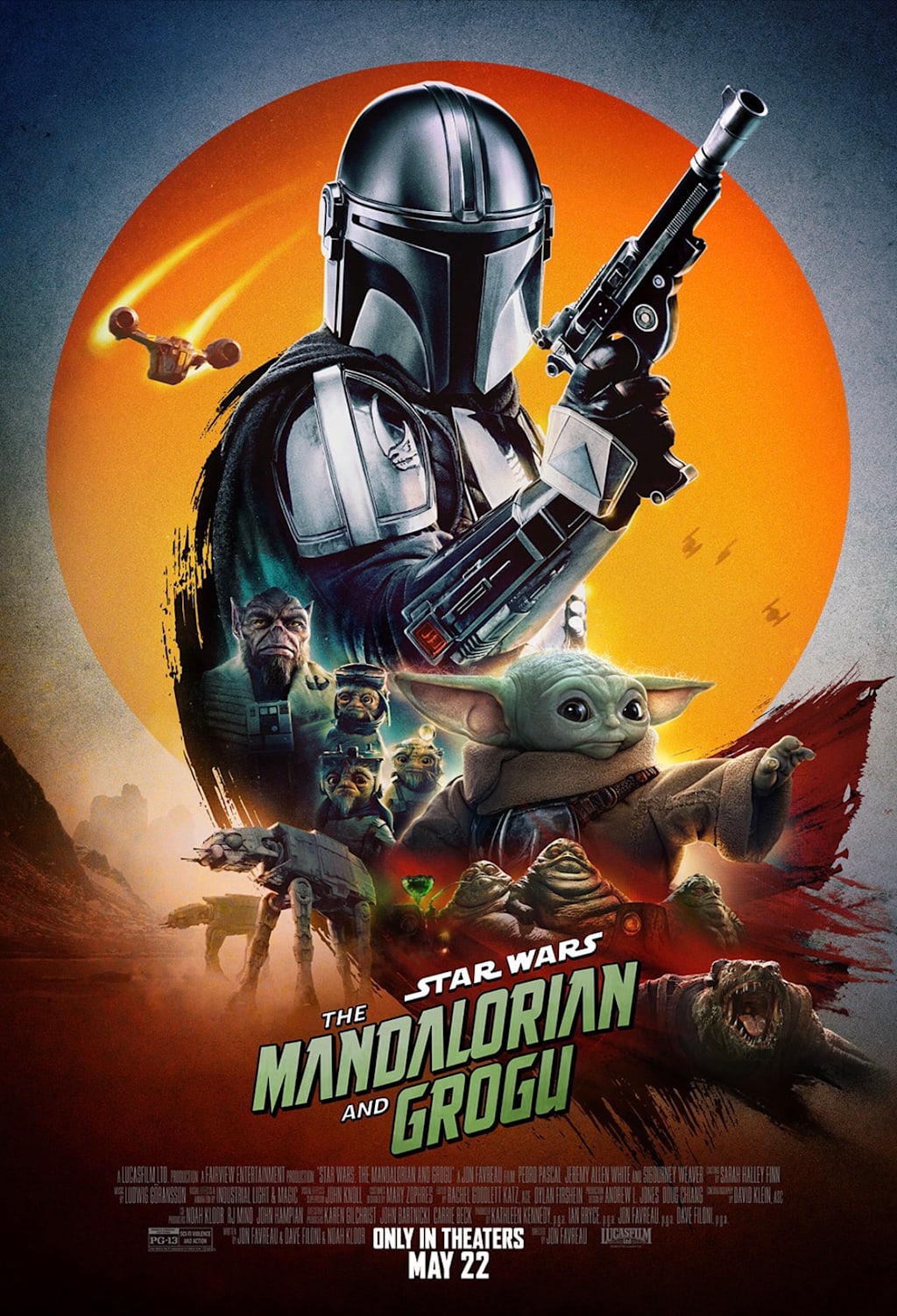
This past Saturday, I saw The Mandalorian and Grogu with my sister and dad at a sold-out show at Apple Cinemas in Merrimack, New Hampshire, and honestly? I walked away pleasantly surprised by how emotional, character-driven, and heartfelt the movie turned out to be.
Overall, I would give the film an 8/10.
While the movie definitely has a few flaws and some creative choices that did not entirely work for me, the performances, emotional storytelling, practical effects, and focus on found family ultimately made this feel like a worthy continuation of The Mandalorian storyline rather than a glorified filler episode stretched into a theatrical release.
Most importantly, the film remembers what made audiences fall in love with this corner of Star Wars in the first place: the relationship between Din Djarin and his son Grogu.
A Natural Continuation of The Mandalorian
One of the biggest strengths of the movie is how naturally it continues where Season 3 of The Mandalorian left off.
Instead of “resetting” the characters or pretending previous development never happened, the story fully embraces Din Djarin and Grogu’s new life together. Din Djarin and his adopted son are now working alongside the New Republic by tracking down former Imperial officers and bringing them to justice across the galaxy.
This setup works surprisingly well because it allows the movie to preserve the “space western” atmosphere that made the show successful while also expanding the scale enough to justify a theatrical experience.
Din still feels like the same lone gunslinger audiences connected with years ago, but there is now a stronger sense of direction in his life. He is no longer simply surviving mission-to-mission. He has a purpose, responsibility, and a growing role within a galaxy struggling to rebuild after the fall of the Empire.
Grogu no longer feels like just “the cute mascot”. The movie finally starts treating him like an active participant in the story and an emotional equal within his relationship with his father.
Rotta the Hutt Was the Movie’s Biggest Surprise
Going into this film, I honestly did not expect Rotta the Hutt, son of Jabba the Hutt, to become one of the movie’s most interesting characters.
At first, I thought the inclusion of the Hutts felt a little random for The Mandalorian. I assumed Hutt-related storylines would probably remain tied to The Book of Boba Fett or future spin-off material.
However, the film completely surprised me with how much emotional depth it gave Rotta. Instead of portraying him as another cartoonishly evil Hutt crime lord, the movie presents him as someone desperately trying to escape the shadow of his late, infamous father. Rotta wants his own identity. He wants freedom. He does not want to inherit Jabba’s violent criminal legacy.
That conflict becomes even more tragic when it’s revealed that members of his own family want him eliminated.
What makes Rotta’s storyline work so well is his growing friendship with Grogu and his admiration for Din Djarin. One of the movie’s strongest emotional threads involves Rotta realizing that Din is the loving father to Grogu that Jabba never was to him when he was growing up.
That realization adds surprising emotional weight to the character. Beneath the Hutt politics, bounty hunters, and action sequences is a story about generational trauma, parental failure, and the desire to become something better than the people who raised you.
Grogu Finally Gets His Most Emotional Arc Yet
For me personally, Grogu’s storyline was one of the best parts of the entire movie.
The emotional turning point comes when Din gets poisoned by a venomous snake dragon bite while the Hutts’ mercenaries are closing in around them. To save his father’s life, Grogu uses force healing while simultaneously trying to protect Din long enough to locate medicine from a mysterious swamp hermit.
What makes this storyline work is that the movie never treats it like a flashy “power level” moment.
Grogu is not trying to become the next great Jedi Master. He is simply terrified of losing his father.
That emotional framing is what gives the sequence so much power. Grogu’s actions are driven entirely by love, desperation, and loyalty rather than spectacle. The Force feels deeply emotional and spiritual again, instead of simply existing as another visual effect.
This becomes the moment where Grogu proves himself to be a Mandalorian at heart. Not because he wears armor. Not because he follows a creed.
But because he will risk absolutely everything to protect the person he loves most.
The movie smartly reinforces the idea that being Mandalorian is not simply about helmets, weapons, or bloodlines. It is about loyalty, sacrifice, found family, and protecting your own.
Grogu embodies those values completely.
Action, Rescue Missions, and the New Republic
The action sequences throughout the movie are consistently entertaining, especially once the story escalates into the rescue mission on Hutta.
I particularly enjoyed the reversal in which Din, who normally spends entire stories rescuing others, becomes the one who needs saving after being abducted by Embo alongside Babu.
Watching Grogu and the remaining Azelleans work together to save both of them added a fresh dynamic to the film by allowing Grogu to step into a more active leadership role while still maintaining his emotional vulnerability.
Including Zeb from Star Wars: Rebels was also genuinely enjoyable. Unlike certain franchise cameos that exist purely for applause moments, Zeb actually contributes to the story in meaningful ways and helps reinforce the idea that the New Republic is attempting to establish stability in a galaxy still plagued by Imperial remnants, criminal organizations, and political instability.
The New Republic’s expanded presence throughout the movie also feels intentional from a larger franchise perspective. It strongly feels like the filmmakers are quietly setting up future developments for a second season of Ahsoka by emphasizing how fragile and overstretched the New Republic still is during this era.
My Biggest Disappointment: The Absence of Mandalore
If I had one major criticism of the movie, it would be the lack of focus on Mandalore itself.
After the third season of The Mandalorian spent so much time building towards the reunification and reconstruction of Mandalorian society under Bo-Katan Kryze, I expected the movie to show at least some progress regarding the rebuilding of the planet and its people.
Instead, that entire storyline largely remains in the background.
While I understand Lucasfilm may save those developments for a potential fourth season of The Mandalorian, it still feels like a missed opportunity considering how emotionally important Mandalore became to the overall series.
Bo-Katan’s reconstruction efforts could have added another interesting layer to the movie by showing what Mandalorian culture actually looks like when it is attempting to heal rather than simply survive.
Sigourney Weaver’s Casting Felt Distracting
One creative choice that did not entirely work for me was the inclusion of Sigourney Weaver as Din’s New Republic superior officer.
To be clear, Sigourney Weaver is an incredible actress and gives a perfectly solid performance in the film. However, her presence sometimes felt less like a natural Star Wars character and more like a recognizable “1980s sci-fi nostalgia” inserted into the franchise.
Personally, I think Hera Syndulla would have made far more sense in that role, considering her established status within the New Republic and her existing connections to Zeb and the wider post-Rebels storyline.
Instead, Weaver’s role occasionally felt like corporate nostalgia casting designed to appeal to older audiences who grew up with films like Alien and Aliens.
The “AI Slop” Criticism Feels Completely Unfair
One criticism surrounding the movie that I strongly disagree with is the claim from some online critics that the visual effects looked like “AI slop”.
That criticism honestly feels both unfair and technically inaccurate.
The film’s end credits and multiple behind-the-scenes videos released online clearly show extensive practical effects work involving puppetry, animatronics, costumes, creature performers, and physical set design that were later enhanced through digital compositing and visual effects editing.
That is not the same thing as generative AI.
Modern Star Wars productions have always blended practical filmmaking with digital enhancement. Even Grogu himself heavily relies on full-fledged puppetry and animatronic work alongside minor computer-assisted adjustments for certain scenes.
Reducing all CGI or digital compositing to “AI” completely ignores the enormous amount of work performed by puppeteers, costume designers, animators, visual effects artists, editors, and practical effects teams who physically help bring these worlds and characters to life.
Final Thoughts
At its core, The Mandalorian and Grogu succeeds because it understands that Star Wars works best when it focuses on emotional relationships rather than lore, nostalgia, or franchise setup.
Din and Grogu’s relationship remains the heart and soul of the movie, and nearly every major storyline, including Rotta’s journey, ultimately circles back to themes of family, identity, legacy, and survival.
The movie is not perfect. Some storylines could have been explored more deeply, certain franchise connections feel intentionally designed for future projects, and a few creative decisions occasionally feel driven more by corporate strategy than narrative necessity.
But despite those flaws, the film delivers an entertaining, emotionally sincere, visually impressive, and surprisingly heartfelt Star Wars adventure that remembers compassion and connection matter just as much as lightsabers and spectacle.
For longtime fans of The Mandalorian, this absolutely feels worth experiencing on the big screen.
About the Creator
Jenna Deedy
Just a New England Mando passionate about wildlife, nerd stuff & cosplay! 🐾✨🎭 Get 20% off @davidsonsteas (https://www.davidsonstea.com/) with code JENNA20-Based in Nashua, NH.
Instagram: @jennacostadeedy
Enjoyed the story? Support the Creator.
Subscribe for free to receive all their stories in your feed. You could also become a paid subscriber, letting them know you appreciate their work.
Comments
There are no comments for this story
Be the first to respond and start the conversation.