
The Girl Who Doesn't Need to Smile
How Sadie Sink weaponises stillness and fracture to reinvent Jean Grey for a generation raised on trauma
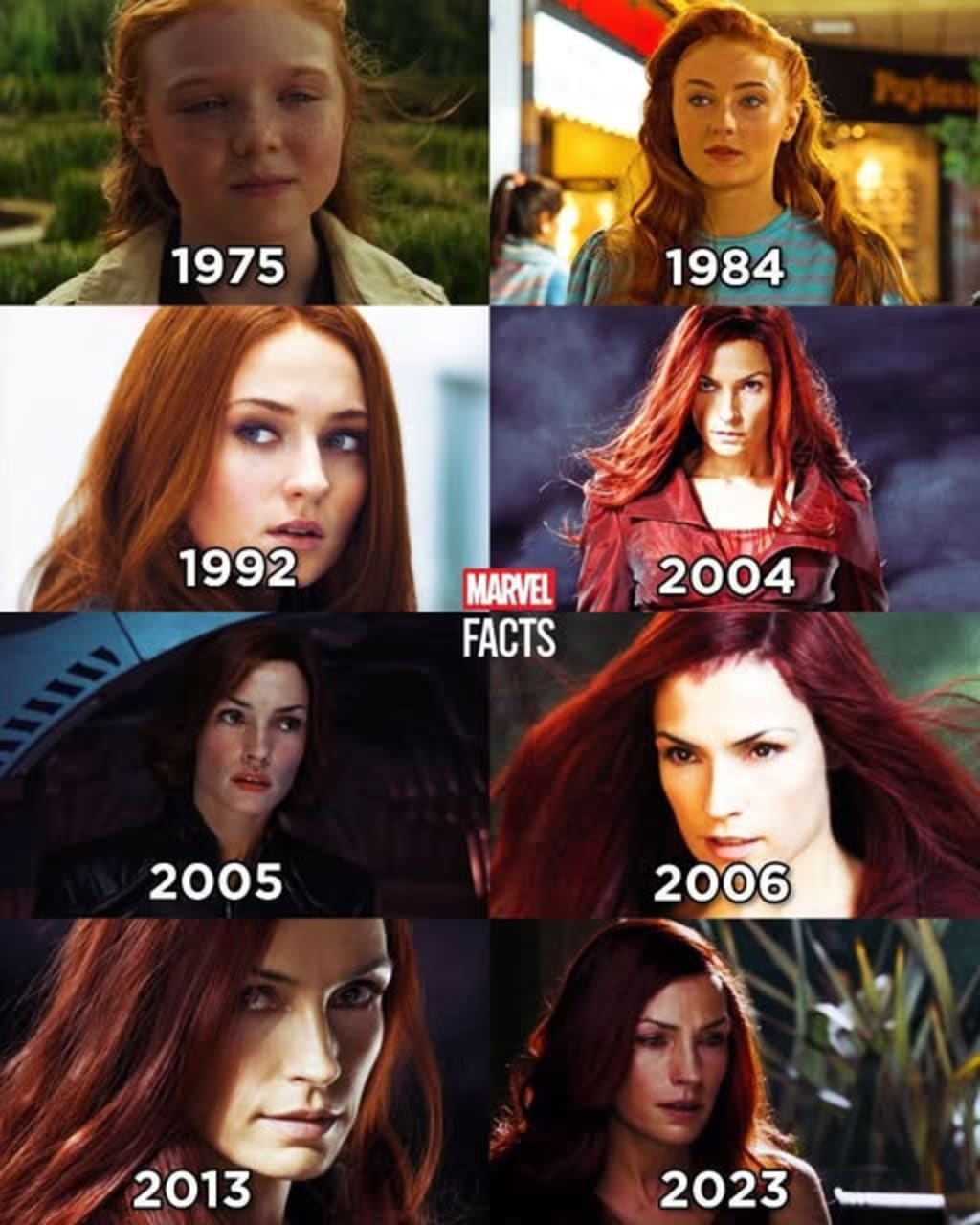
When Marvel cast Sadie Sink as Jean Grey, the internet went quiet. No outrage, no celebration – just a collective pause. Everyone was busy mentally pasting that fiery red mane onto Max from Stranger Things – the girl gasping for air in a cemetery. Only when Spider‑Man: Brand New Day hit the screen, and that face onscreen tightened its jaw and went cold, did the doubts evaporate. What stayed was a near‑unanimous take: this is one of those rare MCU castings that wins half the battle on presence alone.
If She Doesn't Smile, the Story Begins
Sadie Sink has a face that always seems about to come apart. In an industry stuffed with girl‑next‑door types, that's almost defiant. Her eye sockets are deep, her cheekbones sharp, and the corners of her mouth pull downward when she's not smiling. In editorial shots, the moment the photographer tells her not to smile – to let her gaze drift or her brow pinch – the image develops a sharp, restless tension. But put her on a red carpet with a standard grin, and she vanishes into the crowd of conventionally pretty celebrities.
That split – the loss of the smile – is exactly Jean Grey's baseline. The Phoenix Force was never a cool superpower. It's the tinnitus that burns in your skull from childhood, the fear that you might kill your own family in the next second. Sadies doesn't have to act. She just has to drop her camera‑ready smile, and her natural expression carries a post‑traumatic freeze. In one scene, she sits beneath a stained‑glass window in a ruined church, light falling across her face. She doesn't cry, barely registers any expression. But the shadow that covers half her face – you feel its weight.
Entering as a Villain, but Pulling Out Her Own Scars
This Jean Grey arrives as a "dangerous asset" – a walking bomb chased by S.H.I.E.L.D. and every other power. From Spider‑Man's view, she's a cold‑eyed rogue who uses telepathy to toy with agents. But as the memory‑sync unfolds, the script peels back her aggression. It's not rage. It's hyper‑vigilance. Every overstep grows from an irrecoverable loss.
The most elegant beat: she inadvertently enters Peter's mind and sees the man the whole world has forgotten – sitting alone in a coffee shop. At that moment, Sadie's face runs through a quick series of micro‑shifts: first alertness, then a sudden slackening in her eyes, then her breath goes shallow. No tears, no dialogue. Yet from her slowed blink, you read: "He's like me." This kind of recognition – played through tiny muscle movements and breath – is more honest than any breakdown.
Two Kids Kicked Out of the World
The relationship between this Jean and Peter Parker is the movie's biggest surprise. Earlier Spider‑Man romances were mostly adolescent hormone tracks. But here, Jean punches straight through Peter's wall. After everyone forgot who Peter Parker was, he kept running like a wind‑up toy – fighting, saving, joking – but he'd almost forgotten that he, too, needed to be seen.
On that abandoned rooftop, Jean tells him, in a hoarse, muffled voice: "You keep listening to everyone else's screams, but you don't hear your own heartbeat." In another actor's hands, that line could sound like a cheap therapy poster. But Sadie delivers it without a trace of lecture – only a tired tenderness, because she earned that insight through her own wounds. She's not comforting Peter. She's just naming a rotten fact they both know.
They sit on the church roof's edge, legs dangling, looking nowhere, silent for minutes. It's probably the scene with the fewest visual effects and the biggest punch. No hugs, no confessions – just two broken adolescents serving as each other's mirror for half a minute in the dark.
Three Jeans, Three Eras
Famke Janssen, playing adult Jean in 2000, had a classic supermodel face – high cheekbones, a broad jaw, steady eyes. Standing in her catsuit, she radiated an authority that said, "I've got this." Even when the Phoenix Force later broke loose, her loss of control still rested on a mature woman's self‑possession – like a leather strap stretched to its limit but not yet snapped.
Sophie Turner, who took over, still carried Sansa's baby fat from Game of Thrones, her blue eyes perpetually wet. In Apocalypse and Dark Phoenix, she played confusion and struggle well enough. But Sophie's fragility was outward, soft – the kind that makes you want to catch her.
Sadie Sink lands between them – harder and colder than Sophie, younger and more breakable than Famke. Her Jean is caught in a transitional state: not yet formed, but already cracked. She has neither Famke's poise nor Sophie's pitiable innocence. She's more like a freshly sharpened blade that's already chipped – just looking at her makes you uneasy.
Body Speaks Louder Than Dialogue
Sadie built a very specific physical vocabulary for the role. Outside combat, her hands stay in her hoodie pockets, shoulders curling inward – an automatic self‑enclosure. On alert, her neck cranes forward like a cat catching blood in the air, yet her steps grow unnaturally light – as if something outside her is lifting her. This toggle between "closed" and "released" lets you read, without any special effects, whether the Phoenix inside her skull is awake or asleep – just from her posture.
Vocally, she lowered her register, dropping her naturally raspy teen voice for a flat, almost breathless cadence in Jean's monologues. In the flashback recounting her parents' death, her voice runs as level as a frozen river – no inflection. But that very composure is more chilling than any scream. It's a sign of trauma so deep it has lost the ability to express itself normally. She finished the cold coffee and set the cup down; a ring of dried milk stain clung to the bottom.
A Few Beats Short, but Plenty of Time
This Jean Grey isn't flawless. Comic fans will point out that the film barely touches on the cosmic scale of the Phoenix Force, making her power feel like a deus ex machina. Casual viewers may wonder, "Where did she even come from?" To keep the spotlight on Spider‑Man, the script intentionally obscures the mutant/X‑Men backstory, handling the link between childhood trauma and the Phoenix with only one flashback and a few lines. Compared to WandaVision's careful excavation of psychological wounds, Jean's arc feels thinner.
Still, in the post‑credits scene, Jean stands alone by the sea, the low hum of a cerebro‑amplifier faint in the background. Sadie Sink is only 24. She has plenty of time to travel from this chipped blade to the Phoenix Queen. When the sea breeze blows her hood down, she reaches up to press it back – her finger still wrapped in half a torn band‑aid.
Closing
In an era when superhero movies increasingly feel like theme‑park rides, a character who makes you remember pain has become a luxury. Sadie Sink's Jean Grey lingers not because she blows up trucks, but because she shows us that immense power is usually fed by immense loneliness. To admit that you are both fragile and dangerous – that may be the hardest lesson for every kid forced to grow up too fast.
About the Creator
Jin
Writer of reamstories
https://reamstories.com/jin
Enjoyed the story? Support the Creator.
Subscribe for free to receive all their stories in your feed. You could also become a paid subscriber, letting them know you appreciate their work.
Comments
There are no comments for this story
Be the first to respond and start the conversation.