
The Feather That Never Came Home: Why We've Been Sanitizing Odysseus for Centuries
He wasn't a hero who survived. He was a man who learned to feed others to monsters. It's time we let the myth get dark again.
After the Landing: What Odyssey Adaptations Are Afraid to Sink Into the Sea
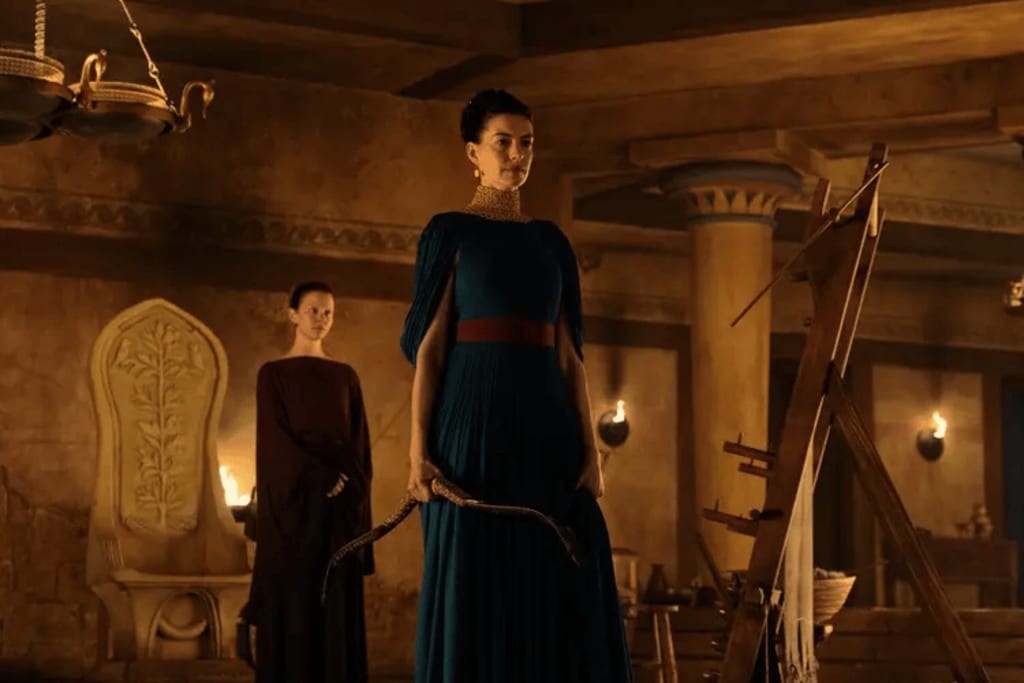
The film’s final scene has Odysseus in the bedchamber, speaking to Penelope. The gist: war destroyed the common order, and he has brought deception and cruelty back home.
The lines are well written. The scene is well staged. The only problem is, this man just passed a two‑and‑a‑half‑hour moral physical with flying colors.
Look back at his adventures: in the Cyclops’ cave he was a resourceful victim; on Circe’s island a reluctant survivor; in the underworld a pious petitioner; before the Sirens’ song a restrained ruler; before the cattle of the Sun the sole keeper of principle. All of his “fall” happens in dialogue, invented by language at the end, not forced by the plot.
A hero can defeat monsters, but a good film must let the hero be contaminated by them. Contamination isn’t a one‑time event. It’s every time he escapes, a little black mud clings to his fingers without his noticing, until his fingers no longer obey him.
Current adaptations are afraid to let Odysseus do evil deliberately. Screenwriters fear the audience won’t forgive him. But in the epic, Odysseus was never meant to be “forgiven.” He was meant to be witnessed: a clever man, step by step in extremity, turning his own cleverness into poison.
I. Five Levels That Must Be Rewritten
Scylla and Charybdis is the only level that touches the threshold. Odysseus holds two prophecies and reveals only one to his men. He monopolizes information under the pretense of “protecting” them. That’s the dividing line: from “sharing risk together” to “deciding life and death for others.”
But the film never follows this thread downward. The subsequent levels all retreat into the comfort zone of “good guy fights bad guy.”
The Cyclops: From “Arrogant Fool” to “Calculating Sinner”
In the original, Odysseus reveals his true name out of vanity. But vanity is too light. A man who fought ten years beneath Troy’s walls long outgrew that stage. What truly drags him down is something else: the inertia of calculation.
If rewritten, the Cyclops level should unfold like this:
Odysseus is trapped in the cave and needs someone to blind the giant. He picks the three youngest, most adoring crewmen, because they are fastest and least likely to ask “Why me?” He lies, calling it a “scouting vanguard.” One of them, trembling as he fastens his leather armor before departure, catches Odysseus’s eye. Without a word, Odysseus plucks the black feather from his own helm and tucks it into the youth’s shoulder strap. The trembling stops.
The giant does not go blind immediately. Enraged, it sweeps toward the mouth of the cave. Odysseus leads the main force out through a side crevice. He hears the crunch of bones behind him and does not look back. Aboard the ship, he counts heads. Three are missing. He glances at the now‑empty slot on his helm, then pulls the helmet down over his face and tells the remaining men: “They were heroes.”
No one objects. But two old veterans exchange a look. What they saw was this: the spot where those three were sent was precisely the direction the giant would strike first.
Odysseus did not lie. He simply chose to place his most devoted followers in the highest‑mortality position. The act itself isn’t dirty. What’s dirty is the calm with which he made the choice. He did the math: three lives for twelve. Worth it.
From this moment, he is no longer a victim of fate. He is a co‑conspirator who actively touches evil for “the survival of the whole.” Poseidon’s curse is not because he shouted his name. It is because he fed young men to the monster in the name of honor.
Circe: The First Account of the Body as Currency
Films usually show only the witch’s seduction and then let divine intervention resolve it painlessly. But this level harbors the most intimate cut in the entire descent:
Odysseus sleeps with Circe to buy the antidote for his men. In the original, the gods break the spell for him, but a film could make the bargain murkier. Circe’s condition is “one night.” Odysseus agrees.
Next morning, he emerges with the potion. His men are still pigs. He feeds each one, watching them revert. When an old soldier regains human form, his first words are: “You smell like her.” Odysseus says nothing, pats his shoulder. That veteran never meets his eyes again.
They all know: the captain traded himself for their lives, but “the captain’s body” is no longer untouchable in their eyes. From that night on, Odysseus is no longer a leader. He is a gambler who will pay anything. Their gazes carry a new ingredient: not awe, not fear, but something unnameable, something they want to look away from.
Odysseus knows it too. That night he sits alone at the stern, rubbing the feather (the one no longer on his helm) over and over. He rubs until his fingers are raw, then tucks it into the leather pouch at his belt and never takes it out again.
The Underworld: Two Prophecies and One Silence
In the underworld, Tiresias gives him two prophecies: one about the route home, and another: “If the cattle of the Sun are unharmed, all may live. If any man kills them, only you shall return to Ithaca.”
Odysseus delivers only the first.
He returns to the ship, faces his hollow‑eyed, starving men, warns them of Scylla, of Charybdis, of the Sirens’ song, but never mentions that they might become his passage fee. He is not protecting them. He is reserving the right to choose. If the time comes when he must trade their lives for his own, he will ensure they never knew it was permitted.
That night, Odysseus sits at the prow. Beside him, an old veteran sleeps. He reaches into the pouch, fingers the feather, does not pull it out. He stares at the sea for a long time, then tightens the pouch’s drawstring.
The Cattle of the Sun: From “Upholding Principle” to “Cold Complicity”
In the original, Odysseus abstains from the beef, an act of moral example. But this is precisely the adaptation’s poison: a man who can resist hunger, why would he suddenly fall at the end?
Rewrite along the descent: Odysseus knew the full condition (“if the cattle die, you alone survive”) from the very first day he returned from Hades. He told no one.
Starving on the seventh day, Odysseus says: “I’ll go to the hilltop to pray to the Sun.” As he rises, the flint‑striker at his belt “accidentally” slips onto the lid of a barrel at the stern. He glances at it, does not pick it up, and walks away.
He truly prays on the hilltop. He kneels, facing the sun. But below, he hears shouts, the bellowing of cattle. He hears the thud of slaughter, the crackling of meat over flames. He knows those men can no longer endure, and they saw the flint he left behind. They take it as a “signal” from their captain.
When the fire rises, Odysseus stands, brushes the dust from his knees. He descends with a face of fury, demanding who broke the oath. He berates the ringleader publicly until the man dares not look up. That night, the man kneels before him, begging forgiveness. Odysseus lifts him and says: “You were only hungry.” The man weeps bitterly, unaware that he has been marked on Poseidon’s ledger.
Odysseus needs a “criminal” to bear the divine penalty for the whole crew. With a merciful tone, he pushes a man onto the altar. That man later becomes the first swept overboard in the storm. Odysseus watches his face vanish into the waves and remembers him kneeling, crying. He does not move.
Scylla: Six Names on a Plank
In the film, the six victims are random. Odysseus would never leave that to chance.
The night before, he sits at the prow, tracing six lines on a deck plank with his fingernail, each corresponding to a man. He recalls each one’s story: the oarsman with two children must survive (without him the oars will lose time); the veteran who defied him at Troy can die (no one will question it); the newly grown archer can die (there is a substitute); the shield‑bearer who once took a blade for him must live (he owes that one).
He finishes the six lines, flips the plank over, and plants his foot on it.
At dawn, the ship passes the strait. He deliberately angles the rudder so that the six on the port side face Scylla’s cliff directly. Six maws descend and seize six bodies. The other men crouch on deck, heads in their arms. Someone shouts, “Why our side?” No one answers.
Odysseus stands at the stern, watching those six faces disappear into the holes. In his mind, he runs the list. All correct. He kicks the plank overboard and watches it drift away, its scratches erased by the sea.
II. Mirrors on the Other Shore
As Odysseus sinks deeper at sea, Ithaca rots in parallel. The film gets this direction right, but plays it too light.
The suitors are not just freeloaders. They are learning how to be tyrants. And each of their steps mirrors Odysseus’s other face, like a reflection beneath the surface.
The Parallel Deterioration
When Odysseus makes his first sacrifice in the Cyclops’ cave:
Antinous, the suitors’ leader, knocks on the palace granary door. He demands not food, but land deeds. “The queen delays her choice,” he argues, “so the land belongs to all nobles in common.” With a dagger, he slashes the parchment of Odysseus’s original land grants. Fragments scatter on the floor. Penelope stands at the threshold, watches the pieces, and does not pick them up.
When Odysseus trades his body in Circe’s bed:
The suitors begin spending nights in the great hall. They call Penelope’s maids to pour wine beside their couches, their hands wandering. The maids lower their heads and evade. The suitors laugh: “You’ll get used to it.” No one intervenes. Telemachus stands in the corridor, hand gripping his sword, trembling, but he does not draw. His wrist is not yet strong enough.
When Odysseus hides the second prophecy in the underworld:
The suitors tie Telemachus’s hunting dog to the city gatepost and begin skinning it from the hind legs. The dog howls for two hours before going silent. The hide is nailed to the city gate. By next morning, flies cover it. Penelope sees through the window crack, closes the shutter, does not weep. She knows tears are useless; tears only tell them she noticed.
When Odysseus listens from the hilltop as the cattle are slaughtered:
Antinous sets a couch in the middle of the hall, pulls a maid onto his lap, and announces to all: “The queen’s body belongs to the conqueror. I am merely sampling in advance.” No one laughs. No one steps forward. Because the old steward who spoke out three days ago was thrown into the harbor, and his body has not yet risen.
When Odysseus drifts alone on the sea, his ship emptied:
On Ithaca’s palace wall, the dog’s hide has dried in the sun. Fewer flies now, but the skin has shrunk, wrinkled, nailed there like a rag. No one removes it. Passersby lower their heads as they walk, as if it were just any ordinary piece of leather.
III. What Was Not Said That Night
Odysseus finishes the suitors. His bowstring snaps three times; he replaces it three times. The last man dies by an arrow‑shaft driven into his throat, because the string is gone.
He sits on the steps, drenched in blood. He lays his sword across his knees and wipes it with a cloth. The cloth is dark, so the blood doesn’t show. He wipes anyway, over and over, until the cloth is soaked. When he finishes, he doesn’t know where to put the cloth, nor where to put his hands. Before, there was always someone beside him to take what he’d used; he only had to hand it over.
Now there is no one. He lifts his hands. Blood drips from his fingertips onto the leather greaves over his own knees. He looks down at the drops and does not move.
From the distant corridor, a voice: the cook asking the kitchen hand, “Shall we light the fire tonight?” No answer. After a pause, the kitchen hand says: “Light it. Dawn is still far.”
Odysseus never raises his head. He does not weep, does not sigh, does not speak. He simply sits there, watching the bloodstains on his knees slowly dry, turning into dark brown crusts.
Penelope enters and stops at the doorframe. She steps on a broken arrow‑shaft on the floor, glances down, then looks up at him.
She looks at him for a long time. This silence is not a sob of reunion. It is the silence of someone standing before an unfamiliar object, trying to determine what it is.
Then she asks: “Where is your feather?”
She means the black plume on his helm. She sewed it on herself before he sailed, with thread spun from her own hair, so that wherever he went, a part of her would travel with him.
Odysseus touches his helm. Bare. Only a needle‑hole remains where it once sat. He doesn’t know when it fell off. Maybe in Scylla’s whirlpool, maybe scraped off by the cave wall fleeing the Cyclops, maybe he pulled it off himself. He cannot remember.
He says: “Gone.”
Penelope stands where she is. She does not step closer. It is not that she doesn’t want to; it is that her feet will not move. Between the face before her and the face she remembers, there are ten years of saltwater, five levels of sacrifice, six faces that were precisely fed to monsters.
She smells something. Not sea salt. Rust, dried blood, and an oily residue left by repeated calculations.
The man she remembers would help her knead dough in the kitchen. This man’s hands—she can see them—the calluses on his palms from bowstring cuts, the fingers bent and swollen from years of tension. He wipes his sword too expertly. Expertly enough to frighten.
At last she says: “I’ll send someone to clean.”
As she turns, she steps on another broken shaft. She pauses for a moment, then does not look back.
Odysseus sits alone on the steps. The blood on his knees has dried, but he keeps the same posture. His hands hang midair: neither lowered nor withdrawn, just suspended.
He does not know what to touch anymore.
IV. On Helen and Xia Ji: How Far the Lens Stands Determines Whether You Are a Goddess or a Whore
Some argue the casting of Helen is not beautiful enough. But the real issue is not her face. It is narrative focal length.
Homer never writes Helen’s physical details. The texture of her undergarments, the scent of her sweat—he gives none of that. He only writes the Trojan elders on the wall, watching her approach, and saying: “No shame to fight ten years for such a woman.”
The lens aims at the observers’ reactions, at the sighs of men, at the gravity of war. Helen is abstracted into a mirror; everyone sees their own desire in her. Thus you read her story and feel it is “honorable.”
The Zuo Commentary oppositely writes of Xia Ji. The historian records Lord Ling of Chen, along with ministers Kong Ning and Yi Xingfu, tossing Xia Ji’s undergarments at each other in the royal court. He records the fabric’s quality, its color, whose hands removed it from her body. The lens is shoved directly into the bedchamber. Close‑ups, and close‑ups are often ugly.
The historian’s goal is not sympathy. It is disgust. He wants you to see a ruler who has discarded even his modesty, and ask: how could such a kingdom not fall?
But consider: if Herodotus had written Xia Ji, she would surely have dreamed of an eastern golden apple, and a Trojan‑style war would have erupted between Jin and Chu. If Sima Qian had written Helen, he would have given us six characters: “The Di raided Si, took its queen; the king attacked.” Nothing more.
Helen is not more elevated than Xia Ji. It is a matter of focal length. At a distance, a woman is the symbol of beauty and fate; in close‑up, she is the vessel of disaster and obscenity. Homer sets his lens on the city wall. Zuo Qiuming pushes it into the bed curtains. Both are real. The difference is how close you stand.
V. So Where Did That Feather Go?
The precise moment the black plume vanished from Odysseus’s helm, no one can say. Not even himself.
But when Penelope asks that question, the hall falls silent for a long time. Odysseus touches the bare spot, his finger pausing on the needle‑hole.
The last time that feather was seen was on the coast outside the Cyclops’ cave: the one he tucked into that young man’s shoulder strap. Later, the giant’s hand crushed the young man’s body. The feather may have stayed in the cave, or the wind might have carried it into the sea.
No one ever searched for it.
Before Odysseus sailed, Penelope sewed that plume on with a needle that pricked her finger; blood seeped into the thread. She said that would make it stronger. He laughed at her for being too meticulous.
Now only the needle‑hole remains, and beside it a faint, barely visible dark ring. The stain of her blood from a decade ago, faded to a blurred ghost on the leather.
Odysseus turns the helm over in his hands for a long time.
Then he sets it beside his knee, next to the sword. The sword is bright, freshly wiped, reflecting shapes. The helm is dark, with a ring of indistinguishable old residue.
He sits between them and touches neither again.
VI. The War Is Over, but the Man Has Not Returned
A great homecoming epic should not merely show “how hard the road home was.” It should ask: When a man turns himself into a precision killing machine to return, can the “home” he reaches still hold him?
Odysseus wins. He kills every suitor. He restores order to the palace. After dawn, the cook will light the fire, bread will rise, children will run into the courtyard to collect broken arrows, and someone will finally take down the doghide from the wall and bury it.
But he has no one to hand his dirty cloth to.
He sawed off his conscience, piece by piece, ground it down, polished it, forged it into a fine bow, all to grip the door ring of his homeland. Now the ring is in his hand, but the bow has snapped. And those sawed‑off pieces of conscience—the parts he once used to love, to trust, to fight side by side with others—are floating on the sea, swallowed by Scylla, buried in the Cyclops’ cave, roasted as offerings to the Sun.
Penelope stands at the corridor’s end, watching the figure seated on the steps. She is certain it is Odysseus. The build, the profile, the slope of his shoulders, all correct.
But what she is not certain of is: when he returned, how much of the man who left was still inside?
Odysseus himself does not know the answer. He just sits there, one hand touching the bare helm, the other suspended in midair, not knowing where to put it.
The war is over. The road home is complete. But the man who fought at Troy died years ago, somewhere in a moral choice on the sea. What sits on these steps now is a thing that wears his face, has learned every human trick of baseness, holds a freshly wiped sword, and finds that no one dares come near him. A thing called Odysseus.
Before dawn, the cook lights the fire. Light from the corridor’s end falls on Odysseus, casting his shadow across the floor: long, thin, alone, stretching from the steps to the doorframe.
Penelope turns and walks away.
She does not close the door.
About the Creator
Jin
Writer of reamstories
https://reamstories.com/jin
Enjoyed the story? Support the Creator.
Subscribe for free to receive all their stories in your feed. You could also become a paid subscriber, letting them know you appreciate their work.
Comments
There are no comments for this story
Be the first to respond and start the conversation.