
The 2 AM Whales: How China’s Game Studios Quietly Built an Economy Around Burned-Out Adults
They don’t post. They don’t complain. They don’t even play. They just log in, drop 648 yuan, and disappear — and they’re the only reason your favorite game is still alive.
In 2024, Justice Mobile added a feature: AI-assisted dungeon clearing. The patch notes said it was for “busy players.” No one explicitly defined what “busy” meant, but the backend data knew — players who logged in less than 40 minutes a day accounted for over 60% of skin sales.
The same thing was happening on PC. World of Warcraft Classic introduced an experience boost buff, doubling leveling speed for new characters. Veterans flooded the forums crying “ruined.” No official response came. But peak concurrent users on weekends kept climbing.
This isn’t “lowering the barrier.” This is paving a road. At the other end of that road stands a crowd — they have money but no time; they have childhood memories but no childhood reflexes; they’ll pay for emotional resonance, but they couldn’t care less about the leaderboards.
The industry calls it “senior-friendly design.” In internal chat groups, the designers just call them “old-timers.”
I
One group earns 8,000 yuan a month. Rent takes 2,500. After rent, the largest fixed monthly expense is the game’s monthly pass and the first-purchase double bonus. They don’t smoke, don’t drink, don’t date. The game is the one domain in their daily life where “effort guarantees a return.”
Another group earns 400,000 yuan a year. No mortgage. Unmarried. Their wardrobe holds over 300 skins — most worn once, never touched again. They can’t explain why they buy them, but every time a new outfit drops, they glance at the preview and tap pay.
The age gap between the two groups is less than a decade. Both were born between 1985 and 1995.
This generation weathered the densest social turbulence: degree devaluation after the college expansion, housing prices rocketing after welfare housing was scrapped, internet fortunes made and dissolved. In their twenties they believed hard work would lift them upward. By forty, they’d learned that hard work only keeps you from falling further.
But one thing never changed — at age eight, the Subor learning console was brought home as a “computer.” The box said “edutainment.” In reality, it was just a bootloader for Contra and Super Mario. Sweat from their palms left yellowish stains on the plastic keyboard. Thirty years later, those stains turned into a hand entering a payment password on a phone screen.
They feel no guilt about games. Only a sense of belonging. This is the only Chinese generation that treats video games as a “childhood default” rather than a “bad habit.”
II
Publishers don’t need to teach them how to spend. They already know.
For the younger generation — born after 1998, most with master’s degrees, who hit the pandemic job-market freeze — publishers tried “grind instead of pay”: stretch playtime, hook them with free pulls, wait for them to convert into paying users after graduation.
It didn’t work.
This generation is numerically small, low on loyalty, and drops the monthly pass on a whim. It’s not that they don’t want to spend — they genuinely have no surplus. Publishers ran the numbers: a 25-year-old’s ARPU is about one-fifth of a 35-year-old’s, but the younger users deliver three times the DAU.
So the division is clear: young users stir up community drama, make fan edits, and keep the matchmaking pool flowing. They’re the “atmosphere crew,” not the wallet. Middle-aged users silently fill up 648-yuan packs. They don’t complain about patches, don’t add friends, don’t broadcast in world chat. They only log in on the first night of each new patch, empty the gacha pool, then disappear until the next version drops.
Some games even built dedicated “mentorship systems” — essentially channels for middle-aged whales to funnel surplus resources to younger apprentices. A soft wealth redistribution: virtual economics sustaining real-world activity.
III
Action games ten years ago: if you couldn’t clear it, you couldn’t clear it. Practice.
Action games now: can’t clear it? A pop-up appears. First-purchase double bonus. A 648 pack with a “skip battle” item attached. Also an “auto-combo” option — the player just watches the screen, presses nothing, and the system chains the boss to death.
People complained. But the complainers weren’t the paying core. The paying core is in a meeting, auto-battle running in the background, glancing down occasionally to confirm “still fighting.”
Publishers know this makes games “less and less like games.” But a deeper logic prevails: the average middle-aged player can carve out at most 45 minutes of uninterrupted playtime per day. In those 45 minutes, they’ll take two work calls and reply to three family messages. If the game can’t deliver enough positive feedback within that window, they’ll switch to other entertainment — short videos, micro-dramas, livestreams.
So games are no longer merely “games.” They’ve become containers holding:
Auto-navigation
Sweep tickets
Offline idle rewards
Daily check-ins (30 consecutive days for a limited skin)
Housing systems (plant crops, raise fish, arrange furniture — no operation required)
Each design, taken alone, is dull. Together, they form a middle-aged person’s digital balcony flowerpot — water the plants once a day, stay ten minutes, then close the app.
IV
1:17 AM.
Only one person is online in the guild channel. They say nothing, run no quests. Just idle in their in-game home. Tree shadows sway across the screen. Their character sits beneath a virtual cherry blossom. Twenty minutes later, they log off.
At 7 AM the next day, they reconnect, claim idle rewards, plant a new batch of crops, check in, and close.
This routine demands no thought. No reflexes. No teammates. It takes less than ten minutes, but they’re certain they “haven’t fallen behind.”
Publishers understand this best. The “stress-reduction plans” in games aren’t about letting players play less — they’re about letting players feel they’re still progressing even when they play less.
It’s precise psychological compensation. What reality can’t guarantee — “a little progress every day” — the game can.
V
What about the real old-timers? The fifty-plus crowd?
Publishers did their homework. This group finds the operation thresholds of heavy games too high. They’re better suited to another model: watch video ads, earn in-game currency, exchange currency for advantages. They don’t need to top up cash — but their “viewing attention” can be packaged and sold to advertisers.
That’s a different business. Outside the harvest range of premium titles.
Next time you see the words “stress-reduction plan,” glance at them and scroll past. No need to be moved. No need to be angry. You know what it means.
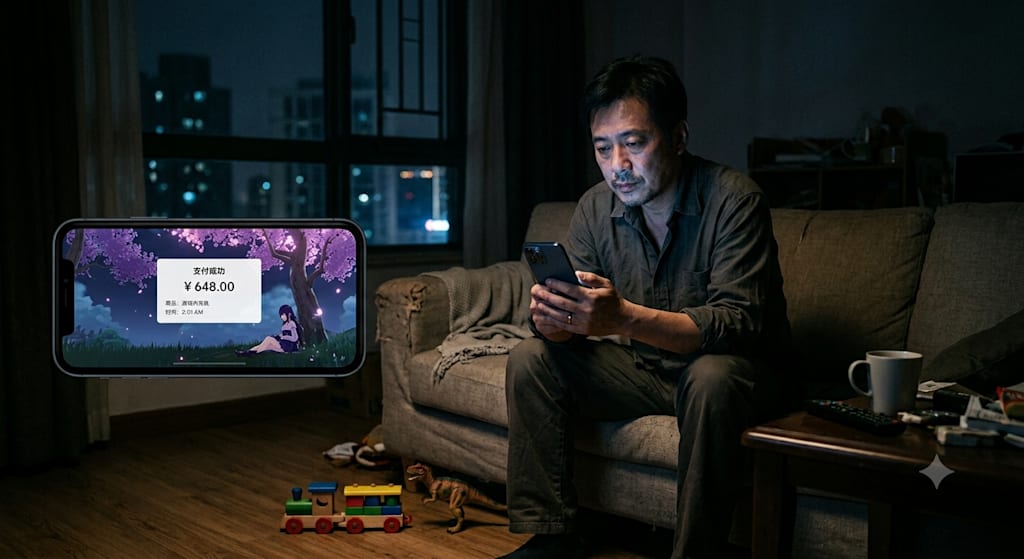
You know there’s someone out there, at 2 AM, after putting the kid to bed, after replying to emails, after washing the dishes, sitting on the sofa, opening their phone, and tapping a 648 pack.
They don’t tell anyone.
The screen lights up. Payment successful.
They put the phone down. And go to sleep.
About the Creator
Jin
Writer of reamstories
https://reamstories.com/jin
Enjoyed the story? Support the Creator.
Subscribe for free to receive all their stories in your feed. You could also become a paid subscriber, letting them know you appreciate their work.
Comments
There are no comments for this story
Be the first to respond and start the conversation.