fact or fiction
Is it a fact or is it merely fiction? Fact or Fiction explores the lesser known truths in the geek universe.
15 More Insane Human Facts You Probably Didn't Know — Part 5
Let’s continue the journey into how insanely impressive and strange the human body really is. From microscopic wonders to mental quirks, these 15 lesser-known facts will make you realize how much we still don’t understand about ourselves. --- **1. Your body produces a brand new stomach lining every 3–4 days.** This prevents your stomach from digesting itself due to its own acid — which is strong enough to dissolve metal. --- **2. Humans glow in the dark (but we can't see it).** Our bodies emit a tiny amount of natural light. Scientists captured this phenomenon using ultra-sensitive cameras, revealing we shine brightest around the face. --- **3. Your brain uses more energy than any other organ — about 20% of your total.** Despite weighing only 2% of your body mass, your brain is an energy monster, constantly active, even during sleep. --- **4. Every time you recall a memory, your brain rewrites it slightly.** Memories are not like video recordings. Each time you remember something, your brain modifies it — which means memories can change over time without you realizing it. --- **5. The strongest muscle relative to its size is your masseter (jaw muscle).** It can generate over 200 pounds of pressure. That’s why biting into something hard feels powerful — and why teeth grinding causes damage. --- **6. Your heartbeat syncs to music — literally.** When you listen to music, your heart rate and even your blood pressure adjust to the rhythm. Slow melodies calm you; fast ones energize you. --- **7. You shed around 500 million skin cells every day.** These dead skin cells float in the air and collect as dust. In fact, a significant portion of the dust in your home is actually you. --- **8. Your bones are stronger than concrete — ounce for ounce.** The femur (thigh bone) can resist thousands of pounds of force. Despite their strength, bones remain surprisingly light and flexible. --- **9. The human nose can remember up to 50,000 different scents.** Your olfactory system is connected to the emotional centers of your brain — which is why a certain smell can bring back childhood memories in an instant. --- **10. Humans are the only animals with chins.** No one really knows why. Evolutionary biologists are still debating the function of the chin — it’s one of the great unsolved mysteries of human anatomy. --- **11. You can survive without several major internal organs.** You don’t need your spleen, one kidney, gallbladder, appendix, one lung, or even parts of your liver or brain to survive. The body adapts in incredible ways. --- **12. Your blood makes a complete circuit of your body every minute.** That adds up to about 12,000 miles per day. Your heart never sleeps — it beats over 100,000 times every 24 hours to keep you alive. --- **13. Your pinky finger contributes to 50% of your hand’s strength.** It may look tiny and useless, but it plays a huge role in grip, balance, and coordination. --- **14. Your tongue print is as unique as your fingerprint.** Every person’s tongue has a one-of-a-kind pattern, shape, and texture. In the future, this could be used for biometric identification. --- **15. Your bones are constantly remodeling.** Over a 10-year period, your skeleton regenerates itself entirely. You’re walking around in a newer version of yourself without even realizing it. --- **Bonus Fact: Your eyes can distinguish up to 10 million colors.** Thanks to over 100 million photoreceptor cells in your retinas, your visual system is incredibly sensitive — even to subtle color changes others might not notice. --- **Final Thoughts:** The more we learn about the human body, the more incredible and mysterious it becomes. You are not just made of cells — you are made of miracles. From invisible light to bone regeneration, your body is performing high-level science every moment of your life. So next time you feel "ordinary," remember: You're literally glowing, regenerating, and syncing with music — without trying. **Stick around for Part 6 — we’re still just scratching the surface.**
By SHADOW-WRITESabout a year ago in Geeks
Who Was Jacob Waltz? The Mysterious German Immigrant Who Took the Secret of America’s Greatest Lost Treasure to His Grave
🏜️ A Name Written in Gold — and Shadows He was born Jacob Waltz, but the world remembers him as "The Dutchman." And more than 130 years after his death, the name still echoes through the desert canyons of Arizona, whispered by treasure hunters, conspiracy theorists, and local legends alike.
By Rukka Novaabout a year ago in Geeks
Legend of the Superstition Mountains: How the Cast Got Rich Chasing a Treasure They Never Found
🏜️ The Gold May Be Lost — But the Real Fortune Was in the Mystery In the blazing heart of Arizona, just east of Phoenix, the Superstition Mountains loom like jagged sentinels. The name alone conjures images of ancient curses, spectral wanderers, and most famously — the Lost Dutchman’s Gold Mine.
By Rukka Novaabout a year ago in Geeks
Film Discussion: In the Heart of the Sea (2015). Content Warning.
I don't often watch films anymore. I just can't find the time but when a stretch does present itself, I like to immerse myself in someone else's vision for a while. Last night, it was Ron Howard's turn to present, in the highly esteemed theatre known as my lounge, his cinematic creation In the Heart of the Sea.
By Rachel Deemingabout a year ago in Geeks
The Quantum Vows
The screen flickered softly in the dimly lit apartment, illuminating Nora’s glasses with strings of code. Somewhere across the city, a parallel window glowed in Leo’s room, syncing byte by byte. They were writing a program that didn’t just run on hardware—it pulsed through their hearts. It all started on an obscure forum where quantum programmers geeked out over Qubit theory and time-entangled algorithms. Nora had posted a puzzle—a theoretical program that could store emotional states and replay them as real-time simulations. It was a thought experiment, a poetic idea more than a practical one. But Leo responded with 300 lines of code that actually worked. That thread turned into direct messages. Then video calls. Then midnight coffee shared across time zones. They never said the word "love," but it was encoded into every laugh, every finished sentence, every variable name they left for each other: nora_heart, leo_soul, forever_loop. Months passed. Their lives outside their screens blurred. Nora was a robotics engineer by day, and Leo freelanced cybersecurity fixes for startups. But their real work—the thing that made their hearts race—was Project Vow. They envisioned a wearable neural link that could translate their thoughts and feelings into encrypted quantum packets, store them, and even transfer them. An emotional time capsule. They wanted to “quantify connection”—to prove that love could be measured, transferred, and never lost. “Why do we do this?” Nora once whispered into her mic as she stared at the sunrise through her window. Leo had smiled, fingers pausing above his keyboard. “Because I don’t want to forget what love feels like. Not even for a second.” On their one-year virtual anniversary, they met in person for the first time—at DEFCON, of all places. Two geeks surrounded by hackers and surveillance jokes, exchanging the most heartfelt handshake of their lives. They laughed over cold pizza and soda and then found a quiet hallway. Their first kiss was shy, electric, and awkward enough to make them both giggle. Then came the breakthrough. With a quantum-ready chip Leo had been experimenting on, and a neural-signal decoder Nora had been building for her lab’s robot empathy project, they actually synced a single emotional state. It was joy. Pure joy. Amplified, encoded, then mirrored. They cried. Together. Then they saved the moment, labeling it vow_entry1. Over the next six months, they refined it. They didn’t need words anymore. They could send affection, calm, safety, and even nostalgia. It wasn’t perfect. The bandwidth was limited. Sometimes signals corrupted. Once, Leo received a packet Nora had meant to delete—her feeling of fear after nearly getting into a bike accident. It rattled him, but also made him realize how connected they truly were. Then the diagnosis came. Nora’s neural scans showed early signs of a rare degenerative brain condition—one that would erase memory over time. Her doctor said she might have a few years of clarity left. Maybe five. Maybe less. She wanted to give up Project Vow. Said it was foolish to keep chasing permanence when her own mind wouldn’t last. Leo refused. “Then we finish it now,” he said. “Not for tomorrow, but for today. I want you to feel everything we’ve built, every line of code, every heartbeat we shared—even when memory fades.” And so, they built the final version of Vow. On the day of their wedding—held on the rooftop of a co-working space, surrounded by friends in VR headsets and family waving from screens—they wore the final version of the device. Their vows weren’t spoken. They were felt. Everyone watched as Nora and Leo stood silently, eyes closed, hands intertwined. The device blinked once, green. Then again. Nora gasped. Leo smiled. The guests erupted into cheers, some confused, most deeply moved. No one quite understood the tech behind it, but they felt the emotion ripple like a pulse through the air. Years later, after Nora’s memory began to fail, Leo still sent her love—packets of encoded laughter, joy, and calm. She’d forget who he was, but she would smile when she received a signal. Sometimes, she even whispered, “Leo,” without knowing why. When she finally passed, Leo uploaded their complete sequence to the cloud—a final tribute labeled QuantumVows_Complete. He now teaches emotional computing to new programmers, telling them their most powerful tool isn’t the quantum chip, but the human heart behind it.
By Syed Kashif about a year ago in Geeks
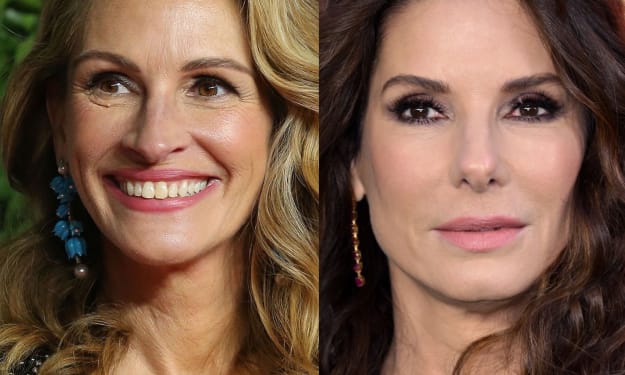
Julia and Sandra. AI-Generated.
Julia Roberts and Sandra Bullock are two of Hollywood’s brightest stars—each with an Oscar, a box office legacy, and more charm than a red carpet can hold. They've led some of the most iconic films of the last 30 years, from Pretty Woman to The Blind Side, and they've built careers on relatability, charisma, and a unique ability to carry entire movies on their backs.
By Travis Johnsonabout a year ago in Geeks