
Page to Screen: Hermione Granger & Ron Weasley
Analysing the portrayal of these "Harry Potter" characters on screen

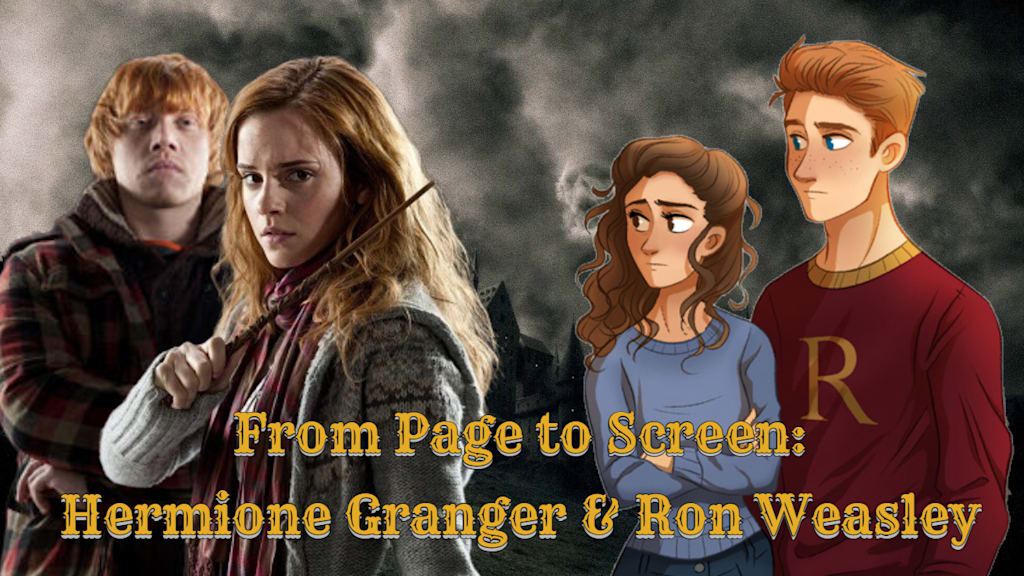
The Harry Potter films brought J.K. Rowling’s characters to life for millions of viewers, but adapting seven books into eight films inevitably meant that some characters, relationships, and storylines were changed. Among the most noticeable changes are those made to Ron Weasley and Hermione Granger.
Although Rupert Grint and Emma Watson gave memorable performances, the film versions of Ron and Hermione are significantly different from their literary counterparts. The books portray them as complementary equals, with very different strengths and weaknesses. The films, however, gradually make Hermione more capable and central while reducing many of Ron’s most important qualities. As a result, the balance between the three members of the central trio changes considerably.
Hermione Granger: From Flawed Genius to Almost Perfect Heroine
In the books, Hermione is undoubtedly one of the cleverest students at Hogwarts. She is exceptionally hardworking, knowledgeable, and determined. However, her intelligence does not make her perfect. In fact, many of her flaws are an important part of what makes her character interesting.
Book Hermione can be bossy, judgmental, anxious, and socially awkward. She often relies heavily on what she has read rather than trusting her instincts, and there are several occasions when she panics because she does not immediately know the answer to a problem.
One of the clearest examples occurs in Harry Potter and the Philosopher's Stone. When the trio encounters Devil's Snare, Hermione correctly identifies the plant but becomes frightened because she cannot immediately remember how to deal with it. Ron, meanwhile, points out the practical solution: they need to make a fire. The scene establishes an important difference between them. Hermione's strength is academic knowledge, while Ron is often better at thinking practically in the moment.
The films reduce many of Hermione's weaknesses. Emma Watson's Hermione is generally more confident, composed, and heroic, particularly in dangerous situations. This makes her an appealing character, but it also removes some of the imperfections that made book Hermione feel human.
More importantly, the films sometimes give Hermione moments that originally belonged to Ron. A notable example occurs in Harry Potter and the Prisoner of Azkaban. In the book, Ron—despite having a broken leg—places himself between Harry and Sirius Black and declares that Sirius will have to get past him to reach Harry. It is an important demonstration of Ron's loyalty and courage. In the film, Hermione takes on much of this dramatic role instead.
This reflects a larger pattern: Hermione is not simply adapted from the books; she is sometimes given qualities that belonged more strongly to Ron.
Ron Weasley: From Essential Friend to Comic Relief
The differences between the book and film versions of Ron are even more significant.
Film Ron is funny, lovable, and often entertaining, but the books give him considerably more depth. He is not merely Harry's comic best friend. He possesses forms of intelligence that are different from Hermione's, and these qualities are essential to the trio.
Ron has an extensive knowledge of the wizarding world because he grew up in it. He understands its traditions, customs, magical creatures, and prejudices in ways that Harry and Hermione sometimes do not. He is also an excellent strategist.
The chess sequence in Philosopher's Stone is perhaps the clearest symbol of Ron's role in the trio. Hermione has the academic knowledge, Harry possesses instinct and courage, and Ron provides strategy. Each character contributes something different, and the trio succeeds because those strengths work together.
Ron is also much braver than the films sometimes make him appear. His insecurity is an important part of his personality, particularly because he constantly compares himself with his successful brothers and with Harry. However, the books repeatedly show him overcoming those insecurities.
His bravery is especially significant because it is not always effortless. Ron is sometimes frightened, but he acts anyway. That makes his courage meaningful.
The films increasingly emphasise his comic side instead. Rupert Grint was exceptionally good at comedy, and the filmmakers understandably made use of that strength. However, the result is that Ron's intelligence, strategic ability, emotional insight, and courage are often pushed into the background.
This becomes particularly important when moments of information or decision-making that originally highlighted Ron are reduced or given to Hermione. The cumulative effect is that viewers who know only the films can reasonably wonder why Harry needs Ron when Hermione often appears capable of solving almost every problem.
The books provide a much clearer answer. Harry needs Ron because Ron brings something neither Harry nor Hermione possesses.
Three Different Kinds of Intelligence
The original trio works so well because the books give each character a distinct role.
Harry represents instinct, determination, and courage. Hermione represents knowledge, logic, and academic intelligence. Ron represents strategy, practical knowledge, emotional grounding, and an understanding of the wizarding world. None of them is supposed to be the "best" of the three. They are strongest when they work together.
The films gradually blur this distinction. Hermione increasingly becomes the character who provides knowledge, practical solutions, courage, and emotional maturity, while Ron is left with a greater share of the comic-relief role.
This is not simply a question of making Hermione more intelligent. The more important change is that the trio's different forms of intelligence become less distinct. When Hermione repeatedly provides the answer, the practical solution, or the moment of courage, Ron loses some of the qualities that made him necessary to the group.
The change is subtle when viewed across eight films, but it becomes much more obvious when the books and films are compared directly.
How the Changes Affect Their Relationship
These changes also affect Ron and Hermione's relationship.
In the books, their relationship develops from constant arguments and irritation into genuine friendship and eventually romance. Their arguments work because they have fundamentally different ways of looking at the world.
Hermione tends to approach problems through knowledge, rules, and logic. Ron is more likely to consider practical realities, emotions, and the way ordinary wizards actually behave. They frustrate each other, but they also complement each other.
The films retain the arguing and romantic tension, but because Hermione is portrayed as more consistently competent and Ron as more frequently incompetent or insecure, their relationship can feel less balanced.
The book relationship is essentially one between two very different people who gradually discover that their differences make them stronger together. The film relationship can sometimes appear to be between the brilliant Hermione and the funny, insecure Ron.
That is a significant difference because the romance works best when both characters bring something valuable to the relationship.
The Importance of Their Flaws
Another important difference between the books and films is how they treat the characters' flaws.
Book Hermione can be unpleasant. She can be stubborn, insensitive, and overly confident in her own judgment. These characteristics do not make her a worse character; they make her more human.
Likewise, book Ron can be jealous, insecure, immature, and occasionally cowardly. But his character arc is partly about learning to overcome those weaknesses. His moments of courage have greater impact because they come from someone who is capable of being afraid.
The films soften many of Hermione's flaws while often emphasising Ron's. Hermione therefore appears increasingly close to an ideal hero, while Ron's shortcomings become more visible.
Ironically, this can make Ron's character development less satisfying on screen. His eventual moments of bravery and maturity have less groundwork because many of the qualities that established his importance have already been reduced.
The Steve Kloves Effect
Steve Kloves, who wrote the screenplays for seven of the eight Harry Potter films, has openly spoken about Hermione being his favourite character, and his preference can arguably be seen in the way she is written on screen.
Hermione is consistently given some of the strongest dialogue, most memorable moments, and most impressive demonstrations of intelligence and courage. At times, she is also given qualities that belonged more strongly to Ron in the books, particularly his practical thinking, bravery, and ability to solve problems.
None of this proves that Kloves deliberately diminished Ron. However, his affection for Hermione is significant when considered alongside the cumulative effect of these choices. The screenplays repeatedly make Hermione more capable and impressive while reducing some of the qualities that established Ron as an equal member of the trio.
The books allow Hermione to be brilliant but flawed, while Ron provides qualities she lacks. The films increasingly make Hermione the character who has the answer, which changes the balance between the trio and makes Ron appear less capable than his literary counterpart.
Conclusion
The difference between book Ron and Hermione and their film counterparts ultimately comes down to balance.
Book Hermione is brilliant but flawed. Book Ron is insecure but intelligent, strategic, knowledgeable, and brave. Their differences are precisely what make their friendship—and eventually their romance—work.
The films make Hermione more confident and heroic while reducing many of Ron's strengths and emphasising his role as comic relief. In doing so, they redistribute some of the trio's qualities, making Hermione appear to possess characteristics that originally belonged more strongly to Ron.
The result is a trio that works differently on screen than it does on the page. The books suggest that Harry, Ron, and Hermione succeed because none of them can do everything alone. The films sometimes give the impression that Hermione can do almost everything, Harry is the hero, and Ron is there to make them laugh.
Revisiting the books through the Audible full-cast audiobooks has made me hopeful for the new HBO series. Hearing these characters brought to life again has reminded me just how much depth there is to Ron and Hermione as individuals, and how important their differences are to the trio as a whole. I hope the new adaptation allows Hermione to retain her flaws as well as her brilliance, while giving Ron the intelligence, courage, strategic thinking, and emotional depth that made him such an essential part of the story. The series has the opportunity to spend far more time with these characters than the films could, and hopefully that will allow Ron and Hermione to feel like the complementary equals they were in the books. Most of all, I hope the new adaptation remembers that Harry, Ron, and Hermione work so well because none of them can do everything alone.
About the Creator
Ted Ryan
Screenwriter, director, reviewer & author.
Ted Ryan: Storyteller Chronicles | T.J. Ryan: NA romance
Socials: @authortedryan | @tjryanwrites | @tjryanreviews
Enjoyed the story? Support the Creator.
Subscribe for free to receive all their stories in your feed. You could also become a paid subscriber, letting them know you appreciate their work.
Comments
There are no comments for this story
Be the first to respond and start the conversation.