
Hongguo Beat Doubao. That Doesn’t Mean AI Lost.
A short-drama app just passed a 4-billion-user AI assistant. The real signal isn’t that AI is useless. It’s that most people don’t want to open a chatbot and write a prompt.
QuestMobile’s September 2026 data puts Hongguo Free Short Drama at 430 million monthly active users and Doubao at 419 million. Hongguo leads by about 11 million, or 2.6%. At the 400-million-user level, that is not an overwhelming victory. The two apps are still in the same tier.
The sharper number is time spent. Short-drama video added 13.329 billion hours of usage. Short video added 5.717 billion hours. AIGC added 978 million hours. The short-drama increase is about 13.6 times the AIGC increase. Doubao users average 72 sessions and 132.5 minutes per person per month, which comes to roughly 4.4 minutes a day. For an AI app with more than 400 million monthly users and ByteDance’s backing, that is how long users actively spend inside it each day.
The data does not show that AI is useless. It shows that ordinary people’s demand for actively opening a general-purpose AI assistant, carefully framing questions, and using it often has been overestimated.
1. Hongguo and Doubao compete for different things
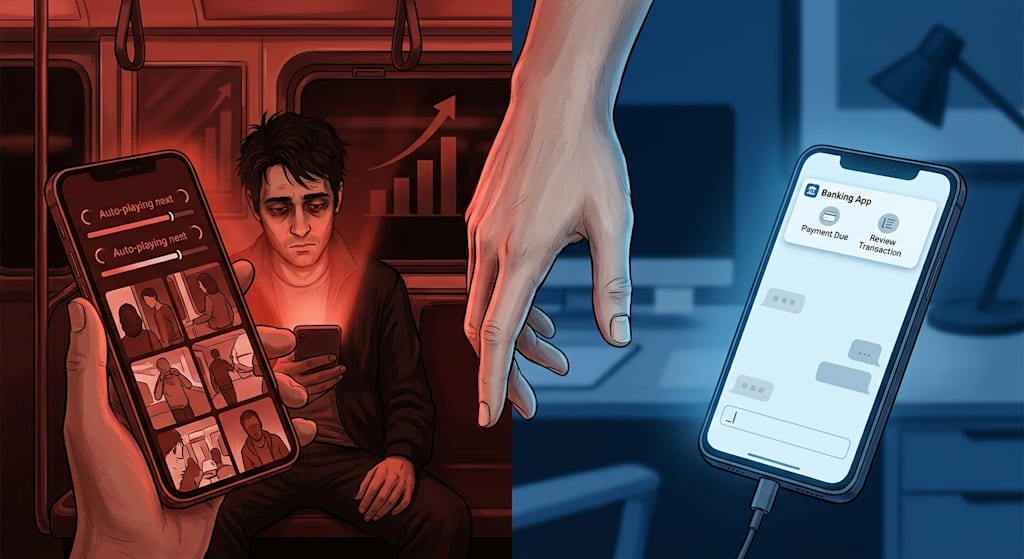
At ten p.m. on the subway, a commuter leans against the gangway and scrolls Hongguo. He does not need to know what he wants to watch. The feed decides for him. A swipe moves the plot forward. A twist arrives every few minutes. An emotional peak arrives every ten minutes. He has no clear goal and no problem to solve.
If he opens Doubao at the same hour, he faces a blank dialog box. He has to know what he wants: analyze a bill, write a leave-request email, look up a policy. Then he has to explain the question, supply context, judge the answer, and follow up if something is wrong. Today’s models can handle vague language. They cannot remove that cognitive work.
Hongguo needs eyes and a little boredom. Doubao needs a goal, language, and judgment. Hongguo can be triggered passively. Doubao requires an active start. One gives immediate emotional reward. The other asks users to spend cognitive effort first.
For someone who works eight hours, commutes, cooks, cares for children, scrolls on a phone, and sleeps, how many tasks require opening Doubao, writing a careful prompt, and asking a model to analyze them? Some do. Not as many as the industry imagines. Registrations can be huge without producing sustained, high-value habits. Heavy users treat AI as a productivity tool and an extension of their thinking. Light users treat it as an upgraded search engine for weather, facts, and the occasional image.
Hongguo does not require a goal. A person can have no AI problem to solve and still want entertainment when tired and bored. The mass-market outcome was not hard to predict.
2. MAU and usage time cannot measure AI’s value
Ten hours of short dramas produce ten hours of entertainment utility. Ten minutes of AI can finish a report, fix code, or process a batch of data and produce a large productive return. The more valuable AI is, the less time a user may need to spend on the same task. Solving a problem in two minutes shows product strength. It does not show that the product is unimportant.
Doubao’s lower usage time does not prove that AI has low value. Entertainment apps compete for attention. Productivity tools compete for tasks, workflows, and delivered results. An agent invoked ten times a month can save a company hundreds of thousands of yuan in labor. Its business value may exceed that of a chatbot with a large free user base.
The AI industry cannot copy the MAU, DAU, and time-spent logic of the mobile internet. For AI products, willingness to pay, retention, task completion rate, and economic value per task may matter more than monthly users. Hongguo wins in the attention market. It does not win in AI’s task market. The two markets need different rulers.
3. The dialog box leaves too much work to users
The AI industry has a long-standing misjudgment: it treats ChatGPT-style conversation as the final form of AI adoption.
The dialog box is powerful, but it leaves too much work to users. Users must identify the need, describe the problem, provide context, judge the output, and often carry the result into the real world. For professional users, that is leverage. For ordinary people, it is a threshold. If the technology is intelligent, why does the user still have to teach it how to do the job?
An ordinary person may not want to open AI and ask it to analyze his finances from income, spending records, and family details. But if a banking app flags unusual spending, explains bill changes, points out wasted money, and offers executable options, he may use it. He may not want AI to plan a trip. But if booking, hotels, itineraries, changes, and transfers are compared and handled automatically, he has no reason to refuse. He may not care whether the short drama he watches is AI-generated. He cares whether it is good and cheap.
Users buy results, not intelligence. For most people, the ideal AI may be one they never open, never prompt, and never recognize as AI. No one today cares how a phone’s database works or which algorithm its video codec uses. The technology has already disappeared into the service.
QuestMobile also reports that native AI apps reached 546 million monthly users, up 82.1% year on year. Demand is growing. The growth may not look like everyone opening a chat box every day. It may look like AI becoming the default capability behind every app, workflow, and consumer service. The most successful consumer AI may never be treated as AI at all.
4. The productivity dividend is splitting
AI can generate productive returns in a way short dramas cannot. Those returns depend on the user’s existing knowledge, goals, and judgment.
Someone with system design, engineering, financial modeling, or business analysis skills can use AI to do the work of many people. He knows how to break down a problem, check the output, spot a hallucination, and ask the next question. His existing knowledge becomes leverage.
Someone else can have the same model for free and still get little economic value from it. He has no clear task, no defined goal, and no way to judge the answer. More capable agents may eventually plan tasks, collect information, and execute for him. For now, the productivity dividend depends heavily on what the user already knows, what he is trying to do, and where he works.
Two opposite outcomes can emerge. A small group uses AI to multiply its productivity. A much larger group uses AI to get cheaper, richer, more personalized entertainment. One group produces. The other consumes. Both needs are real. Their economic value, business models, and social effects are not.
5. Do not mistake technical capability for usage habit
The internet’s early promise was free knowledge, abundant information, and universal learning and creation. Decades later, the technology has delivered much of that. An ordinary person can access more knowledge for free than a leading scholar could a century ago. Then what? People spend six or seven hours a day on short videos, livestreams, gossip, and short dramas. Technology lowered the cost of knowledge. It did not raise the desire to seek it.
AI is repeating the pattern. Giving everyone a theoretically omniscient assistant does not give everyone a sudden appetite for learning, creating, and research. Technology can change production functions, content supply, and the limits of tools. It cannot凭空 change everyone’s interests, goals, and habits.
Hongguo passing Doubao is a reminder. Ordinary people’s high-frequency demand for actively using a general-purpose AI assistant has been overestimated. AI’s demand for embedding in scenarios and completing tasks for people has barely been tapped. AI will spread into every app, workflow, and consumer service. That does not mean everyone will become a heavy active AI user.
At eleven p.m., Hongguo plays the next episode automatically. Another person opens Doubao. The box says, “How can I help you?” He looks at it for a few seconds, exits, opens his banking app, dismisses an unusual-spending alert, and switches back to the short drama. The screen dims. He plugs in the charger.
About the Creator
Jin
Writer of reamstories
https://reamstories.com/jin
Enjoyed the story? Support the Creator.
Subscribe for free to receive all their stories in your feed. You could also become a paid subscriber, letting them know you appreciate their work.
Comments
There are no comments for this story
Be the first to respond and start the conversation.