
Hollywood Is No Longer Human: How AI Is Rewriting the Rules of the Movies You Love
From digital actors to algorithm-written scripts, the silent revolution that's forever changing how movies are made
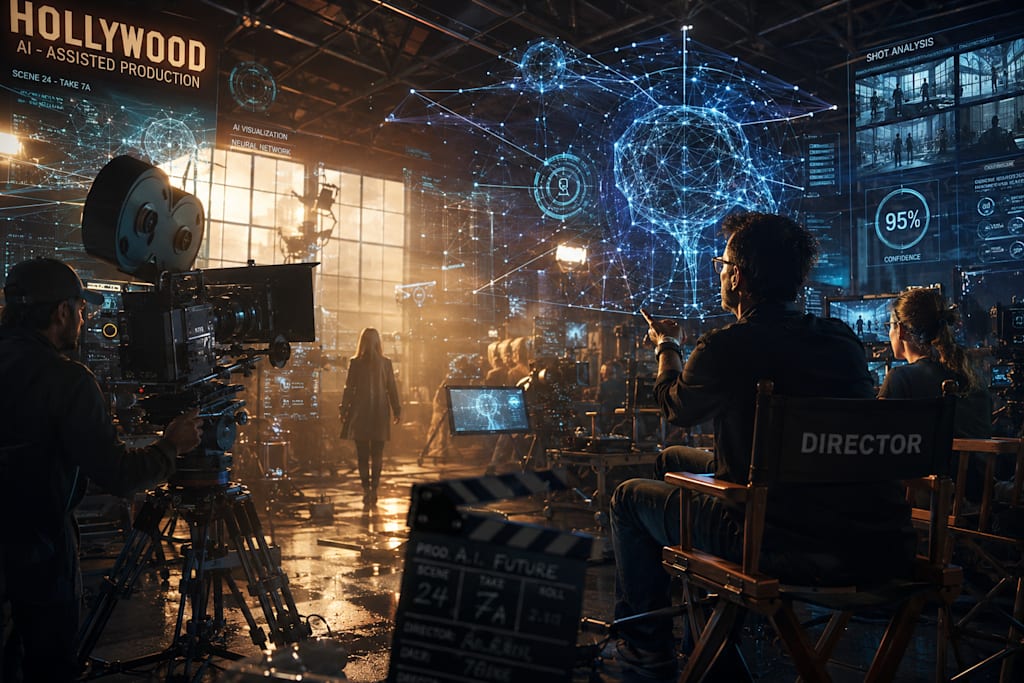
Do you remember the last time you watched a movie and thought, "that looked incredibly real"? There's a good chance what you were seeing didn't even exist. It wasn't a physical set. It wasn't a flesh-and-blood actor. It was artificial intelligence working its magic behind the scenes, and you probably didn't even notice.
Welcome to the new Hollywood, where the lines between real and digital have become so blurred that even experts struggle to tell them apart. And this is just the beginning.
## The Silent Revolution That Changed Everything
There was a time when special effects meant miniature models, prosthetic makeup, and clever camera tricks. Spielberg used a malfunctioning mechanical shark to film "Jaws." George Lucas built scale models for Star Wars spacecraft. Those days feel prehistoric now.
Artificial intelligence has infiltrated every aspect of film production in ways most viewers never imagine. When you see a crowd of thousands in an epic battle, they're probably just a few dozen extras multiplied by intelligent algorithms. When you admire an impossibly beautiful alien landscape, it may have been generated entirely by neural networks.
But the transformation goes far beyond visual effects. AI is writing dialogue, composing soundtracks, editing trailers, and even deciding which movies should be produced in the first place. Netflix, for example, uses artificial intelligence algorithms to analyze the viewing patterns of millions of users and predict what type of content will succeed before investing a single dollar in production.
## Actors Who Never Age (Because They Never Existed)
This is where things get really interesting for film fanatics. Deepfake technology and generative artificial intelligence have reached a point where creating photorealistic digital actors is no longer science fiction.
Remember young Luke Skywalker's return in "The Mandalorian"? That wasn't Mark Hamill from the 1980s magically transported to the present. It was a combination of a body actor, AI-powered facial de-aging technology, and months of digital refinement. The result was so convincing that millions of fans cried with nostalgia without questioning what they were seeing.
But this raises fascinating and somewhat unsettling questions. If we can digitally recreate any actor at any age, what does that mean for the future of acting? We've already seen Peter Cushing "perform" in "Rogue One" years after his death. James Dean, who died in 1955, is scheduled to star in a new film thanks to artificial intelligence.
Studios can now potentially hire a deceased star's image, de-age veteran actors for action roles, or even create completely synthetic celebrities who never need rest, never have scandals, and never ask for raises.
## The Invisible Screenwriter: AI Writing Stories
Here's something that might surprise you: it's very likely that some of the movies you've watched recently had some level of artificial intelligence intervention in their screenplay.
We're not talking about robots writing complete cinematic masterpieces (yet). But AI tools like ChatGPT and its entertainment-specialized competitors are being actively used to generate story ideas, write first drafts of scenes, create dialogue for secondary characters, and overcome creative blocks.
Some screenwriters use them as brainstorming assistants. Others employ them to analyze narrative structures of successful films and apply those patterns to new projects. Studios use them to evaluate scripts and predict their commercial potential before greenlighting production.
The Hollywood writers' strike of 2023 had artificial intelligence as one of its central points of conflict. The screenwriters weren't fighting against robots that wanted to take their jobs (not exactly). They were fighting to establish clear boundaries on how and when studios could use AI in the creative process, and to ensure that humans maintained control and credit for creative work.
## Visual Effects: Where the Magic Really Happens
If there's one area where artificial intelligence has proven genuinely revolutionary, it's in visual effects. And as a film fan, this should excite you.
Traditionally, creating convincing visual effects required armies of artists working for months on each frame. A single second of film contains 24 frames. A two-hour movie has more than 170,000. Making each one look perfect was a brutally slow and expensive process.
AI has fundamentally changed this equation. Machine learning algorithms can now:
Automatically remove wires and equipment from action scenes—a process that used to take hours per shot. Generate complete backgrounds and environments based on text descriptions or reference images. Animate realistic facial expressions on digital characters by learning from recordings of real actors. Enhance the resolution of old footage, allowing cinema classics to look better than ever.
The result is that modest-budget films can now achieve visual effects that a decade ago would have required a Marvel blockbuster budget. This is democratizing cinema in ways that directly benefit more diverse and daring stories.
## The Dark Side: Legitimate Concerns About the Future
Not everything is excitement and brilliant possibilities. The integration of artificial intelligence in Hollywood comes with serious concerns that deserve honest discussion.
The employment issue is the elephant in the room. Every task that AI can automate is potentially a human job at risk. Visual effects artists, editors, library music composers, background actors... many film professions face an uncertain future.
Then there's the question of image rights. If a studio can digitally recreate any actor, who owns that image? Can they use your face without permission if you appeared as an extra in a movie twenty years ago? Current laws aren't prepared to answer these questions.
Originality also orries many creatives. If AI learns from existing films to create new content, aren't we doomed to an infinite cycle of derivatives? Can an algorithm truly innovate, or can it only recombine what already exists?
And finally, there's the misinformation problem. The same technology that can de-age Luke Skywalker can create fake videos of politicians saying things they never said. Hollywood is perfecting tools that have implications far beyond entertainment.
## What's Coming: Predictions for the Next Decade
Based on current trends and the pace of artificial intelligence development, here are some predictions about where Hollywood is headed:
Personalized movies will be possible. Imagine watching a version of your favorite film where the protagonist has your face, or where the story adapts to your personal preferences. The technology for this already exists in primitive forms.
Virtual actors will win awards. Within this decade, we'll see AI-generated performances that are indistinguishable from human ones. This will force the Academy to decide whether an algorithm can win an Oscar.
Film production will be radically democratized. Independent filmmakers will be able to create studio-quality movies using accessible AI tools. This could result in an explosion of creativity... or an avalanche of mediocre content.
An "organic" movement will emerge in cinema. Just as organic food exists, there will be films marketed as "100% human-created," attracting audiences who value authenticity.
## Embracing the Future Without Losing the Magic
As film fanatics, we're living through a historic moment. Artificial intelligence is transforming Hollywood in ways that would have seemed impossible just a decade ago. Some of these transformations are exciting, others are concerning, and many are both things simultaneously.
The important thing to remember is that technology is a tool. Cinema has always been about telling stories that move us, make us think, and connect us with experiences beyond our own lives. If artificial intelligence can help tell those stories in new and powerful ways, we should celebrate it.
But we must also insist that humans remain at the center of the creative process. The best movies aren't just technically impressive; they're deeply human. And that's something no algorithm can truly replicate.
The next time you sit in a movie theater or settle into your couch to watch a film, remember that you're witnessing the result of an increasingly complex collaboration between human creativity and artificial intelligence. The future of cinema is already here, and it's more fascinating than any screenwriter could have imagined.
What do you think about AI in cinema? Does it excite you or concern you? The conversation is just beginning, and your voice as a film fan matters more than ever.
About the Creator
ELIAS PULIDO
Storyteller by necessity. The best stories don't live in headlines — they live in the details nobody notices. I write about people, ideas, and the moments when the world shifts direction. Sometimes without anyone realizing it.
Enjoyed the story? Support the Creator.
Subscribe for free to receive all their stories in your feed.
Comments
There are no comments for this story
Be the first to respond and start the conversation.