
History of The Three Stooges (Part VII: The Original Rebooters - 1952-1954)
The early 1950s saw the Stooges in many remakes and some historic shorts, coming after a tragic time in their lives

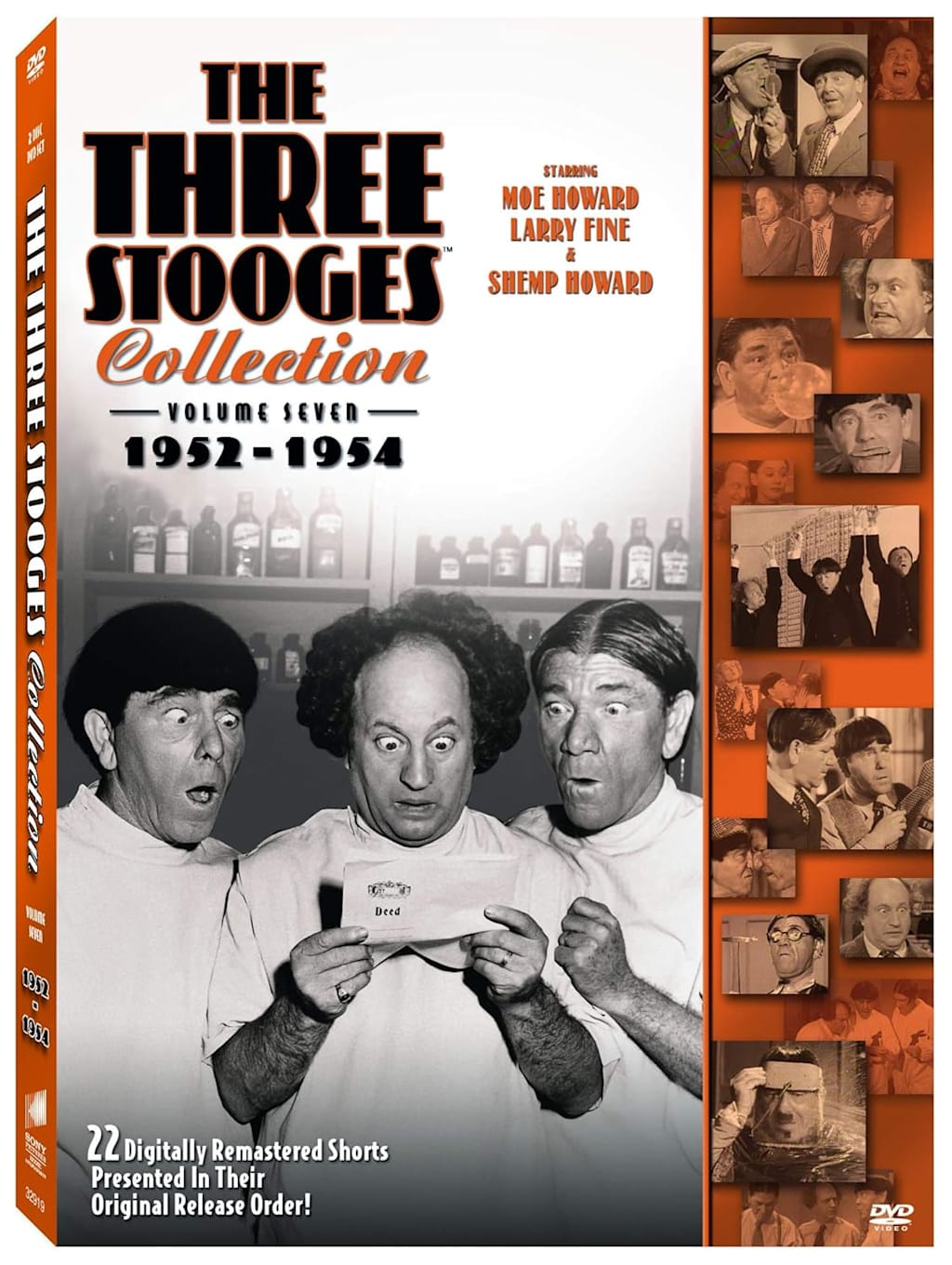
As the 1940s ended and the 1950s began, The Three Stooges were really coming into their own with Shemp Howard, Larry Fine, and Moe Howard as the trio for the second time. The trio found themselves in more shorts involving crime, the Wild West, and romance as time went by, and the evolution would continue as the 50s progressed. The Stooges would enter a period of many changes and some historic firsts.
It was also a tragic period for the Stooges:
Farewell, Curly

On January 18, 1952, Jerome Lester Horwitz, known to all as Curly Howard, passed away at the young age of 48. The youngest of five sons (including Shemp and Moe) from Jenny and Solomon Horwitz, Curly had been riddled with health problems as early as around 1942-43, and they increased in early 1945 when he suffered his first mini-stroke. Following a series of mini-strokes for over a year, Curly suffered a massive stroke on May 6, 1946 while filming what would be his final short as a Stooge, Half-Wits Holiday.
Curly managed to film a brief cameo in 1947's Hold That Lion!, putting him on-screen with brothers Shemp and Moe, and their longtime friend Larry Fine. He filmed another cameo that was intended to be featured in 1949's Malice in the Palace, but his declining health resulted in his scenes being cut. Curly suffered two more strokes; one in 1949 and a final one in 1951. He is forever remembered, and will continue to be remembered, as the greatest of the Stooges by far.
As for the shorts:
1952

1952 saw more Curly shorts get the Shemp treatment, starting with my favorite from that year, A Missed Fortune. This short was a remake of 1938's Healthy, Wealthy, and Dumb, with Shemp in Curly's role as the Stooge who wins a $50,000 cash prize. And similar to the original, the Stooges' time in luxury sees them deal with a large bill and three women looking to get their fortune. To this day, I still say that Listen, Judge was a tribute to Curly. For one, it was the first short released following Curly's passing, and secondly, the short borrowed from three Curly classics: A Plumbing We Will Go (courtroom opening), They Stooge to Conga (the repair scenes), and An Ache in Every Stake (the party scenes). The result was one amazing and hilarious short with a lot of awesome gags that were performed very well by the trio.
Next up was Corny Casanovas, which had the Stooges preparing for their fiancées, only to find out that they're engaged to the same conniving woman. This short featured the Stooge debut of actress Connie Cezon, who almost always played villainesses in Stooges films, and this short was no different. He Cooked His Goose was a very interesting one, as this was the first short that truly individuated the Stooges. This short mostly centered on Larry, the owner of a pet shop who is also a big time flirt. His main target is Shemp's fiancée, Millie, though it's also revealed that he's carrying on with Moe's wife, Belle. Oh boy! This short featured another Stooges debut: Diana Darrin, who appeared as Larry's secretary, Miss Lapdale, and is one of the very few surviving Stooge actors. In contrast, this was Mary Ainslee's final Stooges appearance; her appearances were few but memorable, beginning with 1941 shorts I'll Never Heil Again and In the Sweet Pie and Pie. She later appeared in 1949's Hokus Pokus as villainess Mary, and she takes on another heel role as the adulterous Belle.
Gents in a Jam had the boys facing eviction, until they use the visit of Shemp's uncle, wealthy Phineas Bowman, to convince their landlady to let them stay. The short was the final one to be directed by the legendary Edward Bernds, who had been one of the main directors since 1945. Bernds left Columbia Pictures after they dismissed longtime producer Hugh McCollum, leaving Jules White as the lone director. Three Dark Horses featured the Stooges being used by a pair of crooks to back their corrupt political candidate, but they do back the opponent after realizing what was up. The year ended with an odd entry, Cuckoo on a Choo Choo, which featured Larry and Shemp in a purloined railway car with two sisters, Lenore and Roberta. Larry is with Lenore and wants to marry her, but Lenore is insistent that Shemp has to marry Roberta first. However, Shemp only has eyes for Carrie, a canary that Shemp sees when he's had one too many. As for Moe, he plays a detective on the case of the stolen car, and also had his own designs on Roberta. This was another one that kinda individuated the Stooges, and I've read that a lot of fans don't like this one, but Larry actually listed this short among his favorites.
1953

1953 was a very interesting year for the Stooges, and it kicked off with Up in Daisy's Penthouse, which is a remake of 1937's Three Dumb Clucks. Mostly similar to the original, the boys discover that their father (Shemp in a dual role) is getting married to a young blonde (the titular Daisy), and they rush to prevent that wedding, especially when it comes out that Daisy's part of a gang that plans on doing Shemp Sr. in. I said "mostly similar" because the original had the Stooges in jail and breaking out after hearing about the news. In the remake, the boys are at home and informed by their mother.
The short was followed by a trio of shorts that I like to call the "Hold That Lion! trilogy," which began a habitual tactic by Jules White: using past footage of older Shemp shorts and making them into new shorts. First, Booty and the Beast begins with a crook attempting to break into a house, which the Stooges stop in front of. The trio is later tricked by the crook (Kenneth MacDonald) into breaking into the house and blowing up the safe, and after he gets away, the Stooges learn that the guy was a crook and they have to catch him before they end up taking the rap for his crime. McDonald being cast allowed White to use the second half of Hold That Lion! in this one (including the scene with Curly). Though, they had to dub any dialogue that referred to McDonald's character, because he's nameless in this one. The funniest bit of dubbing came after the Stooges run off after dealing with a lion, and the character emerges. In the original, Moe says, "Hey, it's Slipp!" In the remake:
"Hey, it's him (the "him" uttered by 1953 Moe sounding quite deadpan)."
Loose Loot was an actual remake of Hold That Lion!, with the first half of that short being used to set up the newer short's setting, the Stooges chasing Icabod Slipp to a theater. Slipp has a henchman in this, played by Tom Kennedy, who has appeared in some of Shemp's solo shorts. The "trilogy" was rounded out by Tricky Dicks, which has the Stooges as detectives working a serious murder case. The funniest attribute of the short is the loudly ringing phone, which Moe always answers angrily. We get another Stooge debut in this: Benny Rubin, who appeared in quite a few Stooge shorts after this one. Oh, and the reason why this is part of the trilogy: it uses the one piece left from Hold That Lion!: the drawer scene.

History was made on June 15, 1953, when Columbia Pictures released Spooks!, the very first Stooge short to be released in 3-D. 1953 was the year for 3-D releases, as Woody Woodpecker, Popeye, and Bugs Bunny had shorts released in 3-D that same year. Regarding this short, the Stooges were detectives again, this time taking the case centered on Mary Bopper, who was kidnapped and held captive by mad scientist Dr. Jekyll and his henchman Mr. Hyde. This would not be the only 3-D entry, as Spooks! would be followed by Pardon My Backfire, which has the Stooges as mechanics looking to get enough money to finally marry their fiancées, who they had been engaged to for a decade. The group deals with a gang of criminals invading the garage, with the leader being played by Benny Rubin in the first of only two villainous Stooge roles he'd play. The gang also has quite the femme fatale as well, a nameless villainess played wonderfully by Barbara Bartay. Pardon My Backfire was released on August 15, 1953, exactly two months after Spooks!
Rip, Sew, and Stitch followed, and this short was a pure remake of the 1947 classic Sing a Song of Six Pants. So much stock footage was used, and the plot was the same: the Stooges as owners of Pip Boys, a tailor shop, and they are in debt. Though Shemp states that they could capture bank robber Terry Hargen, collect the reward, and pay their bills. The differences between this and the original are very minimal, with the only big difference being the ending. In the original, they don't get the reward, and Shemp is dejected. In this, they do get the reward, and Shemp's tears are happy ones.
Next was Bubble Trouble, which is a remake of 1947's All Gummed Up. The plot is the same; the Stooges as pharmacists facing eviction from their grouchy landlord, and they make a youth potion for the landlord's wife. This one had large differences from the original, as the remake sees the potion actually turn landlord Mr. Flint into a gorilla. Also, the remake fixes a big problem the original had. In the original, Mr. Flint's humiliation and defeat happens at the end of the midpoint, and the climax and ending feature the cake eating scene. The remake fixes that by placing the cake scenes in the midpoint. Goof on the Roof, 1953's only non-3-D short to not be a stock footage contained remake, followed. In this one, the Stooges are informed by their roommate Bill, that they have to move out, as Bill just got married. They are also told that the new TV set will be installed, but the trio offer to install the set themselves as a surprise for Bill. Bill and his new bride were definitely surprised.
1954

The cost-cutting habit of creating remakes with stock footage increased exponentially in 1954, with two original shorts made per year. One of 1954's original pieces was Income Tax Sappy, which had the Stooges doing their taxes in such a fashion that makes sure that they don't have to shell out anything to Uncle Sam. The boys celebrate the fruits of their labor, but they end up caught and taken away, but not before Larry engages in a losing battle against a bowl of lobster soup. This was followed by Musty Musketeers, which was a remake of 1948's Fiddlers Three with the same plot, though the added material was excellent. We are treated to an opening scene with the Stooges proposing to their sweethearts, and a climactic sword fight that ended the remake.
Pals and Gals was next; a remake of Shemp's second short, Out West. The plot was the same; the boys heading West following the diagnosis of an enlarged vein in Shemp's leg, and they run afoul of the sinister Doc Barker. While Nell does appear in the remake, in this case, she pleads with the boys to save her two showgirl sisters (in the original, it was the town's sheriff). There is one other glaring difference, and it's a dark one. In the original, the mickey that Moe and Larry cook up stymies Doc Barker. In this, it kills him. Yeah.
Knutzy Knights followed; a remake of 1948's Squareheads of the Round Table, and it featured a hilarious opening intro that reveals how Shemp got stuck in that armor. The rest features the same plot as the original; the boys helping Cedric the blacksmith marry the king's daughter, before she ends up in the clutches of the Black Prince, who plans to off Cedric and the king. This short marked the end of one era: it was the final short to feature any new footage of longtime Stooge actor Vernon Dent. Dent's Stooges debut was all the way back in 1936's Half-Shot Shooters, and for 18 years, he played everything from high society types, mad scientists, villainous Nazis, irascible bosses, you name it.
Shot in the Frontier, the only other 1954 original short, has the Stooges in a Western setting and about to get married, only for the sinister Noonan gang to be an obstacle, as they want the girls to themselves. One of the girls, Stella, is played by Ruth Godfrey, who did a few Stooge shorts and was the daughter-in-law of longtime producer/director Jules White. In most of her appearances, Godfrey acts as a love interest for Larry. Finally, 1954 ended with one of my favorite remakes, Scotched in Scotland, which is a remake of 1948's The Hot Scots. We see an alternate opening scene that sends the Stooges to Glenheather Castle, a scene that features Phil Van Zandt as their instructor (one of the few times that he's playing a non-villainous foil). One thing I really loved about this short: so much additional new material of Christine McIntyre as the evil Lorna Doone, including a clip where she snarls over the Earl outsmarting her.
* * *
These 22 shorts were released on DVD as the seventh volume of The Three Stooges Collection on November 10, 2009--just six days after I watched the New York Yankees win the World Series. This was an amazing crop of shorts; I love how the Stooges continued to evolve and were placed in some very interesting genres. And while this was the beginning of Jules White getting remake-happy, the period still delivered some hilarious shorts and some wild moments. But as every Stooge fan knows, we are approaching the end of a few eras here, and they will be told in due time and in the very best way that I truly can.
About the Creator
Clyde E. Dawkins
I'm a big sports fan, especially hockey, and I've been a fan of villainesses since I was eight! My favorite shows are The Simpsons and Family Guy, etc.
Enjoyed the story? Support the Creator.
Subscribe for free to receive all their stories in your feed. You could also become a paid subscriber, letting them know you appreciate their work.
Comments
There are no comments for this story
Be the first to respond and start the conversation.