
History of The Three Stooges (Part VIII: Two and a Half Stooges - 1955 & 1956)
Tragedy strikes the Stooges again, and an era ends in such a controversial manner

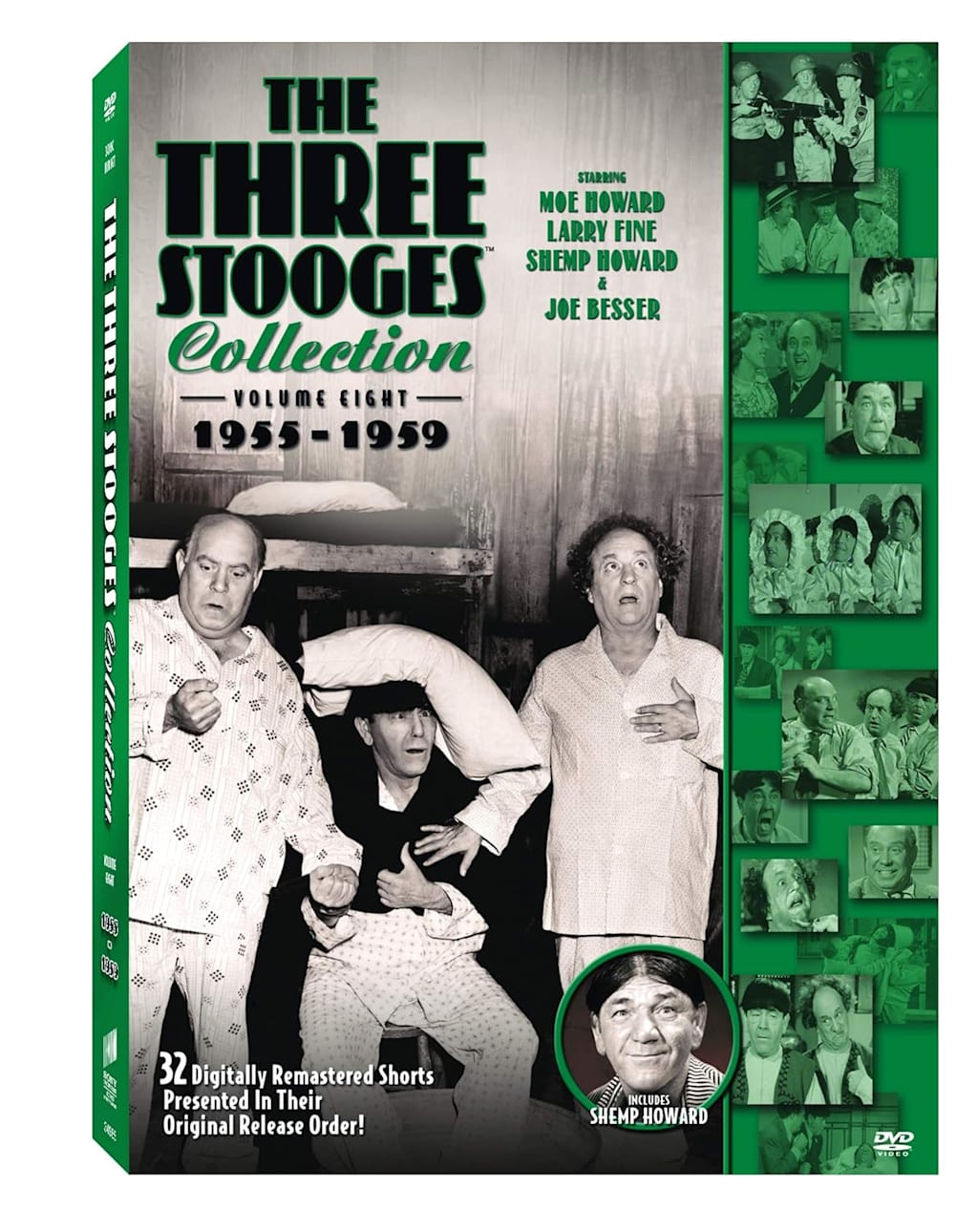
With seven parts detailed in this series about The Three Stooges' history, I had realized that the eighth and last volume of The Three Stooges Collection is mega-sized. It actually contains two periods that each deserve their own section. So I've long decided that Volume Eight will be divided into two parts, and this story, Part VIII, places the Stooges into the mid-1950s, with the remakes still being rampant.
Jules White became the Stooges' sole director following the resignation of Edward Bernds in 1952, which already saw some of the old Curly shorts being remade. By 1953, White began the cost-cutting move of remaking Shemp's earlier shorts with stock footage, and while that year featured four non-remakes (three of the four being completely original--with no stock footage), 1954 saw only two originals out of that year's seven shorts (Income Tax Sappy and Shot in the Frontier).
And the beat marched on:
1955

1955 began with Fling in the Ring, which was a remake of Shemp's first short back with the Stooges, Fright Night. The short has the same plot: the Stooges as trainers for boxer Chopper Kane, only to be told that gangster Big Mike put money on Kane's opponent. We are treated to an intro that shows Big Mike (played by Frank Sully; he was played by Harold Brauer in the original) revealing that he bet on opponent Gorilla Watson, and that he'll intimidate the Stooges into doing what he tells them. Next up was Of Cash and Hash, a remake of 1948's Shivering Sherlocks, which has the Stooges witnessing a bank robbery (thanks to the added intro) and being falsely accused before encountering one of the gangsters. This short featured a lot of final appearances; one, Stanley Blystone's appearance as a customer was his last in a Stooge short. Blystone's Stooges debut was in 1935's Restless Knights, and he did several shorts in the last 20 years. Blystone passed away on July 16, 1956, a year after this short's release.
Frank Lackteen, who reprised his role as Red Watkins from the original, also made his final Stooges appearance. Lackteen played villainous roles quite a bit, and Stooge shorts were no different. He delivered quite a funny moment in the original material; Red's served by Larry, who wonders if he looks familiar. "I was never there!" Red quips humorously. The third final appearance is a big one: Christine McIntyre. McIntyre reprised her role as Gladys in this short, which ended with the Stooges capturing the robbers. We see Shemp celebrating with Gladys and showering her with kisses, and that scene was McIntyre's last with the Stooges. The most famous Stooges leading lady, McIntyre debuted in Idle Roomers in 1944, and appeared in several shorts during the Curly and Shemp eras. Following her retirement, McIntyre went into real estate, working alongside her husband, J. Donald Wilson. On July 8, 1984, McIntyre passed away at the age of 73--six months after her husband's passing. She's forever remembered by Stooges fans as the most iconic actress in the Stooges' history.
Gypped in the Penthouse was next, one of 1955's two original shorts. This one individuated the boys a bit, with Shemp encountering Larry at a Woman Haters Club. The two share stories about being hustled by a woman (the same one, as they would later learn), and each flashback revealed that the woman, Jane, is married... to Moe. This short featured Jean Willes in her last Stooges role as Jane, and this was the only time that she was actually a villainess in a Stooge short. Also, I can't help but love seeing Larry really give it to Moe in his story, and in Shemp's story, Moe goes wild and searches for the other man while wielding a gun.
Bedlam in Paradise was a very wild remake of 1948's Heavenly Daze, and like most remakes, we received an intro that sets up the plot. In this case, Shemp is on his last legs, and Moe and Larry do everything possible to save him, but it's to no avail. Shemp knows this and tells Moe and Larry that he's going to kick the bucket, and tells them to behave or he'll haunt them. Shemp passes, and Moe and Larry mourn him, while Shemp ascends to Heaven. The plot is similar: Shemp is tasked by Uncle Mortimer (Moe in a dual role) to reform Moe and Larry, but the remake has an addition--Phil Van Zandt playing the Devil, as well as a sultry villainess known as Helen Blazes (played by Sylvia Lewis--one of the few surviving Stooge actors).

Stone Age Romeos, a remake of 1948's I'm a Monkey's Uncle, has the boys on a quest to search for evidence of existing cavemen, with the trio being promised oodles of cash if they do. The stock footage from the original is the evidence, or so we're led to believe, as the Stooges boasted that it's a big ruse--as are the beards they had in this. Wham-Bam-Slam!, a remake of 1948's Pardon My Clutch has Shemp's nerves acting up, leading to Larry enlisting Claude A. Quacker to help, resulting in a camping trip to calm their nerves. Both versions have the attempt to go awry, but I did prefer the ending to the remake. Moe and Shemp let Larry have it, but Shemp says he actually feels better.
Hot Ice is one I really love. A remake of 1948's Crime on Their Hands, the Stooges (in the borrowed intro from 1948's The Hot Scots) are looking to become detectives with Scotland Yard, but they end up cleaning a yard. Moe finds an article about jewel thief Dapper nabbing the Punjab Diamond, and the Stooges take the job to prove that they can be detectives. There are many things I loved about this short. One, changing the setting of Dapper's crime from America (in the original) to the UK (in the remake). Two, stock footage from two shorts telling this plot. Three, Barbara Bartay's brief appearance as a heavily armed criminal villainess, and four, the ending that sees Shemp swallow the diamond... again.
As much as I loved Hot Ice, the following short, Blunder Boys, is my true favorite from 1955. This is another short where the Stooges are detectives, but first, Moe (in an homage to Dragnet) narrates their road from the war to attending detective school, to their first case. The boys are tasked by their superior, F. B. Eye (Kenneth MacDonald's only non-villainous role with the Stooges), with capturing The Eel, a robber who dresses in drag. I absolutely love this short, mainly because of the intros the Stooges gave throughout the film. Moe says, "I'm Halladay," Larry says, "I'm Terraday," and Shemp introduces himself as whatever holiday that pops into his head.
Blunder Boys was released on November 3, 1955, and was that year's only other non-remake with original material. For Shemp Howard, sadly, it was his last such short:
So Long, Shemp

On November 22, 1955, 19 days after Blunder Boys' release, Samuel Horwitz (known to us as Shemp Howard), tragically passed away at the age of 60. On that evening, Shemp was leaving a boxing match via a taxi--his first time taking public transportation (one of Shemp's many phobias) in about 20 years. While inside, Shemp slumped on his friend's lap, having what had been labeled a heart attack for years, though it was actually a cerebral hemorrhage that was the true cause. Shemp's passing came three years after the loss of brother Curly Howard in 1952.
At the time of Shemp's passing, he was in the midst of a two year deal for shorts for 1955 and 1956. The 1955 portion was completed. As for the following year:
1956 (Shemp's Final Films)

Since childhood, Husbands Beware has stood as my all-time favorite Stooge short. I knew it was a recent one, but I didn't know the true circumstances until my teenage years. This short was released on January 5, 1956--the first short released following Shemp's passing. In this one, Moe and Larry get married to Shemp's sisters, Dora and Flora, and they show gratitude to Shemp for hooking them up. Once the nuptials are over, however, the brides show their true colors by decking Moe and Larry and bossing them around. They're ordered to cook dinner, but in true Stooge fashion, it goes wrong, and the trio gets thrown out.
Shemp, having seen how disastrous Moe and Larry's marriages are, vows to never get married, but Moe vows payback on Shemp. The rest of the short reuses a lot of material from 1947's Brideless Groom, with Shemp being rushed to marriage to receive a half million dollar inheritance from his late uncle Caleb. But the twist comes after Shemp's officially married: Moe and Larry reveal that Shemp's uncle's alive, there's no inheritance, and this was a prank to get even with Shemp for hooking them up with his sisters. The nagging brides are played by Lu Leonard and Maxine Gates, and while Gates has done a few Stooge shorts before, this was the only one for Leonard. Fans of Married... With Children definitely remember Lu Leonard's appearance in Season Three's "He Thought He Could," as Miss DeGroot, the evil-tempered school librarian who plagued and belittled Al Bundy.
Next up was Creeps, which was a remake of sorts of 1949's The Ghost Talks. The short opens with the Stooges telling their sons (also played by the Stooges) a scary story, and this is where the stock footage comes in afterwards. The major difference is the haunted suit of armor; in the original, he's the spirit of Peeping Tom, but in this, he's the spirit of Sir Tom, and he warns the Stooges about those who want to take him for his armor. The additional material also includes incidents with a fake guillotine, and a battle with Sir Tom. Flagpole Jitters, a remake of 1949's Hokus Pokus, has the same plot as the original: the boys as paper hangers taking care of invalid Mary, and also encountering hypnotist Svengarlic. There's one major difference between this and the original. In the original, Mary is a villainous character faking being paraplegic for money. In this, Mary really is paraplegic, and it's Svengarlic who is the baddie, as he's the head of a bank robbery gang.
Finally, For Crimin' Out Loud, released on May 3, 1956, served as the final short released with original Shemp material. A remake of 1949's Who Done It?, the boys are working on one case when they get contacted by Councilman Goodrich, who informs the trio about his evil niece being involved with the Phantom Gang and planning to do him in. Notice the wording I used in the first statement. This was the final short released with original Shemp material. It was not the final one filmed. That nod went to the previously released Flagpole Jitters. For Crimin' Out Loud didn't have much original material, but any and all original footage in this short was filmed on June 30, 1955. Original material in Flagpole Jitters was filmed on the following day, July 1, 1955, making that short Shemp's true final film.
So that ends the Shemp Howard era, or so you'd think. As I stated before, Shemp's 1956 deal was only half done at the time of his passing, and Columbia wanted it fulfilled by any means necessary. Emphasis on any:
1956 (The "Fake Shemps")

Columbia decided that the next four shorts would feature an actual stand-in for the late Shemp Howard, and the (in)famous "Fake Shemp" period began with Rumpus in the Harem. A remake of 1949's Malice in the Palace, the short opens with original material of Moe and Larry being woken up by their girlfriends, who are in distress. Now, this is where it gets heartbreaking. Moe goes to wake Shemp up ("Shemp, get up! Sheba, Reba, and Heba are here!"), and finds a letter left by Shemp. Moe reads it:
"You guys snore so loud, I couldn't sleep, so I've gone downstairs to open the restaurant. Will see you later. P.S., if you don't get this letter, let me know and I'll write another.
Signed, Shemp"
That scene always gets to me. This was the first short filmed after Shemp's passing, and while Moe and Larry were both grieving heavily, Moe was definitely hit harder--he had lost two of his brothers in just three years. Despite this, Moe performed that moment like the champ he always was, and gave a "How do ya like that dummy?" in response. The plot was mostly similar to the original; they had to get a valuable diamond from the Emir of Shmow, but in this case, they needed it to pay their girlfriends' debts. The short marked the Stooge debut of actress Harriette Tarler, who appeared as a harem girl who beats up the Stooges.
Regarding the stand-in, Joe Palma, who did a number of Stooge shorts beforehand, portrayed the stand-in for Shemp in scenes that needed all three Stooges. Palma is always shown from the back, and regarding this short, Palma Shemp appears a lot. One moment has Palma Shemp being chased, and we get dubbed Shemp lines from Fuelin' Around ("Whoa! Moe, Larry!") and Blunder Boys ("Moe, help!"). I do love the final scene, though; the boys escape the palace, Moe goes out the window first. Palma Shemp provides his own actual yelps and a "Yipe!" before crashing through a closed window, and Larry hits a wall thinking that's where the window is.

Next up was Hot Stuff, a remake of the aforementioned Fuelin' Around, which has the boys as undercover spies tasked with protecting Professor Sneed from being taken by Anemian forces. We get an intro scene with Phil Van Zandt reprising his role as Captain Rork in the original, alongside Gene Roth as Anemia's ambassador, and it's followed by Larry, Moe, and Palma Shemp roaming the hallways. Palma Shemp is sent by Moe to track a suspicious looking woman played by Suzanne Ridgeway (TBH, she should have been revealed as a villainess somehow), and Moe and Larry receive their orders from a pair of female officers, one of them being played by Connie Cezon in a rare heroic role.
Other than the opener, which sees Palma Shemp utter a very Shemp-ish "Right!" to Moe's order, we see the stand-in during the pacing scene, imitating Shemp's "Heep-heep-heep!" So yeah, very minimal screen time compared to the previous short.

Scheming Schemers, considered to be the best of the four "Fake Shemps," is a historic first: it's a remake of a remake. This short is a remake of 1949's Vagabond Loafers, which was a remake of 1940's A Plumbing We Will Go. Similar to the plot of the original remake, the Stooges head to the Norfleet house, but in this one, Mr. Norfleet tasks them with finding his wife's ring in the plumbing. We get the same plot afterwards, with the Allens looking to steal a valuable painting, and Moe and Larry's battle with Mr. Allen includes a pie fight that contains material from 1947's Half-Wits Holiday. As a result, this makes Scheming Schemers the only short to feature material from three previous shorts.
This short marked the final Stooge appearance of Kenneth MacDonald in any original material. Regarding Palma Shemp, we only see him once: when he's honking the horn and Moe calls him over, after which we get the Shemp dubbed line, "Hold yer horses, will ya?," from The Ghost Talks. Scheming Schemers was released on October 4, 1956--four days before Don Larsen's perfect game in the World Series.

The Shemp Howard era, as a whole, ended with Commotion on the Ocean, released on November 8, 1956--two weeks shy of a full year after Shemp's passing. A remake of 1949's Dunked in the Deep, the Stooges (via the borrowed intro from 1948's Crime on Their Hands) learn about atomic documents being stolen, and they want to be on the case. Later on, they visit their neighbor Bortch (the actual thief), and tell them about their assignment.
Regarding Palma Shemp, we only see him once, and it's immensely minimal. We see Palma Shemp shield his face after Moe smacks Larry, and he stands in between Moe and Larry as the latter suggests getting in on the story. We also get a humorous fish-eating scene after Larry tells Moe that Shemp went to find some food. The "fish" that Larry, Moe, and Bortch eat is wooden, prompting Moe to say, "I hope Shemp got something decent to eat," resulting in the borrowed scene with the salamis.
* * *
And that brings the Shemp Howard era to an end that is memorable, yet heartbreaking at the same time. Shemp's final shorts definitely had their great moments despite obvious circumstances. The 1955 collection was quite hilarious, especially Hot Ice and Blunder Boys. The 1956 collection's first half saw Shemp's final performances, and they were very amazing and hilarious, and regarding the "Fake Shemps," I do think that, while it was a very controversial way to end the era, they were done pretty well. So one era came to an end, but Part IX of this series will detail the end of another era, an end that was even more controversial.
About the Creator
Clyde E. Dawkins
I'm a big sports fan, especially hockey, and I've been a fan of villainesses since I was eight! My favorite shows are The Simpsons and Family Guy, etc.
Enjoyed the story? Support the Creator.
Subscribe for free to receive all their stories in your feed. You could also become a paid subscriber, letting them know you appreciate their work.
Comments
There are no comments for this story
Be the first to respond and start the conversation.