
History of The Three Stooges (Part VI: Comparisons - 1949-1951)
Shemp Howard's second stint with the Stooges sees more development and remakes that draw comparisons from modern fans

On May 6, 1946, during the last day of filming for Half-Wits Holiday, Curly Howard suffered a debilitating stroke, coming after at least a year and a half of health issues. At age 43, a young age, Curly's career was over, and with a void left in the Stooges, Curly's older brother Moe Howard contacted his and Curly's older brother, Shemp Howard, to get the old gang back together. In the time that passed after leaving the trio in 1932, Shemp had worked a lot with W.C. Fields and Abbott & Costello, and he even had his own solo shorts for Columbia, but he quickly hopped on the chance to reunite with Moe and Larry Fine.
One thing I couldn't help but notice as a Stooges fan is that the stories seemed to evolve during the heart of the Shemp period, which is what this part details. And I think it's from this period that drew the modern fans to compare Curly and Shemp; you'll see as I continue on:
1949

1949 kicked off with The Ghost Talks, the first of a number of times that the Stooges were placed in a spooky setting in the Shemp era (this only happened twice with Curly). In this one, the trio are movers tasked with moving furniture out of spooky Smorgasbord Castle, where a suit of armor inhabited by the spirit of Peeping Tom (voice of Phil Arnold) tells the trio his story. Next up was Who Done It?, which featured the trio as detectives who are tasked with solving the abduction and attempted murder of Old Man Goodrich (Emil Sitka), while dealing with the sinister Phantom Gang, which includes Goodrich's evil niece (Christine McIntyre). Fun fact: this was supposed to be a Curly short. In fact, work on this was supposed to come after Half-Wits Holiday was completed, but Curly's stroke changed their plans.
Hokus Pokus featured the Stooges as paperhangers who are also taking care of Mary, an invalid woman who is wheelchair-bound... or so they thought. The short's opening revealed that Mary's a fraudster, faking being laid up to get $25K from the insurance company, and the short also sees the trio under the influence of noted hypnotist Svengarlic. Fuelin' Around (another of my favorites) has the Stooges being captured by forces from the country of Anemia, after they mistake Larry for Professor Sneed, the genius behind a powerful brand of rocket fuel.

Malice in the Palace followed, the most recent of the four "public domain" shorts, with the Stooges as restaurateurs who end up in a scheme involving stealing a valuable diamond from the Emir of Shmow. But take a look at that pic. Recognize that mustachioed chef? That's Curly! A year after filming his cameo for Hold that Lion!, Curly actually did appear and film this brief scene with his brothers and Larry Fine. However, his health continued to take a turn for the worse at that time, so Curly's cameo was cut, and that would be the final time he would work with the Stooges in any capacity.
Next up was my actual favorite from 1949, Vagabond Loafers. This marked another first, as it was the first time that a Curly short received the Shemp treatment. In this case, it was 1940's A Plumbing We Will Go that turned into this short, with many differences. Similar to the original, the Stooges are plumbers working at the lavish Norfleet estate, where the lady of the house is showing off an expensive painting--which a couple (Kenneth McDonald and Christine McIntyre) are set on stealing. Mrs. Norfleet was played by Symona Boniface, and this was her final appearance in a Stooge short; her overall final role was in the Jerks of All Trades Stooges pilot that was filmed six days after Vagabond Loafers was released. Boniface (who passed away on September 2, 1950) appeared a lot with the Stooges, usually playing high society types. She never played villainous roles; the closest we came to a heel Symona Boniface was her 13-seconds long scene in G.I. Wanna Home. The trio's search for an apartment saw them run into Boniface's character, a haughty landlady who ejects the trio, and then--with a smug smile--looks at the Stooges and says, "Besides, no dogs allowed." Curly barks in response, only for the heel landlady to yowl and hiss at the scurrying Stooges.
The last short of 1949 (and the 1940s overall) was Dunked in the Deep, which features yet another debuting side actor: Gene Roth. Roth appeared as Bortch, a Russian spy who had stolen important documents on rolls of film, and he smuggles them into watermelons, while also tricking the Stooges into taking him into a getaway boat. This short is best known for the climactic chase scene between Bortch and Shemp, coming after the Stooges learn the truth, and it's mainly due to Bortch's "Give me dat fill-um!" line.
1950

The Stooges quickly entered the 1950s with this Western piece, Punchy Cowpunchers, undoubtedly my favorite from 1950. It was a dramedy, if you will, as the boys are sent out West to take down the notorious Dillon gang, and this short had everything. Drama, comedy, chilling music stings, action, and an ensemble cast. Hugs and Mugs featured the Stooges being romanced by a trio of gorgeous women who were just released from prison for jewel theft, though the romancing was due to the fact that the Stooges inadvertently had the ill-gotten loot. This short marked the debut of a very underrated Stooge actress: Nanette Bordeaux. Quebec-born Nanette Bordeaux had a lot of interesting roles in Stooge shorts; again, you will see as I continue. Dopey Dicks featured the trio as janitors thrust into a case when a woman enters in distress before she's abducted, and Love at First Bite is a hilarious short that has the boys preparing for their European fiancées, and it includes a hilarious moment where a drunk Shemp and Moe engage in a seltzer fight.

Love at First Bite was followed by a second straight "rom-com" in the form of Self-Made Maids, which actually has the Stooges playing all of the roles. They played themselves, their sweethearts, and their children. Moe played the girls' father, and Shemp and Larry played another couple, making this the first of only two shorts not to have a supporting cast. I think this was a cost cutting move, either that or the boys wanted to show their mettle, but it worked out for them. Three Hams on Rye featured the boys as stagehands who are tasked with keeping a critic who could dampen the latest production from entering, and this was followed by another "showbiz" short: Studio Stoops, which has the Stooges as exterminators who are mistaken for publicity writers, and they are tasked with devising a staged story that details the "kidnapping" of famed actress Dolly Devore--a story that becomes real when Dolly actually is taken. The last two shorts actually borrow gags used in Curly shorts; Three Hams on Rye reused the "comforter" gag from Uncivil Warriors, and Studio Stoops featured the "three watches" gag from Dutiful but Dumb and Rhythm and Weep.
There are many reasons why I love Slaphappy Sleuths. One, the title alone sounds like something the Stooges would have done in the 30s, not the 50s. Two, the opening scene with Gene Roth actually playing a non-villainous role was amazing. Three, the plot: the Stooges posing as gas station workers to uncover a string of robberies at various stations. Four, for once, Emil Sitka actually looks his age in this one; he often played older characters, but in actuality, he was younger than the Stooges by quite a bit. Five, the fight scene in the climax. Six, and most of all, Nanette Bordeaux. I stated before that Nanette played some interesting roles with the Stooges. Nanette turned heel for this short, as her character, Louise, was not only part of the robbery gang, she was basically leading it! She's been a Stooge antagonist a few times, but this was her one time playing a truly evil villainess, and it was epic! A Snitch in Time has the Stooges running a furniture shop and performing their duties for Miss Scudder, whose home is invaded by jewel thieves, who the trio learn about much later.
1951

1951 had an interesting crop of shorts, beginning with Three Arabian Nuts, which had the Stooges as junk men--and Shemp finding a magic lamp with a genie inside, but they deal with a pair of thieves looking to get the lamp for themselves. Baby Sitters Jitters has the trio as sitters who are on the job, and it features the running gag of Shemp standing on his head to make the crying baby suddenly laugh. Don't Throw That Knife has the Stooges as census takers who console a woman (Jean Willes) who has a very jealous husband (Dick Curtis), and this short has a line that I just can't help but dwell on:
Shemp: "I have an uncle who can make things disappear."
Moe: "Is he a magician."
Shemp: "No, a kleptomaniac!"
Scrambled Brains was a crazy one that centered on Shemp being released from the hospital due to nerves, but his delusions remain intact. His main one centered on his eventual fiancée, Nora. Shemp sees a glamorous beauty. Moe and Larry, and everyone else, saw otherwise. This short included a humorous moment where the Stooges get into it with a man inside a phone, and he pops up again and reveals himself as Nora's father.

Merry Mavericks is another Western short that has the Stooges heading to the town of Peaceful Gulch to escape vagrancy charges. This short is a remake of 1943's Phony Express, and mostly has the same plot of the trio being mistaken for lawmen, while dealing with a gang that has a sultry villainess played by Marian Martin. The following short, The Tooth Will Out, has the trio enrolling themselves in dental school after failing to hold jobs, and it features a very funny moment where Shemp's monstrously created teeth come to life and taunt the boys, even leading them in a singing number. Fun fact: the second half that sees the boys at a Western town opening their dentistry practice was originally intended to be used in Merry Mavericks (if I had to guess, it would have opened the short). Because the scene ran too long, they had to cut it from the short, but they decided to build The Tooth Will Out around it. Also, on a somber note, this short was Dick Curtis' final Stooges appearance; often playing villains in Stooge shorts, Curtis passed away on January 3, 1952, just months after the release of the short, which had Curtis as an irascible sheriff.
Hula-La-La, the only short to be directed by longtime producer Hugh McCollum, features the Stooges as dance instructors who are sent to a Pacific island to teach the natives to dance, though once there, they deal with headhunters! Finally, my favorite 1951 short, Pest Man Wins, a hilarious remake of 1936's Ants in the Pantry, which has the Stooges as exterminators who drum up their own business by planting pests in a lavish estate. Again, this is where the comparisons really come in, and I'll just say this. Curly was the ultimate super Stooge, that's a fact. But I truly think that a lot of the Shemp remakes are actually funnier than the Curly originals. Pest Man Wins is a big example; I loved so much about this short, the pie fighting scene being among them. A mix of original material and footage from 1941's In the Sweet Pie and Pie and 1947's Half-Wits Holiday. Very well done!
* * *
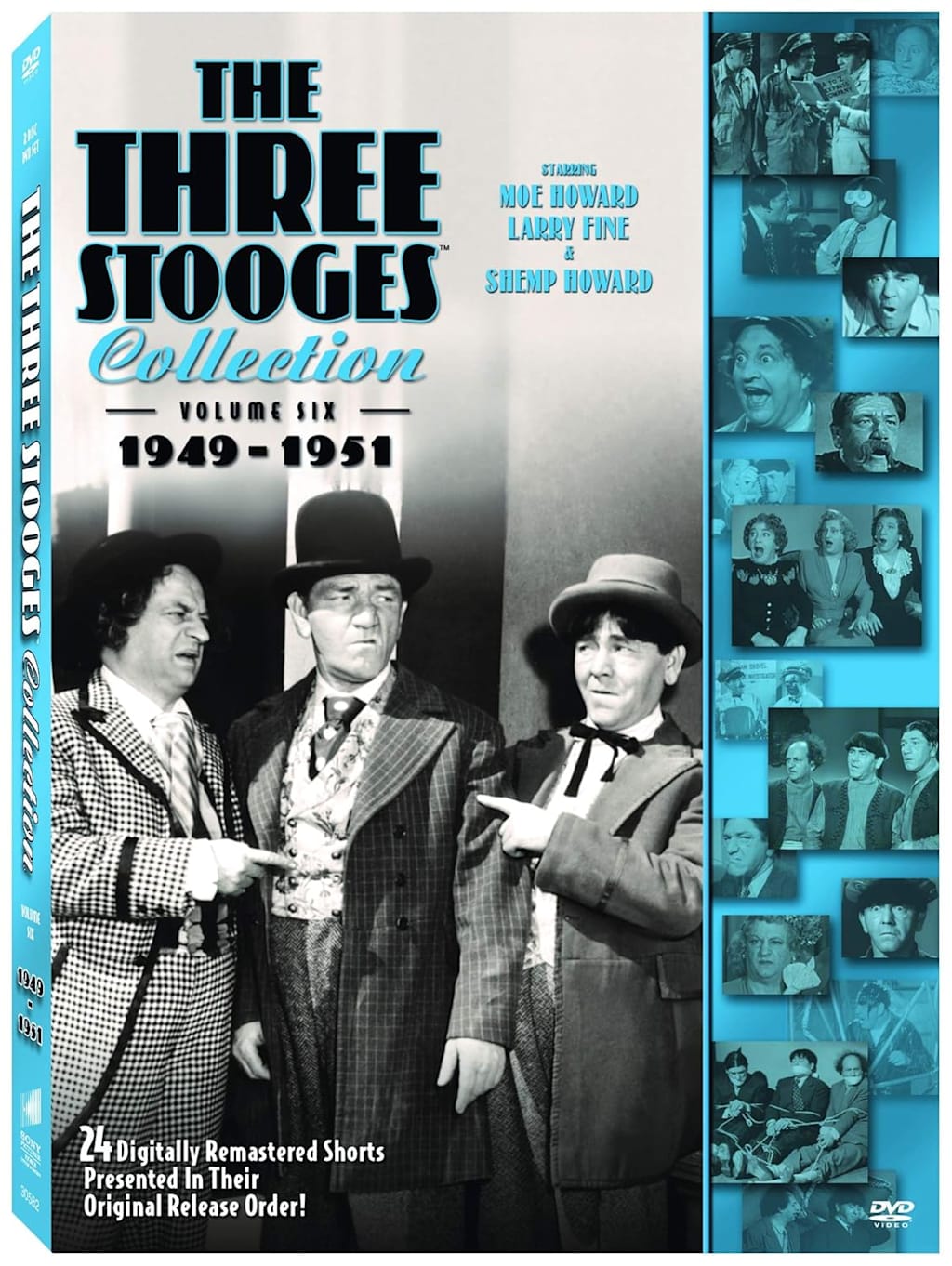
The 24 shorts released from 1949-1951 were released as the sixth volume of The Three Stooges Collection on June 16, 2009. I consider this period the prime of Shemp Howard's second stint with the Stooges; these shorts showed an evolution from the trio that hadn't been seen at that time. What would follow is a very interesting period that saw more history and hilarity from the Stooges, but that nugget will be saved for later.
About the Creator
Clyde E. Dawkins
I'm a big sports fan, especially hockey, and I've been a fan of villainesses since I was eight! My favorite shows are The Simpsons and Family Guy, etc.
Enjoyed the story? Support the Creator.
Subscribe for free to receive all their stories in your feed. You could also become a paid subscriber, letting them know you appreciate their work.
Comments
There are no comments for this story
Be the first to respond and start the conversation.