
History of The Three Stooges (Part V: One Era Ends and Another Resumes - 1946-1948)
A dramatic paradigm shift hits the Stooges during this period of their careers

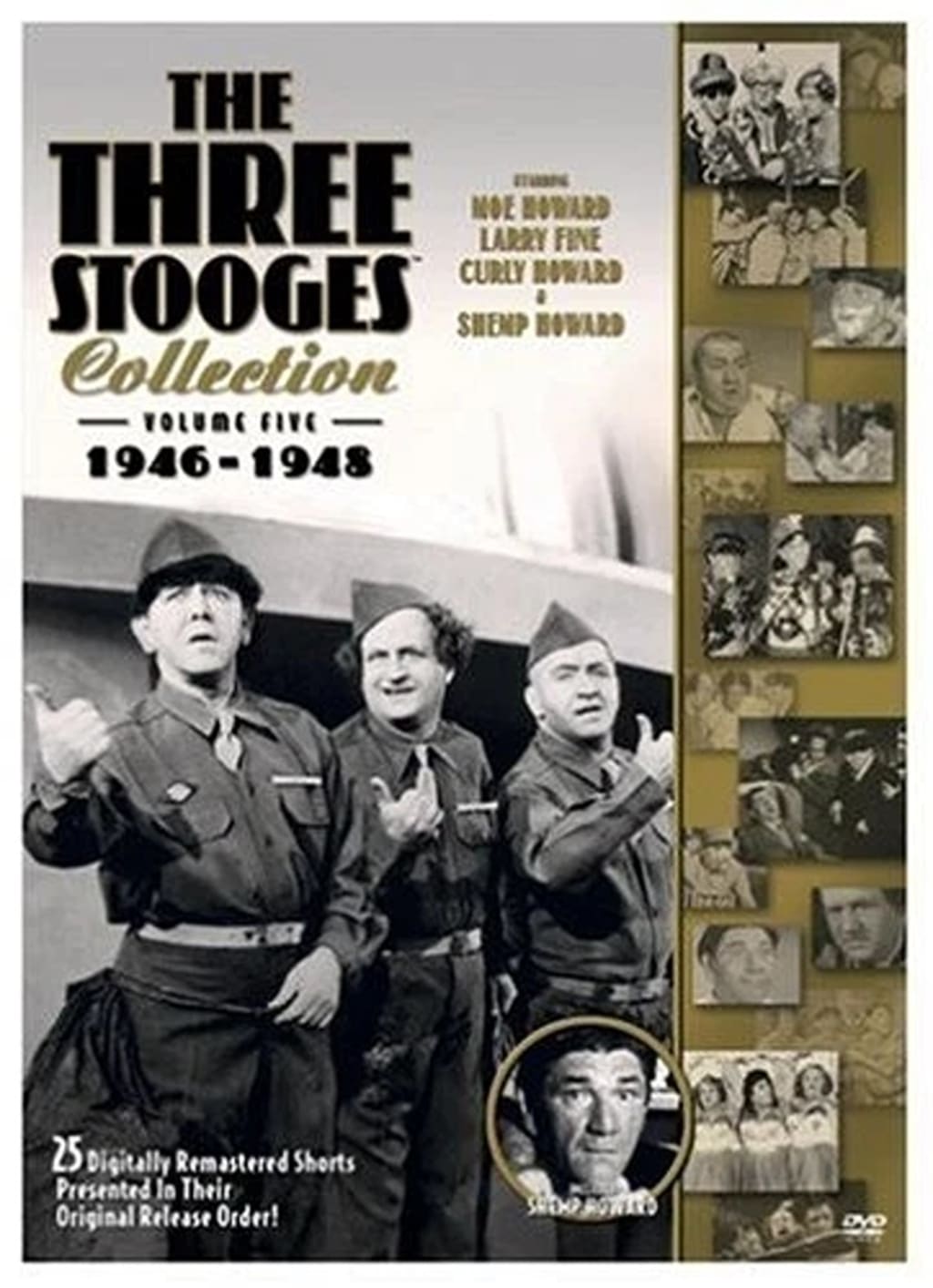
In Part IV of this series, the Three Stooges' wartime period was detailed; the years that saw a number of short films that referenced the Second World War, some of which were quite controversial. However, by 1945, the Stooges would be dealt quite a blow. Entering that period, Curly Howard's performance was declining, slowly. By 1940, Curly had put on a lot of weight and lived it up a lot; partying, drinking, overeating. Moe, from what I've learned in various stories, had to keep a watchful eye on Curly, pretty much taking the role of a second father rather than an older brother.
Despite this, Curly partied hard, and it got to him. The effects were there by 1942, but his performance wouldn't be affected too much, even as decline continued in 1943 and 1944. By the end of the latter year, Curly (under Moe's advisement) saw a doctor, who gave him the bad news: hypertension, obesity, retinal hemorrhaging. And in January 1945, the first mini-stroke hit. The first real effects of Curly's performance was witnessed in If a Body Meets a Body and Micro-Phonies, which finished off a very short 1945. The Stooges were hoping for more time off so Curly could really recover, but Columbia president Harry Cohn wouldn't hear of it.
Speaking of Cohn, I have to mention this. Cohn, from what I read, was a piece of work. It's bad enough that Cohn kept the Stooges under his thumb by lying to them; claiming that the company was going under and the shorts could save them. Not allowing the Stooges to breathe enough to help Curly's ailment was much worse. Holy moley. So to make up for the short 1945, nine shorts were filmed for 1946, and with Curly's health being at a low point, those shorts were quite a task.
1946
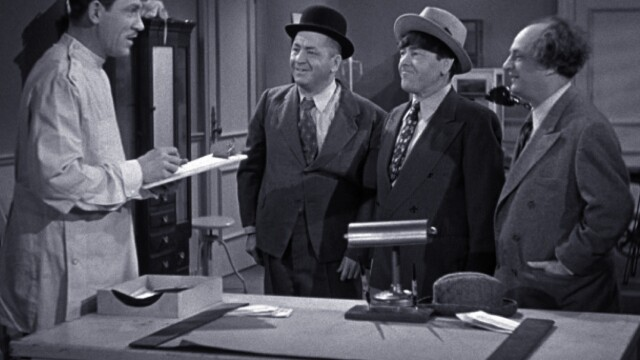
1946 began with Beer Barrel Polecats, which featured the Stooges--faced with a beer shortage--deciding to make their own beer. This includes a hilarious moment where they are about to put in three cakes of yeast, but after Moe does so, both Larry and Curly do so thinking that they weren't in yet. An attempt to sell a bottle landed the Stooges in jail, and most of the jail scenes were borrowed material from In the Sweet Pie and Pie and So Long, Mr. Chumps (both from 1941). The reused footage was added due to Curly's bad health.
The following short, A Bird in the Head, featured the trio as paperhangers who end up pursued by a mad scientist who wants to use Curly's brain. Regarding this, I mentioned in Part IV, that Edward Bernds debuted as director with Micro-Phonies, but in actuality, this short was actually Bernds' first. Bernds filmed two shorts prior to Micro-Phonies, but A Bird in the Head saw Curly not at his best. Bernds feared that he'd be done before he started, but producer Hugh McCollum decided to release Micro-Phonies (which featured a better Curly) first. That solidified Bernds' place as a director.
Uncivil War Birds followed, and just like 1935's Uncivil Warriors, the Stooges were placed in the Civil War, just as they were set to marry their sweethearts. In a weird mix-up, Moe and Larry joined the Union, while Curly joined the Confederacy. Unfortunately, controversy is involved in this one--there's a small clip of the Stooges performing in blackface, YIKES! The Three Troubledoers followed, and in his final Western short, Curly is made sheriff (with Moe and Larry as deputies) after he protects a woman from the clutches of Badlands Blackie. Bernds directed this one as well, and this was also filmed prior to Micro-Phonies. As Bernds himself stated, it was another down performance compared to Micro-Phonies, though Curly did have his moments.
Monkey Businessmen, the first short to be filmed in 1946, featured the Stooges as recently fired electricians who decide to, as Curly advised, "go somewhere for a nice long rest." The boys end up at Mallard's Rest Home and Clinic, and find themselves run ragged by Dr. Mallard and his goons. The short marked the debut of two known Stooge actors: one, Jean Willes (who played Nurse Shapely), and two, Kenneth MacDonald, who played Dr. Mallard, and played villains in all but one appearance with the Stooges. This was another Bernds short, and according to Bernds himself, Curly was really down in this one. Curly's condition decreased to the point where he had to be reminded to utter his lines, and during a point in the short, Moe can be seen nudging his brother to utter a line of dialogue ("Oh, I know, a nice big bowl of milk!").
Three Loan Wolves featured the boys as pawn shop owners who deal with the sudden introduction of a baby, as well as being harassed by gangster Butch McGee--played by the debuting Harold Brauer, one of only two actors to have worked with all of the Stooges. This short placed Larry front and center, with director Jules White doing so as a result of Curly's illness. G.I. Wanna Home was an interesting one; filmed just months after WWII ended, the short has the boys returning from the war and finding their fiancées out on the street, as the housing shortage hit them. Regarding Curly, the decline was getting worse, and it was shown in a scene where he's cleaning potatoes. Rhythm and Weep was a good one, but it had quite a dark opening. The Stooges, having been fired again from another gig (the 26th theater they've been thrown out of in a month), decide to actually end it all. They meet a trio of budding starlets who are also despondent, but their spirits are lifted when they meet a piano player with connections.
Three Little Pirates (Curly's last hurrah)
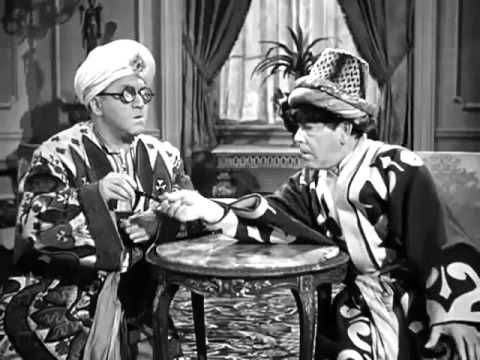
And then, there's Three Little Pirates. The last short to be released in 1946, and it's one of the most memorable ones. In this one, the Stooges are shipwrecked on Dead Man's Island, and earn the ire of the island's governor (Vernon Dent) when they hit on his betrothed. The Stooges are to be executed, and after one escape plan fails, they cook up another one: disguising themselves as a Maharajah (Curly) and his dignitaries (Moe and Larry). Enter the famous "Maha! Aha!" scene, which the Stooges did five years prior on a variety show.
Released on December 5, 1946, Three Little Pirates is forever known fondly by Stooges fans as serving as Curly's last hurrah; his last great classic performance. Curly's health had been failing him for a year at that time, and his performances were unpredictable. He'd have some good ones (If a Body Meets a Body and Micro-Phonies) and some not so good ones (A Bird in the Head, The Three Troubledoers, and Monkey Businessmen), but when it came to Three Little Pirates, Curly was perfect. Top of his game, performed the "Maha! Aha!" scene brilliantly, even performed pratfalls like it was nothing. For one last time, it was Curly Classic.
And then:
1947 (Half-Wits Holiday - Curly's Farewell)
The 97th Stooge short, Half-Wits Holiday, was released on January 9, 1947, kicking off that year for the trio. This short was the very first remake of a past short, and in this case, they borrowed from 1935's Hoi Polloi. Same plot--a pair of professors debating between environment and heredity, and one makes a bet that he can use environment to create gentlemen. Enter the Stooges, as pipe layers, and the subjects of this bet. The short marked another first; the Stooge debut if the most famous Stooge supporting actor, Emil Sitka. Sitka, similar to Harold Brauer, has worked with all of the Stooges, appearing in an immense number of shorts, films, and damn near everything Stooge related.
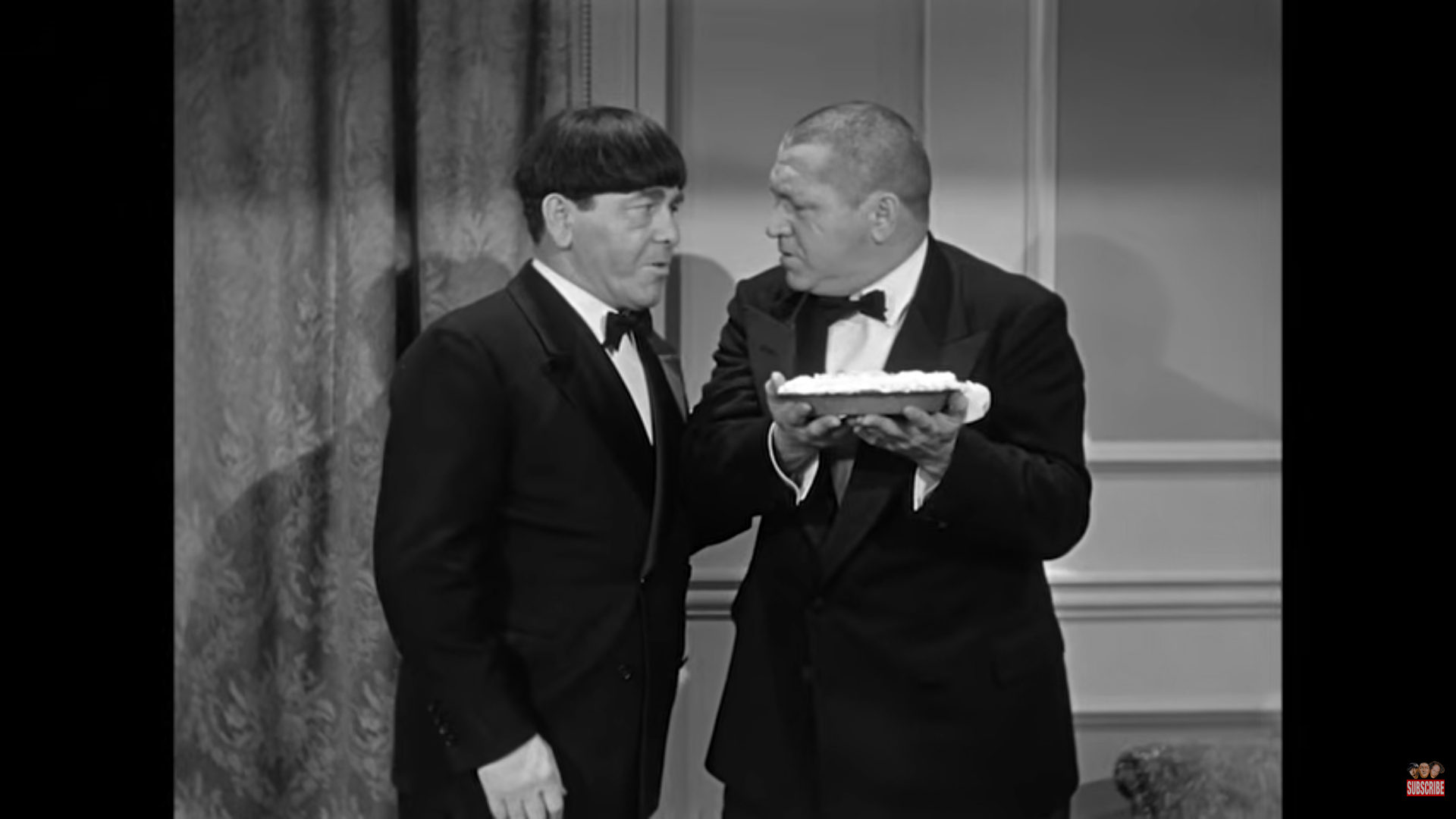
Half-Wits Holiday was filmed from May 2-6, 1946, and regarding Curly, he was nowhere close to duplicating his Three Little Pirates performance. Curly really struggled with his dialogue, needing assistance from Jules and/or Moe. He still delivered some good moments; for one, his back and forth with Moe at the dinner table was hilarious, and secondly, the moment where Moe and Larry drag Curly after he steals a jewel from a woman's ring. After some conkings, the boys emerge, and Curly takes a pie for himself, but Moe stops him:
"Why, you petty larceny Stooge; what are you trying to do, ruin us? Gimme that pie. Now you go over there and sit down before I crown ya. Go on!"
Curly walks off. That would be the last time we'd see him.
The pie fighting scene takes place, and Curly is called to participate. Sadly, Curly is found (according to many accounts, by Moe) with his head slumped on his shoulder, in tears. He had a stroke, a big one. This happened on May 6, 1946, the last day of filming; Curly was rushed to the hospital, and the pie fight scene was revised to cover Curly's absence.
Curly's career was over after 15 years working with Moe and Larry. However, the Stooges would march on.
1947 (Welcome Back, Shemp)
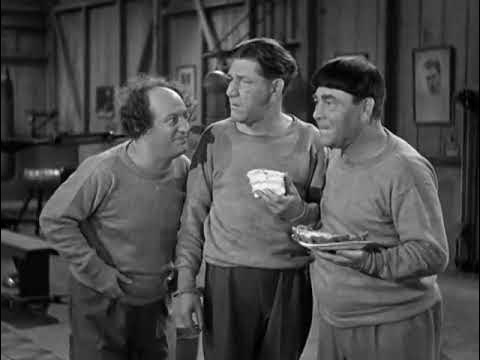
With Curly's career over, Moe made the call to his and Curly's older brother, Shemp Howard, and instantly, Shemp agreed to get the band back together after 15 years. A month after Curly's stroke, the trio got to work filming Fright Night, officially marking Shemp's return to the Stooges. In this short, which was released on March 6, 1947, the boys are trainers for Chopper Kane, which includes a hilarious sparring session with Shemp. However, the boys are later threatened by gangsters working for Big Mike, who told them that Kane has to lose because Big Mike's betting on his opponent. This was Shemp's favorite short, mainly because he was a big boxing fan.
Out West followed, which had the boys heading to a Western town as a form of therapy due to Shemp's bad leg. Once they arrive, they encounter the ruthless Doc Barker, who has his own plans. Already in his second short, Shemp was doing Westerns, and this was a good one.
The Four Stooges
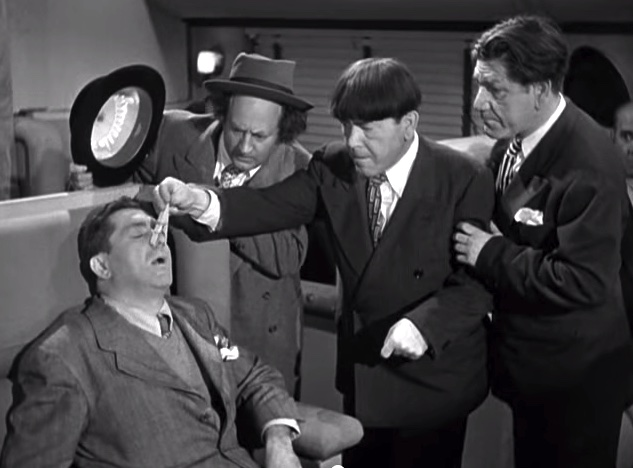
Hold That Lion! marked three milestones. One, this was the 100th Stooge short overall. Two, the theme was changed one last time to a version that would be used for the rest of the Stooges shorts, after Fright Night and Out West continued to use the jazzed up "sliding strings" version (my favorite version; more on that later). In this short, the Stooges are set to receive an inheritance, but there's one problem: Icabod Slipp holds the estate, and he's looking to keep it. This leads to the trio pursuing Slipp on a train, and leads to the third milestone. The boys find a sleeping passenger, and guess what? He's played by Curly! The brief scene marked the first and only time that we see four Stooges appear, including brothers Shemp, Moe, and Curly.
Next up was Brideless Groom, one of the most known shorts in Stooges history, mainly because it's in the public domain. In this one, Shemp portrays a music teacher who learns that his Uncle Caleb passed and left him $500,000--which he'll only receive if he gets married in a few hours. There were two main attributes from this short: Shemp's memorable scene where he ends up as Christine McIntyre's punching bag, and two, Emil Sitka's line, "Hold hands, you lovebirds!" (which is actually on Sitka's headstone). This short was followed by another public domain piece, Sing a Song of Six Pants, which has the boys as the owners of Pip Boys Cleaners, but they face massive debt, as well as a bank robber on the loose. All Gummed Up featured the boys as pharmacists who are being told by their crotchety landlord that they are being evicted. The same old codger also ditches his wife for being "too old" for him, but the Stooges create a youth potion that works wonders on her.
1948
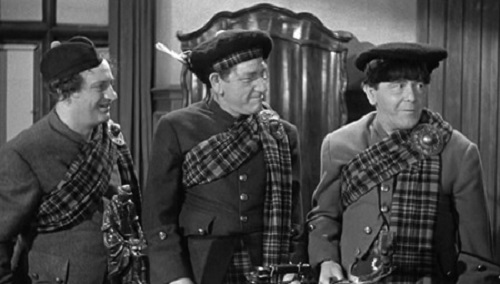
1948 began with Shivering Sherlocks, the last short to be directed by Del Lord, which featured the Stooges as employees at the Elite Cafe who are suspected of a robbery. They're quickly cleared when it's revealed to be a Lefty Loomis job, and the Stooges and their friend Gladys have Loomis and his gang to deal with. Pardon My Clutch is an odd one that has the boys and their wives set to go on a camping trip to ease Shemp's nerves, doing so under the advisement of their friend, Claude A. Quacker (the surname should have been a dead giveaway. Squareheads of the Round Table places the boys in medieval times, where they help Cedric (a blacksmith) woo a princess, whose kingly father is against the relationship. The short marked another Stooge debut; Phil Van Zandt appeared as the Black Prince, one of many villainous roles he'd play in Stooge shorts. This included the following short, Fiddlers Three, which featured Van Zandt as an evil magician who abducted a princess who the Stooges have to save.
The Hot Scots, my favorite from 1948, has the trio looking to become detectives, only to become yard workers instead. While working, Moe finds an article about a case at Glenheather Castle in Scotland, and that's where they go. Squareheads and Scots were the final two shorts to use that jazzy "sliding strings" theme, as those two were actually filmed in late 1946. Regarding Scots, the film was the first to feature Christine McIntyre as a villainess, and was also Ted Lorch's final film; Lorch passed away on November 14, 1947, months prior to Scots' release.
Heavenly Daze was a wild one that portrays Shemp as having passed on and looking to get into Heaven. However, his case is being analyzed by Uncle Mortimer (Moe in a dual role), who states that Shemp, Larry, and Moe were pretty bad boys. Mortimer gives Shemp one chance; he returns to Earth and if he reforms Moe and Larry, he can return to Heaven for good. What follows is Moe and Larry dealing with hijinks from the ghostly Shemp, as well as trying to sell their wild invention: a fountain pen that writes with whipped cream. The next short, I'm a Monkey's Uncle, actually places the Stooges in prehistoric days as cavemen who end up fighting for their sweethearts, while Mummy's Dummies has the boys as chariot salesmen (Honest Moe, Honest Shemp, and Larry) turned makeshift dentists. Finally, Crime on Their Hands has the boys as janitors who are looking to become reporters, and they hop on the case regarding the stolen Punjab Diamond.
* * *
These 25 shorts were released on DVD as Volume Five of The Three Stooges Collection on March 17, 2009. This was a tough period for the Stooges. Curly's declining health resulted in unpredictable performances, and while Three Little Pirates saw Curly on his A-game, Half-Wits Holiday served as Curly's finale as a Stooge. The void was filled by the returning Shemp Howard, who had been working a lot with Andy Clyde, W.C. Fields, and Abbott & Costello before accepting the call to return to the Stooges. Already, a vast majority of Shemp's first 15 shorts back were period pieces, which is a fascinating trait. The Shemp era would continue to evolve as the years went by, but that is another story for another time.
About the Creator
Clyde E. Dawkins
I'm a big sports fan, especially hockey, and I've been a fan of villainesses since I was eight! My favorite shows are The Simpsons and Family Guy, etc.
Enjoyed the story? Support the Creator.
Subscribe for free to receive all their stories in your feed. You could also become a paid subscriber, letting them know you appreciate their work.
Comments
There are no comments for this story
Be the first to respond and start the conversation.