
Ginny Weasley Got the Ending, Not the Story
She appears in Book Two, becomes Harry's wife in Book Seven, and somewhere in between Rowling forgets to show us who she is.
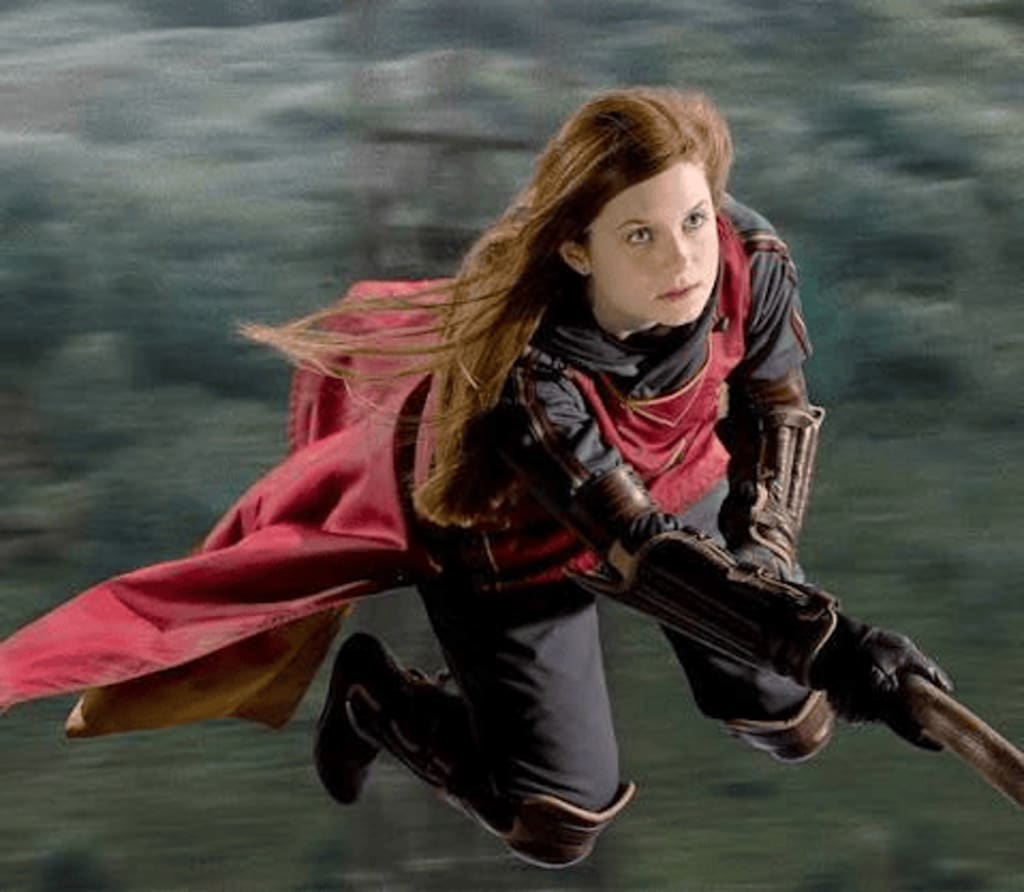
Book Six, Gryffindor common room. Harry sees Ginny kissing Dean. Harry had never noticed her before. Rowling writes through Harry's eyes: Ginny's lips against Dean's, something in Harry's chest bursting. The action works. It also shows the problem. Harry falls for Ginny when he finally starts looking at her. The reader has been looking since Book Two and still does not know when she became this person.
Book Two gave her a good hand
The Ginny of Chamber of Secrets is not empty. She is eleven, the only girl among six brothers. In her first year she is controlled by Tom Riddle's diary. She writes blood on the walls, opens the Chamber, releases the basilisk, and nearly dies. She wakes up crying. Harry saves her. She sends Harry a singing Valentine. Malfoy reads it aloud. The Great Hall laughs.
Those are concrete actions. Shyness, loneliness, control, mockery, rescue. A character with that history could grow in many directions: shame, anger, distrust, complicated feelings for Harry, resentment of her brothers, an early understanding of Dark magic. She could stop being the little sister. She could learn to use a sharp tongue as armor. She could train until she never needs saving again.
In Book Three, most of that disappears. Ginny appears at the station, in the common room, in the noise after a Quidditch win, at the ending. She has no scene of her own. The Chamber might never have happened. Her trauma has no nightmares, no avoidance, no reaction to the name Tom Riddle. Harry's trauma has scars, nightmares, and talks with Dumbledore. Ginny's trauma is erased.
Rowling planted foreshadowing. She did not turn it into cause and effect.
Books Three and Four: present, but not in the story
Ginny's Book Three scenes are few enough to list: the train station, the common room, the noise after a Quidditch win, the ending. She has no private conversation with Harry. She has no personal reaction to Peter Pettigrew, Lupin as a werewolf, or Sirius Black's escape.
Book Four, the Yule Ball. Neville invites Ginny. She wears pink robes and dances with Neville. Harry sees her and thinks she has grown up. Rowling gives Ginny a chance here: the first time she is seen as a girl, not a sister. But Rowling only writes what Harry sees. What does Ginny think? Why does she accept Neville? Is she happy at the ball? What do they talk about? How does she get along with her brothers? Is there awkwardness with Harry? None of it.
At the end of Book Four, Cedric dies. Ginny is at the station. She has no reaction. She is not in the core circle, which is understandable. But a girl once controlled by Voldemort, hearing that Voldemort is back, should have a line, an action, a silence. Rowling gives none.
In Books Three and Four, Ginny is a name on a backdrop. She exists. She does not accumulate.
Book Five: she starts doing things, but everything serves the plot
In Book Five, Ginny joins the DA. She replaces Harry as Gryffindor Seeker. She becomes friends with Luna. She starts being sharp-tongued around Harry. She fights in the Department of Mysteries and is injured.
Taken separately, these are good setups. Rowling writes Ginny as a function. The person underneath never gets written.
Ginny is on the DA list. She uses the Bat-Bogey Hex in training. The reader never sees how she learned it, why she chose it, or how she reacted when it first failed. She replaces Harry as Seeker and catches the Snitch under Summerby's nose. Then nothing. No training, no pressure, no mistakes, no friction with teammates. She becomes friends with Luna, but the reader only sees them laughing together. Why are they friends? What does Ginny do when Luna is called Loony? Nothing.
She is sharp-tongued around Harry. When Harry says Umbridge banned him, Ginny says, "Then you can come and watch us train." That is action and dialogue. It still serves Harry's emotions. Harry is low. Ginny gives him a push. Where are Ginny's emotions? Was she punished by Umbridge? Is she afraid? Is she angry? How does she handle it?
In the Department of Mysteries, a Death Eater injures Ginny's ankle. And afterward? There is no afterward. Her injury changes nothing about her, nothing about her relationship with Harry, nothing about her view of fighting.
Ginny in Book Five is more active than in Books Three and Four. She is still a puzzle piece. When the plot needs a Seeker, she is one. When it needs a DA member, she is one. When it needs Luna's friend, she is one. The puzzle piece has no picture of its own.
Book Six: one line from Hermione, one filter from Harry
Book Six is where the abruptness is strongest. Rowling uses two patches.
First patch: Hermione's mouth. Hermione says Ginny stole the twins' brooms when she was six and was a natural. Hermione says Ginny no longer cares about Harry and has started being herself. Hermione says Ginny is with Dean, then broken up. These are retroactive additions. The reader never saw Ginny steal a broom at six. The reader never saw Ginny decide to stop caring about Harry. The reader never saw how she and Dean began or how they ended.
Second patch: Harry's romantic filter. Harry suddenly smells flowers on Ginny, sees her hair, notices boys looking at her, feels his chest explode. Harry sees Ginny kissing Dean and then wants to kiss Ginny. Harry sees Ginny being sharp with Ron and thinks she is cool. These are Harry's feelings, not Ginny's character. A filter can make Harry fall in love with her. It cannot make the reader believe she is worth it.
Ginny's "sharp-tongued cool girl" image in Book Six is held up by a few lines. She says to Ron, "None of your business." She says to Harry, "Then find someone else." She says to Malfoy, "You've got a mother too." The lines themselves are fine. They have no roots. Why did she become this? How did the girl who sent a Valentine in Book Two get here? The bridge is missing.
Ginny and Harry's romance also lacks a bridge. Why does Harry suddenly love her? Because she is the ideal girlfriend: pretty, popular, good at Quidditch, good at Defense Against the Dark Arts, not clingy, supportive, and shares his interests. The reader sees a stack of attributes. A person would need wants, fears, mistakes, and a history.
Cho Chang stands up in one Quidditch match
Book Three, Gryffindor versus Ravenclaw. Rowling writes Cho Chang without writing "Cho Chang is strong." She writes:
Wood says Cho is strong, that she was badly injured in the last match and still has not recovered, and Wood hopes she will not be able to play.
Cho plays anyway.
She rides a Comet, far inferior to Harry's Firebolt, but she overtakes him several times and forces him to stop.
She sees Malfoy and his friends disguised as Dementors and is the first to call out a warning to Harry.
In the end, she loses to Harry's dive. Harry's dive has been built up since Book One as something far beyond ordinary. Losing to that move is no disgrace.
In one match, Cho's courage, kindness, skill, ability under limits, and tactical conservatism all come out. Even her later hesitation, appeasement, and emotional passivity in Book Five can be traced to this match. She can force Harry to stop even on a Comet, but her tactical choices remain defensive. She is not the adventurous type.
That is how to write a character. It does not rely on narration, filters, or retroactive patches. It uses action, limitation, and choice.
Ginny's Quidditch has only result sentences
Ginny's Quidditch highlights, Rowling writes:
"Ginny caught the Snitch under Summerby's nose."
"Ginny caught the Snitch under Cho Chang's nose."
Then nothing.
No training. No tactics. No mistakes. No pressure. No style. No cost. The reader only sees the result: she won, she caught the Snitch, she is very good. "She is very good" is a setup. It is not a character.
If Rowling wanted to write Ginny's Quidditch, she could write:
She plays as badly against Hufflepuff as Ron, and Slytherin sings "Weasley is our King."
After Umbridge bans Harry for life, Ginny trains late into the night in the broom shed. Angelina, Wood's spiritual successor, worries about her health.
She makes a last-ditch comeback against Ravenclaw. Cho guards her. Ginny feints past Cho and dives.
After catching the Snitch, she does not smile. She sits on her broom, breathing hard, hands shaking.
These scenes could show Ginny's will, anger, competitiveness, trauma, and growth. Rowling does not write them. During that time Harry is depressed, and Quidditch is not his focus. Rowling chooses to have Hagrid drag Harry and Hermione off to see his giant half-brother. Ginny's match is skipped.
Ginny's Quidditch is not her story. It is scrap from Harry's point of view.
Luna stands up in a few appearances
In Book Five, Luna appears. She reads The Quibbler in the carriage, talks about Wrackspurts, and is called Loony by classmates. She says directly, "My mum died. It was very sad." She believes Harry about Voldemort's return. She wears a necklace of Butterbeer corks. She joins the DA. She fights in the Department of Mysteries.
These are concrete actions and lines. Luna's oddness, her being bullied, her insight, her use of absurdity as protection, and her being clearer than most at key moments all come out. She likes Harry, but does not lose herself because of it. Her father, her necklace, her "Wrackspurts" are all part of her character.
Ginny has no such independent moment. Her sharp tongue, her Quidditch, her popularity are all spoken by others, seen through Harry, summarized by Hermione. She rarely has a scene that belongs only to her, shows only her, and serves no main plot.
The crack between the Weasleys' poverty and the school beauty setup
The Weasleys are poor. Wands are passed down. Uniforms are passed down. Textbooks are passed down. Pets are passed down. Ron damages a wand and is scared to death because the family cannot afford a new one. Scabbers is a rat, not a standard wizarding pet, but Ron uses him for years. Ginny is the only girl. She may be spoiled. She may have one or two new robes. But "school-wide star social butterfly, all-around, dazzling, liked by everyone" requires what?
It requires social time. Clothes. A broom. Confidence. Room for trial and error. A social circle.
What is Ginny's broom? What does she ride as Seeker? Rowling does not write it. How does she maintain a popular image under the Weasleys' economic conditions? How does she face others mocking her family? How does she build her own social standing in the shadow of six brothers? Rowling does not write it.
A poor girl can be popular. She can be a school beauty. She can be good at Quidditch. If Ginny is set up as this kind of person, Rowling needs to explain how she got these things. Without explanation, there is a crack between Ginny's school-beauty setup and the Weasleys' poverty.
Rowling is good at outsiders, not at writing the universally adored
The people Rowling writes best are all some kind of outsider. Hermione is clever but anxious, excluded. Luna is odd, called Loony. Neville is clumsy, bullied. Snape is gloomy, hated. Lupin is poor, a werewolf. Harry has a scar on his forehead and lives in a cupboard.
Rowling understands these people's psychology. She understands what it is like to be excluded, to defend yourself with intelligence or eccentricity, to watch others from a corner.
Cho Chang is not a typical universal heartthrob either. She is popular, but she has grief, contradiction, weakness. Rowling writes her as a flawed ordinary person.
Ginny is asked to carry too much: girl-next-door sister, school beauty, universal heartthrob, Quidditch war goddess, Defense Against the Dark Arts expert, sharp-tongued cool girl, ideal girlfriend, rebel, and eventually Harry's wife. Stacked together, these attributes approach a fantasy of the perfect woman. Rowling stacks ideal attributes onto Ginny. She does not write the ordinary logic or psychological structure of those attributes.
She does not know what a school beauty from an ordinary family goes through internally.
She does not know how a girl who was both protected and ignored by her brothers builds confidence.
She does not know how a child once controlled by Voldemort faces trauma.
So Ginny comes out flat. She has too much setup and no stable core.
Harry's point of view keeps her growth offstage
Harry Potter is told from Harry's point of view. Early on, Ginny is not in Harry's core circle, so much of her growth can only happen offstage. To keep Harry oblivious and keep the romance suspenseful, Rowling deliberately keeps Harry from noticing Ginny.
That choice is not a problem by itself. Many characters can grow outside the protagonist's point of view and still be felt by the reader through details, dialogue, others' evaluations, and side description.
Rowling skimps on ink. She puts Ginny's growth offstage. When Ginny is needed as the canon love interest, she patches it in with Hermione's mouth, Harry's romantic filter, and other people's reactions.
The result: Ginny's growth happens where the reader cannot see it. Her changes happen in time the reader does not share. Her charm depends on others saying it. Her love depends on Harry suddenly waking up.
The reader finds it abrupt because it is abrupt.
Rewriting Ginny: scenes that matter
If Rowling wanted to write Ginny well, she could write it like this:
Book Three. Ginny sees Harry in the common room. She has a new card in her hand but does not give it to him. She tears the card up and throws it into the fire. Fred sees and asks what she is doing. Ginny says, "I don't want to be the little sister who needs saving anymore." No explanation. No summary.
Book Five. Harry is banned by Umbridge. Ginny trains late into the night in the broom shed. Angelina tells her to stop. Ginny says, "I can't let Slytherin see me lose." Her hand bleeds when she catches the Snitch. She does not go to the hospital wing. She wraps it herself.
Book Six. Ginny and Dean break up. Dean says, "You're always looking at Harry." Ginny says, "Who I look at is none of your business." She leaves through the portrait hole, sits on the stairs for a while, then goes to training. No crying. No narration.
With Harry. Harry sees Ginny in the kitchen helping Mrs Weasley, her hands covered in dishwater. She says, "What are you staring at?" Harry says, "Nothing." She says, "Then don't." This action shows equality. She no longer worships Harry. She no longer hides from him.
These scenes are not many. Each one makes Ginny choose, pay a price, reveal her inner life, and drive change. She needs fewer result sentences and more scenes where she chooses something and pays for it.
Ginny stops at the results sheet
Rowling writes Ginny playing Quidditch and leaves only two sentences:
"Ginny caught the Snitch under Summerby's nose."
"Ginny caught the Snitch under Cho Chang's nose."
These two sentences are like a results sheet without a process. The reader sees the score. The reader never sees the match. Ginny Weasley stops there: a person declared a winner, a person never seen running the whole race.
About the Creator
Jin
Writer of reamstories
https://reamstories.com/jin
Enjoyed the story? Support the Creator.
Subscribe for free to receive all their stories in your feed. You could also become a paid subscriber, letting them know you appreciate their work.
Comments
There are no comments for this story
Be the first to respond and start the conversation.