
Gangnam Style: The Song That Forced YouTube to Rewrite Its Code
How an Unknown Korean Artist Literally Broke the World's Biggest View Counter and Changed the Internet Forever


## The Night the Internet Stopped Counting
It was December 2014. Somewhere in Google's offices, an engineer probably spit coffee all over their keyboard. YouTube's view counter—that number we all took for granted—was about to do something nobody had anticipated: stop.
Not because of an error. Not because of a hack. But because a music video of some Korean guy doing a ridiculous dance on an invisible horse had reached a number that programmers in 2005 considered mathematically impossible: 2,147,483,647 views.
If you lived through YouTube's golden years, you probably remember exactly where you were when you first heard ""Oppan Gangnam Style."" Maybe it was at work, when a coworker showed you ""this super weird video of a Korean dude."" Or perhaps at a party, when the DJ played that song and everyone, absolutely everyone, attempted the horse dance.
What you probably didn't know is that moment of collective fun was writing technical history. This is the story of how a Korean pop song exposed the limitations of the world's largest digital infrastructure.
## The Origin of an Unlikely Phenomenon
Park Jae-sang, known professionally as PSY, wasn't exactly a nobody in South Korea. He'd spent over a decade in the music industry, with several albums and decent local recognition. But outside Korean borders, his name meant absolutely nothing.
Gangnam Style dropped on July 15, 2012. The song was a satire about Seoul's Gangnam district, an area known for its ostentation and nouveau riche culture. The Korean equivalent of mocking Beverly Hills or people who show off fifteen-dollar coffees on Instagram.
The video was deliberately absurd. PSY, a middle-aged man without the typical K-pop star physique, danced exaggeratedly in stables, buses, saunas, and parking lots. The famous ""horse dance"" wasn't a precisely choreographed move but rather a parody of the movements horseback riders make.
Nothing about that video suggested it was destined to conquer the world. And yet, that's exactly what it did.
## The Mechanics of a Digital Virus
The first few weeks were relatively normal. The video gained traction in South Korea, as expected. But then something strange started happening. Western celebrities began sharing it on Twitter.
T-Pain tweeted about the video. Then Katy Perry. Then Britney Spears. Each mention was like pouring gasoline on a fire already out of control.
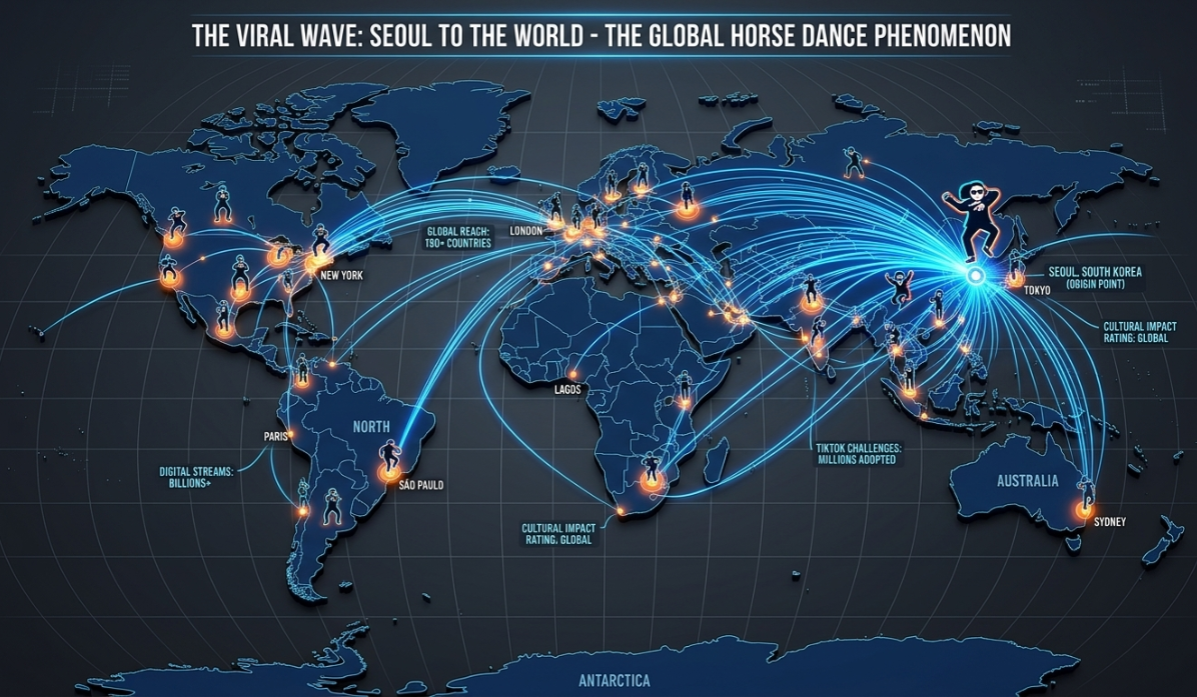
By August 2012, Gangnam Style was everywhere. Late-night TV shows parodied it. Politicians attempted the dance (with generally embarrassing results). Flash mobs appeared in cities worldwide. Even the then-Secretary-General of the United Nations, Ban Ki-moon, practiced the dance with PSY during an official meeting.
The video hit 500 million views in 58 days. To put this in perspective, the previous record holder was Justin Bieber's ""Baby,"" which took over two years to reach that figure.
But this was only the beginning.
## The 32-Bit Problem
To understand what was about to happen, we need to talk about something technical. Don't worry, I'll keep it simple.
When YouTube engineers created the platform in 2005, they needed to decide how to store the view counter. They chose to use a signed 32-bit integer. Without getting into overwhelming technical details, this means the maximum number they could store was 2,147,483,647.
Two billion. It seemed more than enough.
In 2005, the idea that a single video could reach two billion views was absurd. YouTube barely existed. Viral videos of that era reached maybe a few million views. The most-watched video in the platform's early years was ""Evolution of Dance,"" with a modest 70 million views.
The programmers weren't being negligent. They were being reasonable by the standards of their time. Nobody could predict what was coming.
## The Countdown to Collapse
As 2014 progressed, YouTube engineers started getting nervous. Gangnam Style hadn't just stopped growing—it was still accumulating millions of daily views, years after its release.
The calculations were clear: the video would reach the counter's maximum limit before year's end.
What would happen when it hit 2,147,483,647? The possibilities weren't good. The counter could simply stop, frozen forever at that number. Or worse, it could ""overflow"" and reset to zero, or even display a negative number.
Imagine the chaos. The most-watched video in internet history suddenly showing negative views. The conspiracy theories would have been epic.
## The Emergency Solution
Google didn't wait for disaster to strike. Sometime in 2014, YouTube engineers performed a massive infrastructure update. They migrated the view counter from a 32-bit integer to a 64-bit one.
The new maximum limit was now 9,223,372,036,854,775,807. Over nine quintillion. A number so absurdly large that even if every person on Earth watched a video a billion times, they wouldn't come close to reaching it.
When Gangnam Style finally surpassed the old limit on December 1, 2014, YouTube celebrated the moment with an Easter egg. If you hovered your cursor over the view counter, the numbers would spin like a slot machine—a playful nod to the video that had broken their system.
In a statement, Google wrote: ""We never thought a video would be watched in numbers greater than a 32-bit integer... but that was before we met PSY.""
## The Technical and Cultural Legacy
Gangnam Style held the record for YouTube's most-watched video until 2017, when it was surpassed by Wiz Khalifa's ""See You Again."" Currently, the video has over 5 billion views and continues accumulating more every day.
But the video's impact goes far beyond the numbers.
From a technical perspective, Gangnam Style forced digital platforms to rethink their limits. If one video could break YouTube's counter, what other design assumptions were waiting to be challenged? The upgrade to 64-bit became standard not just for YouTube but for virtually any system handling large amounts of data.
Culturally, the video proved that viral content knows no borders. An artist singing in Korean, with cultural references specific to Seoul, conquered the world without needing translation or adaptation. This opened the doors for the global K-pop explosion that would follow. Without Gangnam Style, it's hard to imagine the phenomenon of BTS or Blackpink reaching Western audiences the way they did.
## Lessons from an Invisible Horse
There's something deeply ironic about this whole story. The world's most brilliant engineers, working for one of the planet's most valuable companies, were outsmarted by a guy dancing like he was riding an invisible horse.
It's not that they were incompetent. It's that the future is fundamentally unpredictable. In 2005, nobody could imagine a world where billions of people would watch the same video. In 2012, nobody could predict that video would be a Korean pop song.
For those of us who lived through that era, Gangnam Style is more than a nostalgic meme. It's a reminder of a specific moment in internet history, when virality still felt magical and unpredictable, before algorithms controlled everything.
## The Day We All Danced Together
If there's one thing Gangnam Style demonstrated, it's the unifying power of the absurd. For a few months in 2012, the entire world shared the same joke. Wall Street executives, teenagers in Tokyo, grandmothers in Brazil—all attempting the same ridiculous dance.
In an era of increasingly fragmented internet, where everyone lives in their own algorithmic bubble, it's hard to imagine something like that happening again. Gangnam Style was perhaps the last great moment of viral unity, the last video that absolutely everyone watched.
And in the process, it broke YouTube. Literally.
The next time you see a view counter on any platform, remember that number can go up to nine quintillion thanks to a Korean artist nobody knew and a dance nobody should have taken seriously.
Oppan Gangnam Style, indeed."
About the Creator
ELIAS PULIDO
Storyteller by necessity. The best stories don't live in headlines — they live in the details nobody notices. I write about people, ideas, and the moments when the world shifts direction. Sometimes without anyone realizing it.
Enjoyed the story? Support the Creator.
Subscribe for free to receive all their stories in your feed.
Comments
There are no comments for this story
Be the first to respond and start the conversation.