
Eleven Ships. Three Minutes. No CGI.
Inside the most brutally practical scene in Christopher Nolan’s The Odyssey—and why it leaves the Homeric story behind.
The first stone left the cliff edge while the sea was still green.
Over two meters in diameter, limestone, its surface crusted with dried barnacles. It took roughly four seconds to punch through the deck of the first ship. The wood split from the center, cracks racing toward bow and stern like an invisible blade had sliced it clean down the middle. There were seventeen oarsmen aboard. They were furling the sail when the stone landed. No one looked up.
The second stone struck the stern. Smaller, maybe the width of a man’s torso, but faster. The helmsman at the tiller was driven into the water along with the steering oar, the spray rising three feet higher than the mast. Then the third, the fourth. Eleven ships turned into eleven piles of floating wreckage and eleven slowly fading halos of blood in the water in less than three minutes.
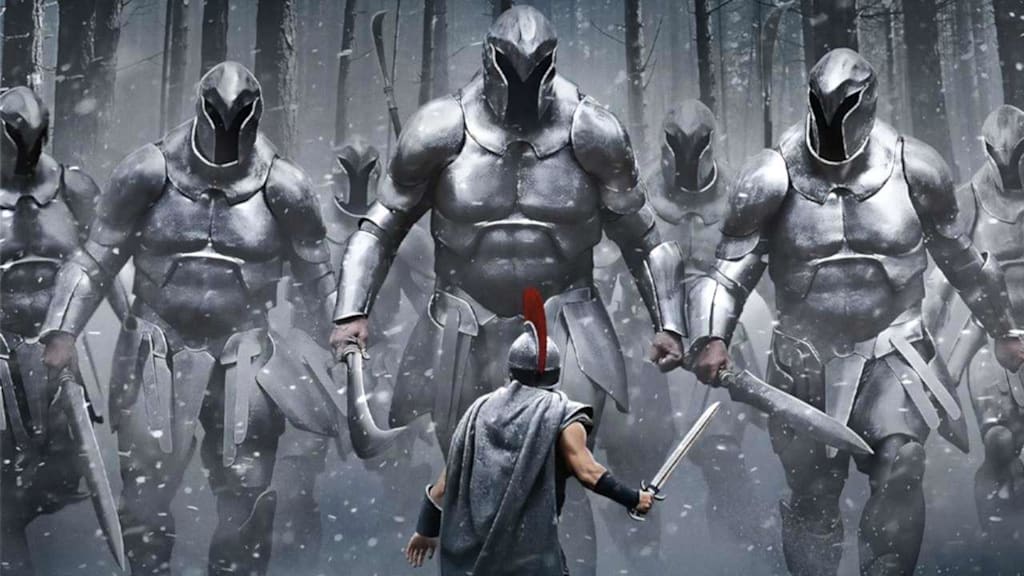
Nolan cut this sequence short. From the moment Odysseus’ flagship entered the outer harbor to the moment the giants appeared above the cliffs, there was only about two minutes of transition. No line of dialogue explained who these giants were. No map marked the borders of their territory. No voice-over announced, “This is the land of the Laestrygonians.” All the audience saw were hunched, dark silhouettes backlit against the sky, shoulders rising above the scrub brush on the cliff edge, arms hanging past their knees, palms wide enough to cup the entire curvature of a boulder.
In the text Homer composed around the eighth century BC, these giants had a name: the Laestrygonians. In Book X, Odysseus sent three scouts along a level road to the water source, up to the palace of King Antiphates. The palace gates were so high one had to crane one’s neck to see the lintel. Antiphates came out, asked no greeting, offered no wine or bread, simply seized one scout by the shoulder, lifted him off the ground, and bit through the artery in his neck. The other two fled back to the beach, and behind them came an entire race of giants. They stood on the harbor cliffs, hurling boulders at the fleet below, and spearing the struggling Greek soldiers in the water with sharpened poles, fishing them out like olives on a fork.
Odysseus had left his own flagship outside the harbor mouth. His customary caution. That ship, and the few dozen men left on it, became the last living flesh of the entire Greek expeditionary fleet. Before this, he had lost men in the land of the Cicones, and six more companions in the cave of the Cyclops Polyphemus. But this time, eleven ships and the hundreds of oarsmen and soldiers aboard them were reduced to zero in a single morning.
Nolan’s crew did not generate the giants with computers. On Reddit’s movie discussion boards, a self-proclaimed extra who claimed to have been on set mentioned that the director’s team scoured the country for actors over seven feet tall to play the giants, while simultaneously recruiting stunt performers under five feet to play Odysseus and his crew. When they stood on the same ground, the camera had to be fixed at a precise pitch angle: ten degrees of tilt, no more, no less, or the perspective would break. Matt Damon later mentioned in an interview that his stunt double for the giant sequence was a remarkably petite woman, who had to wear the same armor and oarsman’s gear as Damon, matching his arm swing and head bob in high-speed runs. She trained for six weeks. Damon said the first time he saw the finished cut, he couldn’t tell which shots used the double.
Anne Hathaway added another detail: the hunched posture of the giants’ shoulders was not the actors’ natural bearing. It was sculpted by custom foam muscle suits. Each suit weighed about thirty kilograms, with an internal metal frame supporting the protruding angle of the shoulder blades. Once the actors put them on, their center of gravity shifted forward, their heels hit the ground a third heavier than normal, and when throwing stones, the rotation of their waists was a full circle shorter than a natural effort because the foam restricted ribcage expansion. The camera captured every ounce of that physical bluntness, so the giants on screen never looked nimble. Their arms rose slowly, turning took two steps, and after each throw the whole body lurched forward half a pace. It was that very clumsiness that produced an almost visceral pressure in the audience: not fear, but the helplessness of knowing that the other being is ten times your weight, twice your height, a third your speed, but every blow carries real mass.
Yet pressure cannot replace narrative.
The confusion raised by the original Reddit poster only surfaces after the credits roll: who were these giants? Why did they attack? Where did they go afterward? Homer spent roughly forty lines setting up the scouts’ walk from the beach to the palace, describing the width of the aqueduct, the height of the palace walls, the number of women gathered at the gate. Nolan did not have forty lines of screen time. He compressed the diplomatic approach into three shots: scouts disembark, scouts walk up the mountain path, scouts do not return. Then only stones remain.
There is a logic to this compression. The Laestrygonians appear only once in the entire narrative architecture of the Odyssey. They do not provide intelligence like Circe, they do not pursue Odysseus for ten years like Poseidon, they do not generate a curse that echoes in later books like the Cyclops. They are a pure consumable obstacle, designed to reduce twelve ships to one, and after they accomplish that, they exit the story. No character biography, no tribal epic, not even a death scene needs to be filmed. Nolan simply translated Homer’s own treatment of the episode, equally one-off and equally functional, into cinematic language.
The problem is that in the oral tradition of epic, the audience already knew who the Laestrygonians were. In the maritime folklore of that age, the name of the man-eating giant tribe was shared cultural background, needing no explanation. But a movie theater audience in 2026 does not have that background. When the giants on screen have no origin, no dialogue, no aftermath, they read less as mythological figures and more as a random natural disaster from a catastrophe film, like a tornado or a tsunami. It comes, it goes, no explanation required.
Nolan’s refusal to explain is, on a technical level, almost obstinate. He used thirty-kilogram foam suits and a ten-degree lens tilt to reproduce onto the screen the most primal terror of the Homeric age: something three times your size standing on high ground and dropping things. He added no psychological motivation and no social structure, and he withheld moral judgment. The giants are simply large. The stones are simply heavy. The fleet simply splinters into timber. What the audience receives in that moment is not story, but physics itself.
After the last stone dropped into the sea, the surface flattened again. Driftwood carried outward on the tide, the blood-tinged water diluted to invisibility against the blue-green. Odysseus’ flagship turned, the oars sliding into the water: one stroke, two, one, two. The ship took about forty seconds to clear the harbor. The camera pulled back from the stern, the harbor shrinking to a dark cleft, the giants on the cliff reduced to six tiny black cutouts, motionless.
The first stone to fall (two meters across, its barnacles dried) lies somewhere on a shallow shoal in the Ionian Sea, to this day.
About the Creator
Jin
Writer of reamstories
https://reamstories.com/jin
Enjoyed the story? Support the Creator.
Subscribe for free to receive all their stories in your feed. You could also become a paid subscriber, letting them know you appreciate their work.
Comments
There are no comments for this story
Be the first to respond and start the conversation.