
China’s Short Drama Machine Is Conquering the World, and It Has Nothing to Do With ‘Human Nature’
Inside the industrial system that turns revenge, humiliation, and payback into a global export, and why AI is about to make it worse.
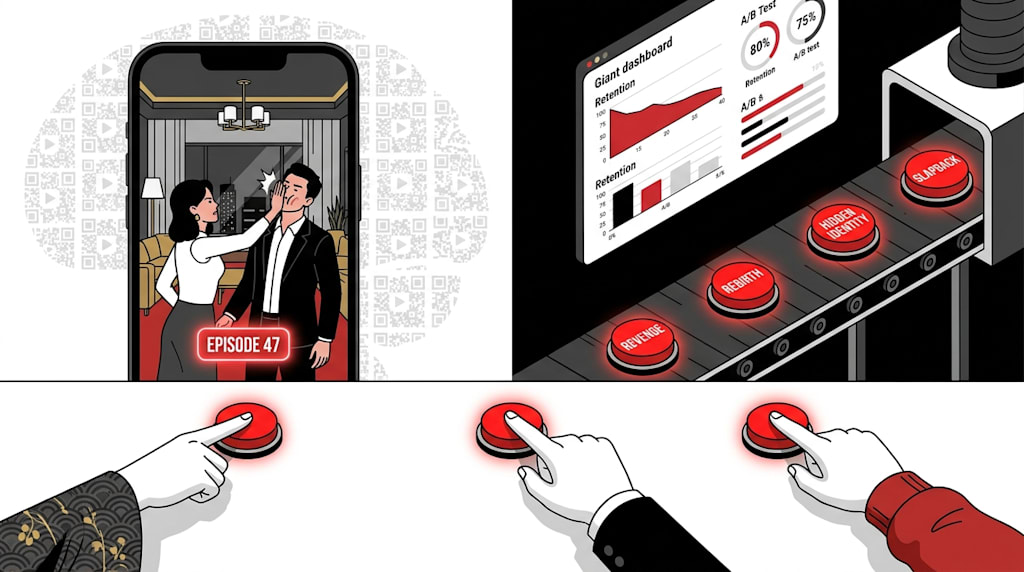
A popular argument goes like this: Europe, the United States, and Japan control the language of film and television, so a costume drama should look like Game of Thrones, and a small, tender story should feel like a Shunji Iwai film. China, by contrast, has supposedly found the “code of human nature.” Its short-drama exporters take the domestic formula of comeback, revenge, and the hidden master who plays the fool. They repackage it with local flavors (yakuza, wealthy families, live-in sons-in-law, manipulative boyfriends) and push it overseas. Platforms such as DramaBox, ShortMax, and ReelShort began with live-action vertical dramas and are now moving toward AI. Genres will multiply: time travel, mecha, magic, anime-style adaptations. Soon not only women aged 20 to 40 will be pulled in, but everyone.
The argument is half sharp and half inflated.
The sharp half: the export advantage of Chinese short drama comes from turning popular narrative payoffs into modules, testing them with ad spend, and dressing them in local cultural skin. That process does not require telling “Chinese stories to the world.” It requires knowing which three seconds will make a thumb stop.
The inflated half is the phrase “code of human nature.” What the industry has found is a set of buttons that can be pressed within three seconds, measured by retention, and monetized at a paywall. That is attention engineering. It captures the layer of motivation that can be triggered quickly and measured cheaply: dignity, safety, belonging, recognition, status, and the pleasure of retaliation. These motives are limited. Their cultural expressions are not. The industry measures the first part and mistakes it for the whole.
The advantage is engineering
Revenge, humiliation, hidden identity, the fool who turns out to be a master, the son-in-law who rises, the family reunion, the public slapback after an insult. These are not Chinese inventions. They are part of the global stock of popular narrative. Latin American telenovelas run on family secrets and status reversals. Korean dramas have built entire industries on chaebol revenge. Japanese manga and yakuza films know the pleasure of the outsider who reveals his power. American superhero stories and Cinderella plots are also stories of recognition and payback.
What Chinese short-drama teams built is a production and distribution system around these motifs: low-cost, fast shooting; vertical video built for a phone; a three-second hook; aggressive A/B testing of opening frames and ad creatives; mini-program payment links; batch production; and rapid replacement of cultural skin for different markets. The system does not need to know what the audience wants in advance. It can test many versions and let the metrics decide.
That is the real engine. It is an attention pipeline, not a map of the human soul. It captures the layer of human motivation that can be triggered quickly and measured cheaply. These motives are limited. Their cultural expressions are not. The industry measures the first part and mistakes it for the whole.
Localization is more than a sticker pack
Japan is often used as the test case. Take the Chinese revenge formula, add yakuza, wealthy families, a live-in son-in-law, and a manipulative boyfriend, mix in anime or manga aesthetics, and Japan will supposedly be conquered.
The direction has commercial logic. Japan has a long tradition of yakuza stories, family inheritance dramas, manga adaptations, and period dramas. A story about a modern man with an automatic rifle falling into the Edo period (an Armed Into Edo variation on the Chinese example Armed Into Song) fits a familiar fantasy: modern force arrives in a premodern world and rearranges the power structure. The image is strong. It can sell a trailer.
But effective localization finds the local emotional entrance and moral grammar. It does not stop at adding labels. “Live-in son-in-law” is not a central structure in mainstream Japanese social imagination. A “PUA scumbag” plot depends on platform tone, audience age, and local sensitivity. A rifle in Edo raises questions of historical accuracy, violence standards, platform policy, and national memory. A concept can capture one segment without capturing the whole market.
A revenge story in Japan can run through yakuza honor, workplace bullying, family succession, or the resentment of the provinces toward the center. A comeback story can borrow the heat of manga, the underdog against a conglomerate, or the local against the capital. The skin changes. The skeleton remains: humiliation, pressure, reversal, public payback, identity reveal, retaliation. That skeleton is universal. It is also easy to exhaust.
AI widens the catalog, but “seconds to generate” is a pitch deck line
The AI transition will change supply. It lowers the cost of testing. A team can generate a concept trailer, storyboards, voiceovers, background plates, and character looks for mecha, magic, time travel, anime-style romance, middle-aged male power fantasy, or rural comeback stories. It can test a long-tail genre before committing to a live-action shoot.
That will widen subject matter. It will also widen the audience beyond urban women aged 20 to 40. Middle-aged men, anime fans, and lower-tier market users can all be served with more targeted formulas.
But “a few seconds to generate a full drama” is exaggeration. Coherent narrative, character consistency, performance, dubbing, music, copyright, platform review, payment conversion, and user acquisition still require human work. AI is an accelerator for samples and assets, not a fully automatic money printer. Live-action short drama will remain a major part of the market. AI will eat part of the long tail and the testing layer.
The “everyone will be pulled in” line also has limits. Children’s content involves advertising, payment, and child protection rules. Platforms and regulators will draw boundaries. Adult revenge fantasy cannot simply be extended to minors.
Slop reveals the metric, not the species
The network fills with slop: three-second hooks, one reversal per episode, high emotional density, flat characters, identical lighting, identical revenge beats. Algorithms reward what can be measured. Slow burns, ambiguity, and complicated people get pushed out.
This does not prove that human nature is monotonous. It proves that the slice of human nature captured by short-cycle metrics is monotonous. The button that converts is simple. The person who presses it is not.
The stronger claim is narrower: human motivations are finite, but their cultural forms, moral frames, and narrative imaginations are not. Short drama has found the buttons that are easiest to monetize. It presses them repeatedly. Audiences tire. Platforms compete. Regulators arrive. Creators look for the next skin.
Armed Into Song and its cousins do not need to be ashamed of themselves. Genre pleasure is fast food. It can be tasty, efficient, and commercially real. The problem is not that fast food exists. The problem is mistaking the menu for a worldview, and mistaking an ad-testing dashboard for anthropology.
A more stable conclusion
The replicable advantage of Chinese short drama overseas is an industrial system: payoff modules, local skin, ad testing, and low-cost production. AI will amplify that system. It will also amplify its homogeneity. It can capture part of the Japanese audience and widen genres globally, but it will not conquer a market simply by adding yakuza, wealthy-family, and live-in-son-in-law labels.
Human nature is not monotonous. It has been sliced into monotonous pieces by algorithms that reward only what can be measured in a short window. Short drama sells the few slices that have been tested and proven to convert. Fast food is fine. Do not confuse the menu with the world.
About the Creator
Jin
Writer of reamstories
https://reamstories.com/jin
Enjoyed the story? Support the Creator.
Subscribe for free to receive all their stories in your feed. You could also become a paid subscriber, letting them know you appreciate their work.
Comments
There are no comments for this story
Be the first to respond and start the conversation.