
China’s Music Industry Is Broken for Everyone
Singers make pennies. Platforms bleed cash. Listeners drown in VIP tiers. The system keeps running anyway.
1
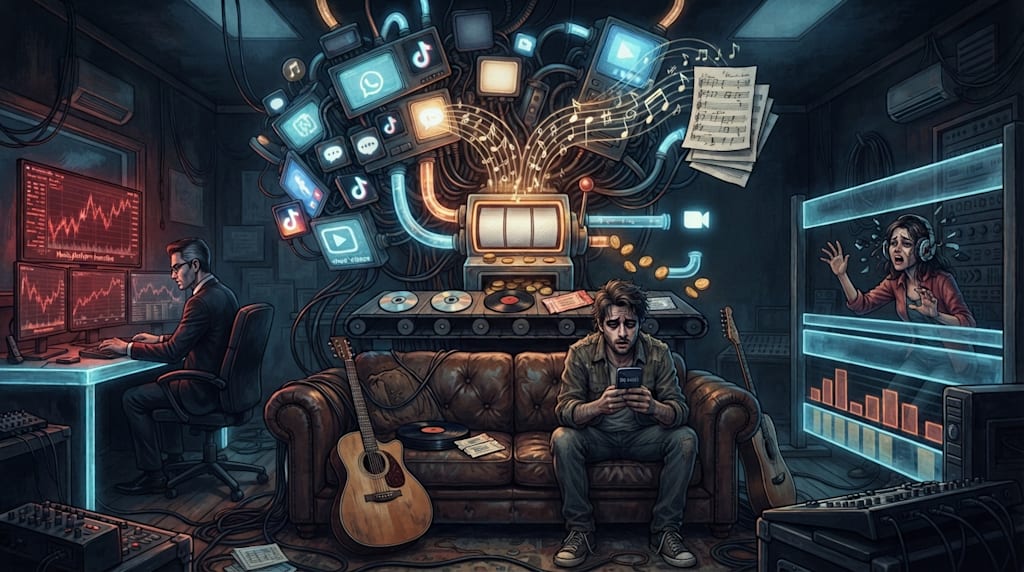
At two in the morning, a singer sits on the sofa outside a recording studio. His phone screen is still lit.
Three days after release, his new song has two million plays. In the comments, someone writes, “I’ve had this on loop all day.” Someone else writes, “The chorus hit and I started crying.” He scrolls down to the backend revenue details. One yuan and seventy cents.
He stares at the number, locks the phone, and puts it face down. Inside the booth, the producer is still adjusting the mix. Through the glass, he gestures: one more take. The singer stands up, pushes the door open, and puts on the headphones.
He wrote this song over four months. The arrangement went through seven versions. Two mixing engineers came and went. On recording day he had a cold. He sang for six hours. The high note in the last chorus was hit while pinching his own thigh. Before release, his copyright agent told him the platform would give him a recommendation slot. The slot came. The plays rose. Where the money is, he does not know.
He asked the copyright agent. The agent said, “Quarterly settlement. Wait a little longer.” He asked the platform. The platform said, “We only deal with the rights holder.” He asked the label. The label said, “The contract says revenue share. I’ll check the exact percentage later.” Three months passed. Nothing was checked.
Eventually he stopped asking. Releasing a song became a pure act: write it, sing it, put it out. Then wait for gig offers, variety show bookings, livestream gifts. Whether the song itself makes money, he no longer expects.
This is most singers in China’s music industry.
2
Twenty years ago, the path was clear.
A record company paid for production, pressed CDs, and distributed them through dealers to music stores. For every copy sold, the record company collected the money and paid the singer and songwriters according to contract. The numbers were not transparent, but the path was open. A singer knew where the money came from and whom to ask.
Making music was a business. Not a big business, but one with decent margins. Record companies signed new artists, planned projects, spent half a year polishing an album. Because it sold. Music store shelves were stocked. Fans saved pocket money and bought. They opened the CD and read the lyric booklet until the pages curled. Concert tickets were paper stubs. After the show, you kept them.
That was the golden window of Chinese-language music. Not perfect. Piracy existed all along. Channels squeezed artists. But there was a basic loop: the work generated cash, cash returned to the content side, and the content side kept investing. Singers lived off their work. Record companies lived off copyright. Channels lived off sales. Listeners paid and got something physical.
Then the loop broke. More than once.
3
The first cut came from piracy.
After MP3s appeared, the music store business collapsed. Street vendors sold burned discs, five yuan each. Then came forums, torrent sites, cloud drives. Record company revenue fell off a cliff. The first budget cut was project planning. Then new artist signings. Then production budgets.
A record store owner once described that period. The most obvious change was not sales. It was the shelves. At first, the shelves held new albums. Later, they held blank burnable discs and MP3 players. Later still, the shelves were gone, and the store became a milk tea shop. He packed the remaining CDs into boxes and stacked them in a warehouse. One box held a first-edition signed disc by a diva. He kept it for twenty years and never sold it. It was not about the value. It represented an era.
Piracy did not kill music. It killed music’s ability to settle as a commodity. The work still circulated, even more widely. The money no longer flowed back. The content side began to bleed.
4
The second cut came from platforms.
After piracy crippled record companies, music platforms entered under the banner of legitimization. At first, everyone thought it was a good thing. Finally someone was willing to pay for copyright. But the platform’s logic was not to sell music. It was to buy traffic. Copyright was a customer acquisition cost, not a profit center.
Then the exclusive copyright wars began. Platforms bid against each other and pushed copyright fees to absurd heights. Record companies breathed a short sigh of relief, then discovered that this money was not ongoing cash flow. It was a one-time advance. After the platform bought the rights, how to split, how much, and when were not decided by the record company. The platform decided.
More critically, the platform turned listening to music into a free or extremely low-priced public service. Users got used to paying a dozen yuan a month to hear everything, or paying nothing and still hearing most of it. The price anchor for music in users’ minds was dragged down completely. Ask someone to pay thirty yuan for a digital album, and they think it is expensive. Ask them to pay fifteen yuan for a monthly VIP, and they think it is acceptable. Out of that fifteen yuan, the amount allocated to each song is negligible.
Platforms have their own suffering. They spent too much buying copyright, and user payment rates will not rise. China’s online music payment rate has long hovered around twenty percent. In Europe, North America, Japan, and many other markets, it can reach forty percent or higher. A monthly membership of a dozen yuan cannot cover copyright costs, operating costs, and research and development. Platforms make up the difference through livestreaming, social entertainment, and advertising. For a long time, Tencent Music’s social entertainment segment contributed most of its profit. NetEase Cloud Music has been under pressure for years. Spotify only achieved its first full-year profit in 2024.
Platforms are not unwilling to make money from music. Pure music subscriptions simply cannot support them.
5
The third cut came from short video.
The biggest change short video brought to the music industry is that it did two things at once: it amplified distribution and intercepted revenue.
When a song explodes on short video, plays can reach billions. Who benefits most? The short-video platform, the MCN, the streamer, the advertiser, the merchant selling goods. The singer gets fame, then uses that fame to monetize through concerts, livestreams, variety shows, and endorsements. The value of the music itself is broken apart in the short-video system into traffic, topics, background music, and emotional material. It rarely returns to the main channel of copyright settlement.
A friend who does short-video music licensing told me that many songs today are written for short video from the start. The intro cannot exceed five seconds. The chorus must appear within fifteen seconds. Ideally there is one lyric that can serve as a caption. The entire song structure is compressed into a fifteen-second explosion plus loop. He said this is not creation. This is making material.
Music became fuel for short video. Once burned, the heat disperses, and the song passes. The singer gained exposure. The platform gained traffic. The user gained free background music. Only copyright revenue is still spinning in place.
6
After three cuts, the industry structure changed.
The content side did not grow giants. Universal, Sony, and Warner survived piracy, digital downloads, and streaming. They still hold massive copyright portfolios. They can still maintain bargaining power when negotiating with platforms. China has no comparable content producer. The copyright pool may be large enough on paper, but it is scattered across the market. No single entity can form a stable budget, long-term investment, and systematic development. Singers, songwriters, and producers can only attach themselves to platforms, variety shows, MCNs, and short-video institutions.
The channel side, however, is too strong. Platforms are simultaneously distribution channels, content buyers, user gateways, and data owners. A singer does not know who listened to his song, how many times, or how much he should be paid. The platform knows, but the platform has no incentive to make the accounts too clear. Clear accounts mean higher costs.
Users are caught in a contradiction. It is not that they refuse to pay. Paying does not buy a certain experience. You buy VIP, but there is still Super VIP. You buy Super VIP, but there are still digital albums. You buy the digital album, but there are still singles. Downloads cost money. Ads are still there. Copyright is still fragmented. Users feel they are not buying a service but being harvested repeatedly. So willingness to pay drops further. Platform revenue drops further. So platforms design more payment points. A vicious cycle.
7
So the strangeness of China’s music industry is not strange at all.
Singers monetize through concerts, variety shows, livestreams, and endorsements. That is rational. Platforms supplement revenue through social entertainment, advertising, and VIP stacking. That is rational. Listeners use short video, free clips, and cross-platform switching to reduce spending. That is also rational. Every actor makes the optimal choice under the existing structure. Together, they produce a bad equilibrium: music itself does not make money, music value is settled elsewhere, the content side has no giants, the channel side is too strong, payment rates are too low, distribution is opaque, and external monetization intercepts the value.
Sentiment cannot solve this. Cursing platforms, listeners, or singers cannot solve this. It is a problem of cash flow and bargaining power.
You once mentioned an observation line. The day China produces a music content producer with annual new budget investment, including employee expenses, of four billion RMB, it will have emerged. That line is cruel, but accurate. Without cash flow and budget at that scale, the content side cannot cultivate a stable creative pipeline, nor can it stand up to channels in negotiations. Every year looks lively, but it is still a few scattered creators reciting a menu.
8
What would it take to break the equilibrium?
The content side needs real copyright or label giants. Ones that can invest steadily, cultivate creators systematically, and negotiate with channels. Without a producer spending four billion RMB a year on content, the music world can only survive, not thrive.
Payment rates and average revenue per user need to rise to a level that covers reproduction. Not through forced VIP, but by making users feel that paying buys a certain, complete, non-annoying experience.
Royalty distribution needs to be transparent. Singers, songwriters, and producers should know clearly who used their work, how much it earned, and how much they should get. If the black box of distribution is not broken, creators will never have security.
Short-video platforms need to pay reasonable consideration for music. They cannot enjoy the traffic and emotional value music brings while pushing copyright settlement to the margins.
Diversified distribution needs to grow. Concerts, merchandise, vinyl, games, film and television, hardware, KTV, sports and fitness. All should become channels for recovering music value, not just streaming subscriptions.
These conditions will not mature at the same time. But the direction is clear.
9
Back to the recording studio at two in the morning.
The singer finishes the last take. The producer gives an OK sign. He takes off the headphones, walks out of the booth, and picks up his phone from the sofa. The screen is still lit. The backend revenue details are still stuck at one yuan and seventy cents.
He glances at it, locks the screen, and puts the phone in his pocket. Then he opens his notes app and starts writing down the city list for his next tour. The first stop is his hometown, a third-tier city. Next to it he types in parentheses: “Venue not too big. Try a small one first.”
He does not know when that song will make him money, or whom to ask for it. But he knows tomorrow there is a show, the day after tomorrow a variety show taping, next week a livestream. The song itself does not make money. What the song brings can.
He can only survive this way. The whole industry can only survive this way.
This is a bad equilibrium. It is stable. Everyone is dissatisfied. No one can move.
About the Creator
Jin
Writer of reamstories
https://reamstories.com/jin
Enjoyed the story? Support the Creator.
Subscribe for free to receive all their stories in your feed. You could also become a paid subscriber, letting them know you appreciate their work.
Comments
There are no comments for this story
Be the first to respond and start the conversation.