
A Viking Ship, a $6,000 Bill, and the Blockbuster That Forgot to Pay
Christopher Nolan’s Odyssey made $700 million. A tiny Swedish charity is still waiting for its repair money — and one cracked plank tells the whole story.
In the summer of 2026, The Odyssey crossed $700 million at the global box office by its third weekend. Christopher Nolan's name was once again printed at the top of every review, with praise centered on practical filming, IMAX stock, and that "old‑world craftsmanship" feel.
At the same time, in the village of Nysäter on the outskirts of Säffle, Sweden, a nonprofit called Vikingaleden was going through its books. One entry showed 60,000 kronor (about $6,000) in receivables that had been outstanding for over a year. The debtor was a project company under Universal Studios. The last email reply had come the previous winter. Messages sent after that were neither returned nor opened.
I. The Ship
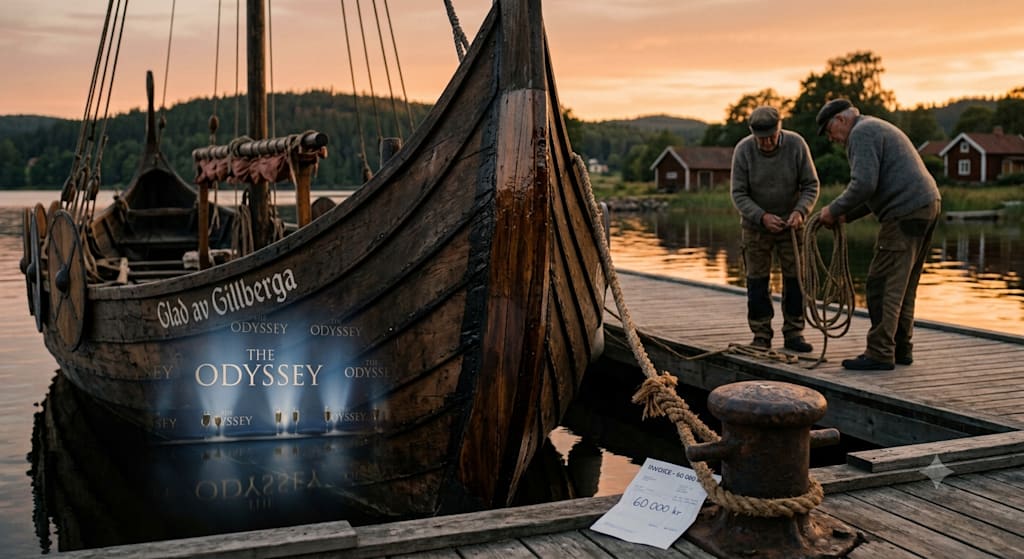
Glad av Gillberga is not a prop. It is a Viking longship built by hand by members of Vikingaleden between 1995 and 1998. No existing plans were reused, no prefabricated keel was available. Oak was selected from local forests, shaped into planks with axes and adzes, caulked with tar and hemp, and rigged with a hand‑woven linen sail. Every technique was reconstructed from archaeological findings of the Viking Age.
The ship is roughly 16 meters long and can carry 30 oarsmen. After launching, she took part in Baltic Sea Viking cultural cruises, called at ports in Denmark, Norway, and Finland, and was entered into the Swedish Maritime Museum's register of folk vessels.
In the spring of 2024, a production coordinator from Universal Studios contacted Vikingaleden through a third‑party rental agency. The email was politely worded: "We need three Viking‑style longships for practical shooting on director Nolan's new film. Your vessel meets all our requirements."
A contract was signed. The lease ran for six months, with an undisclosed rental fee (organization chairman Peter Olausson declined to give the exact figure, only saying it was "enough to cover basic maintenance while the ship was idle"). The contract also stipulated that any damage during transport or use would be borne by the lessee, with costs settled on an actual‑cost basis.
The ship was loaded onto a trailer and transported by road to a location in the UK. Olausson did not accompany it. He said, "We trusted the contract."
II. The Crack
In the autumn of 2024, the ship was returned to Nysäter. As it came off the trailer, volunteers noticed a longitudinal crack in the outer planking on the port side of the stern, roughly 40 centimeters long, running from the waterline up to the deck edge. The stern rudder shaft socket also showed wear, with loosening at the joint.
They took photographs and drew up a two‑page repair plan. The materials list included: a three‑meter length of selected oak plank (needing to be re‑air‑dried), hand‑forged iron nails, tar, hemp, and natural varnish. Total: 60,000 kronor. No labor was charged because the eight volunteers who carried out the repairs worked without pay. It took them three weeks to complete the work. The ship was relaunched in May 2025, just in time for the first public sailing of the tourist season.
The invoice was sent in January 2025, addressed to the production company named in the contract. After two weeks with no reply, Olausson sent a follow‑up email. A month later, he called the agency, which said, "It's been forwarded to the production department." After that, emails began to be ignored.
In March 2025, Olausson tried contacting Universal Studios' U.S. headquarters customer service email. No response. In April, he checked the registered information of the contracting company through the Swedish Business Association—it was a Delaware‑registered limited liability company, incorporated in September 2023, precisely matching the filming schedule of The Odyssey.
"By May, I started to think they weren't going to pay," Olausson told Sweden's Expressen in an interview. His tone was flat, without anger, as if stating something already digested.
III. The Industry Structure
The way Hollywood project companies (special purpose vehicles, or SPVs) operate is no secret in the industry. Every major production typically incorporates a separate legal entity to sign contracts, pay wages, and handle various expenses. After filming ends, the company closes its books, transfers remaining assets back to the parent, and dissolves. If there are unpaid accounts before dissolution, they do not automatically transfer to the parent—creditors must sue separately in the company's state of incorporation (usually Delaware or California), and can only claim against what remains of the SPV's assets.
And SPVs often zero out their cash—or even book a loss—before dissolution.
This is not a legal loophole; it is a well‑designed firewall. It protects the parent and investors from post‑production lawsuits, and it means that small suppliers face prohibitively high startup costs when pursuing small claims.
Olausson put it bluntly: "We can't sue. That would mean hiring a lawyer in the U.S., spending several times that amount in legal fees, and going up against an entire legal department. We only have one set of books."
He did not use the word "unfair." He simply said, "We don't have the capacity."
IV. The Contrast
What does 60,000 kronor mean?
In Vikingaleden's annual budget, it accounts for about 8% of total operating funds. That money pays for the museum hall's electricity, winter storage rental for the ship, website maintenance, and brochure printing. Without it, the organization would have to cut back elsewhere—for example, by reducing two scheduled school sailing trips in spring 2026, which would mean hosting about 60 fewer primary and secondary school students.
On The Odyssey's production sheet, $6,000 is roughly what the crew spends on location catering for a regular shooting day. During the promotional period, at the London premiere after‑party hosted by the studio, the champagne served was priced at about $180 a bottle. With 200 guests in attendance, just the drinks bill came to over $36,000.
Universal's first‑quarter 2026 earnings report showed global marketing expenditure of $210 million, with The Odyssey's individual promotion budget around $120 million. The theatrical ad spend for its opening weekend exceeded $8 million.
All these numbers are publicly available.
V. The Price of Trust
Vikingaleden had worked with film companies before. In 2019, a Nordic co‑production rented one of their other ships, damaged the bow ornament, and paid the repair cost within a week, along with an additional thank‑you letter. In 2022, Swedish Television filmed a Viking‑themed documentary, using the same Glad as a backdrop—the contract stipulated the ship was not to leave the shore, with a dedicated attendant each day, and it was returned undamaged.
Olausson said he chose to partner with The Odyssey partly because of Nolan's reputation and partly because the contract terms were clearly written, and the other side had proactively offered to "cover all reasonable wear and tear." He had no reason to doubt.
Now he admits that if a similar offer comes again, he will require a prepaid repair deposit or an irrevocable letter of credit from a U.S. bank.
"We won't trust 'settle after the fact' anymore," he said.
That may be the most concrete yet unquantifiable loss—a small cultural organization, after completing one cross‑border collaboration, has learned not to trust its partner's promises. That change was triggered by a $6,000 unpaid bill, but its effects will persist across every future contract the organization signs.
On Universal's side, the department responsible for sourcing similar location props continues to function as usual. Their slate for 2026 includes at least three more productions involving historic vessels or specialty vehicles. They will still call other museums and other民间 groups. The people answering those calls may or may not have heard the name. But their response, when they do, will be different from what it was a year ago.
VI. Aftermath
In mid‑July 2026, three days after the story broke, a Universal spokesperson responded by email to a query from The Hollywood Reporter: "Our records show that all invoices relating to Glad av Gillberga have been paid in full, including repairs. The production has contacted the association to clarify any misunderstanding."
When asked by a reporter whether he had received payment, Olausson said, "As of now, no new deposits have arrived in the bank account. I'm still waiting."
He has not sent another email. He said the matter had already been discussed enough; continuing to press might not change the outcome and could make the organization look like it was leveraging public opinion.
"What we really want isn't the $6,000 itself," he said. "We want a reply. An email that says 'why.' Even if it says 'we made a mistake,' that would be better than nothing at all."
VII. Back on the Boat
The repaired Glad av Gillberga completed its first public sailing of the season in June 2026, carrying 22 passengers from the Nysäter dock, heading downstream along the Byälven River for about two hours. The weather was fine. Volunteers on board explained Viking navigation—they had no compasses, relying instead on the sun's angle and the flight directions of birds to gauge the coastline.
At the end of the trip, a ten‑year‑old boy asked Olausson, "Has this ship ever been to America?"
Olausson thought for a moment. "No," he said. "The farthest it's gone is England. To make a movie."
The boy asked again, "So is it famous?"
"Probably," Olausson said. "But being famous doesn't do it much good. It's still wood and nails, and it has to be tarred again every year."
He finished tying the mooring line to the iron bollard on shore. The repaired plank at the stern wore fresh varnish, slightly darker than the surrounding old wood. It would take two or three more summers of wind and sun for the color difference to fade entirely.
By then, the invoice might still be listed in the books. Or it might have been cleared. But the ship will launch as usual, carry passengers as usual, and be re‑oiled as usual.
Olausson said that is why they run the organization. Not to make money, not to be in movies. Just so that every summer, someone can sit on that boat and feel what the river looked like to people a thousand years ago.
That will not change.
About the Creator
Jin
Writer of reamstories
https://reamstories.com/jin
Enjoyed the story? Support the Creator.
Subscribe for free to receive all their stories in your feed. You could also become a paid subscriber, letting them know you appreciate their work.
Comments
There are no comments for this story
Be the first to respond and start the conversation.