
A Short-Drama Character Told Me to Sleep. My Thumb Kept Scrolling.
Hongguo’s new rest reminder is a friendly gesture. It cannot compete with autoplay, dopamine hooks, and an algorithm built to keep me awake.
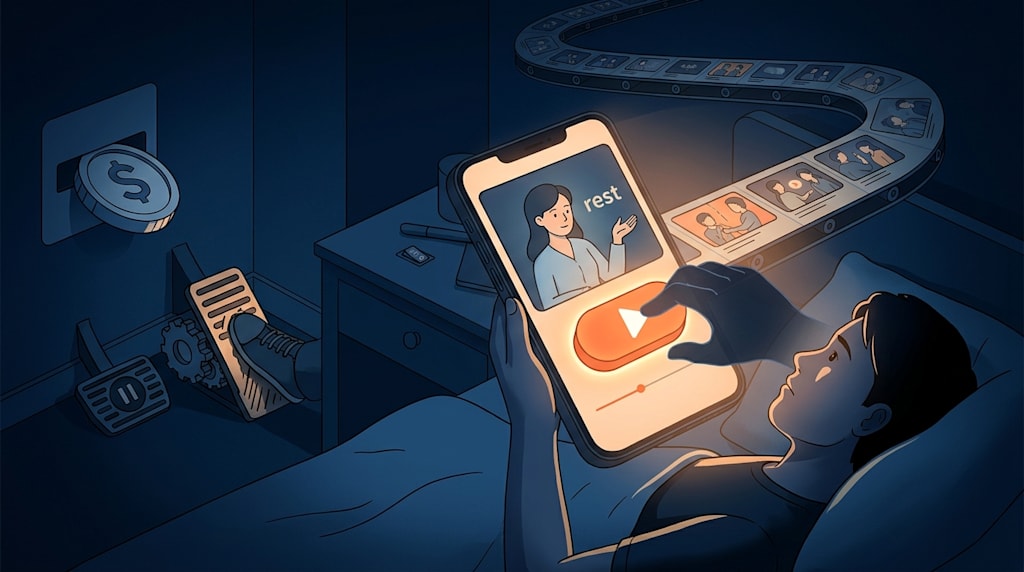
Hongguo Short Drama now shows “rest reminders” and “sleep reminders.” If you watch too long or open the app late at night, a character from a short drama may appear on the recommendation page and tell you to take a break. The move is easy to like. A platform is finally saying, “Go to sleep,” and it does so without sounding like a warning label. But a character’s friendly nudge will not stop people who cannot stop scrolling short dramas.
The reason is simple. Short dramas hold attention through a content system built on physiology, psychology, and algorithmic distribution. A reminder video sits outside that system and asks one gentle sentence to compete with a design meant to keep people watching. The result will be limited.
1. Short dramas run on a dopamine rhythm, not plot quality
Short dramas are short and fast. They are loaded with hooks. An episode lasts a few minutes. Conflict arrives at the start. A hook lands every few seconds. A reversal follows. The ending opens another question. Viewers do not get time to judge whether the plot makes sense before the next emotional push arrives. Poverty, humiliation, betrayal, and workplace abuse give way to an inheritance, an awakening, or a public comeback. These formulas are old, but they hit ordinary psychological gaps with precision.
A worker who has been humiliated feels vindicated when the protagonist turns the tables. A viewer with a flat life projects into the sudden windfall. Control and compensation that are hard to find in reality arrive every few minutes. The feedback is too fast and too dense. Under constant high stimulation, the brain becomes less sensitive to the same level of pleasure. It needs stronger conflict, faster reversals, and more episodes to feel excited. The loop follows: the more you scroll, the harder it is to feel satisfied; the harder it is to feel satisfied, the more you scroll. You end up empty while watching and emptier when you stop.
A line like “You have been watching for a long time; please rest” cannot act as a brake in this system. The viewer is not facing a reminder. The viewer is facing the suspense of the next episode. The reminder can be swiped away. The algorithm is already preparing the next item. A gentle nudge and a high-stimulation feed do not carry the same weight.
2. Reminders and algorithms can cancel each other out
A platform that adds anti-addiction reminders has taken a step. The step matters only if the reminder sits at a key point in the product logic. If a rest reminder appears while the algorithm keeps pushing high-hook content, the reminder works as soft persuasion that users can bypass. It does not work as a boundary.
One commentator described the problem well: the reminder is a brake, and algorithmic recommendation is the accelerator. The brake is tapped. The accelerator stays pressed. The car does not slow down. A user opens short dramas late at night, and the recommendation page keeps serving “the next one will be better.” A user is told “time to sleep,” swipes once, and lands in a new plot. The reminder has no mandatory stop and no default pause. Autoplay keeps running. Its force is small.
The reminder can also create a false sense of care. A user sees the prompt and thinks, “I have been reminded.” That thought can loosen vigilance. The platform has shown concern. The user keeps watching. A reminder designed to raise awareness becomes a ritual comfort when it has no hard edge.
3. Platform subtractions matter more than the reminder video
If you look only at the character video, the conclusion is easy: more gimmick than effect. The more important question is whether Hongguo will make costly changes on the incentive side. The company has begun phasing out “watch dramas to earn coins.” The coin system used small rewards to push users to watch longer. It was an artificial accelerator for watch time. Removing coins means the platform is dismantling its own watch-time lever and accepting a possible drop in activity.
Adding a reminder costs little. Giving up coins accepts a data loss. The second move carries the actual cost. A platform’s anti-addiction effort should be judged by what it gives up, not only by what it says. A platform that tells users to rest while rewarding them for watching more is offering a gesture. It is not setting a boundary.
A gesture still has value. It shows that the platform recognizes the limits of a model that trades incentives for watch time. It brings viewing boundaries into product logic. A gesture becomes an effect only when it reaches hard switches in product design.
4. Effective anti-addiction depends on default options, not persuasion
Character reminders cannot rein in people who already feel empty without scrolling. The target is not “this episode.” The target is the emotional regulation pattern that drives the scrolling. Some people watch while eating or cooking, and even in the bathroom. They fast-forward until the dialogue is unintelligible and still refuse to stop. In that state, a sentence saying “time to rest” does little. The user needs an external boundary that works without willpower.
Industry discussion is moving from “should we remind” to “should we set default options that cannot be bypassed.” Examples include pausing automatically after a set number of episodes, turning off autoplay late at night, lowering the recommendation weight of high-hook content at night, and setting default time limits for minors. Some short-video platforms already offer minor modes with default daily limits and nighttime shutdowns. Short-drama platforms mostly offer reminders that users can dismiss. Time-management features are still promised for later.
Anti-addiction works when the platform chooses the right default. Autoplay as the default forces users to stop actively. A pause at a set point removes the need to fight yourself after every episode. The useful move is to make “putting it down” the easier choice rather than persuading you to put down your phone.
5. Conclusion: a character telling you to sleep is a start
Hongguo’s character reminder is not a bad idea. It puts the word “rest” on the recommendation page and brings platform responsibility into view. It will not stop people who cannot stop scrolling short dramas. The addiction comes from a dopamine rhythm and psychological gaps, amplified by algorithmic distribution. One dismissible video cannot counter that combination.
The question to watch is whether the platform will make equal subtractions in recommendation and interaction, not how friendly the character sounds. Less high-hook content. Less autoplay. More default pauses. More nighttime boundaries. A character telling you to sleep is a beginning. Sleep becomes possible when the platform stops treating “make you scroll a little longer” as the default goal.
Anti-addiction is a product-values decision. Reminders alone cannot carry it. Gentle reminders can stay. Without hard boundaries, they remain gentle.
About the Creator
Jin
Writer of reamstories
https://reamstories.com/jin
Enjoyed the story? Support the Creator.
Subscribe for free to receive all their stories in your feed. You could also become a paid subscriber, letting them know you appreciate their work.
Comments
There are no comments for this story
Be the first to respond and start the conversation.