
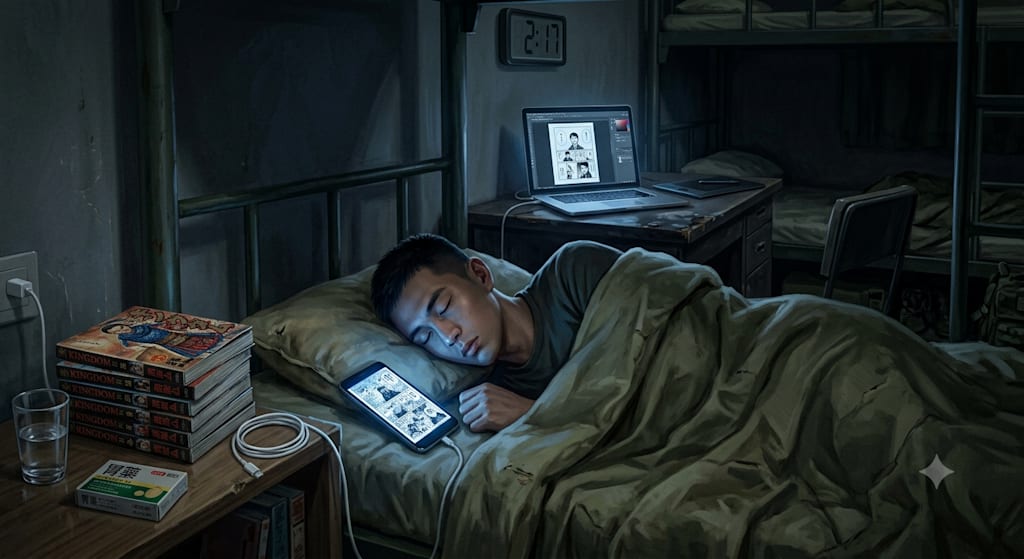
2:17 AM: Scans Across the Strait
For over a decade, a quiet pipeline ran on traditional characters, night‑shift Photoshop, and a gray disclaimer no one believed. This is how Taiwanese manga crossed the water, one raw scan at a time.
"Scans are here. Tong Li edition, page thirty-seven has a folded corner. Who's taking the typesetting?"
The sender's ID was "A-Xiang - Raw." He'd just gotten off watch duty. The glow of his phone screen lit up his face; across the room, the rhythmic snoring from the bunk beds rose and fell. Weekend at a military camp in Tainan. He was the only one awake in the four-man dorm. He dragged thirteen scanned files into the channel with his thumb. Every image carried the watermark of "Tong Li Publishing" in traditional Chinese characters. He'd unbound the books on Friday when he went home, scanned them over the weekend, and brought the files back to camp on Saturday night. Monday morning, duty resumed. The week's translation window was exactly that narrow.
A new avatar appeared in the channel. "A-Jie - Typesetter" accepted the files. He worked a government job in a southern province. His day-to-day had nothing to do with comics. But during every night shift's downtime, he'd dim his monitor to minimum brightness and open Photoshop. He had three solid hours—enough to clear the dialogue bubbles on thirteen pages, embed the text, and send them back.
Two chairs. One strait between them. Two people staring at the same batch of images in their own off-hours.
"Hey, the splash title on this issue's cover—Tong Li printed it in Kaisho, but the original Japanese used Kantenryū. Should I swap it back to traditional handwritten style?" A-Xiang asked.
"Leave it. Just overlay traditional characters directly—no need to redo the background cleanup." A-Jie replied. "And when you're unbinding, watch out for torn inner pages. Last time someone's scan left a white streak right through a speech bubble. Took me forty minutes to fix."
"Got it. This batch is wrapped in kraft paper—safer than the bubble wrap from last time."
The channel went quiet for eight minutes. A-Jie was working on page three. A-Xiang had already renamed the next batch of scan folders and dragged them into the shared drive.
This workflow had been running across the strait for over a decade—Taiwanese physical volumes as the raw input, mainland typesetters as the technical output, traditional characters as the handshake between them. In this context, traditional script wasn't an aesthetic choice. It wasn't about the audience. It was a production step—like how open-source code has to follow a single indentation standard. The Taiwanese provider scanned books that were already in traditional Chinese, and the mainland typesetter just kept using them that way. No discussion needed. No explanation. Switching to simplified would mean realigning every dialogue bubble's coordinates, hunting down an entirely new font library, testing how thick each stroke had to be to cover the original Tong Li characters without leaving jagged edges. Nobody wanted to spend an extra twenty minutes per page on that.
What ran deeper than the workflow was an unspoken understanding, discussed endlessly but never written down.
Every group's release page ended with the same gray disclaimer, two font sizes smaller than the main text: "This work is provided for educational exchange purposes in Hong Kong, Macau, Taiwan, and overseas regions only. Please delete within twenty-four hours of download. This group is based in the Taiwan region and is not subject to the relevant laws and regulations of the People's Republic of China."
That text had been drafted by the first generation of group leaders a decade ago. Every subsequent group just copy-pasted it, changing only the group name. Everyone knew the truth. The forty members in the channel were scattered across Beijing, Shanghai, Guangzhou, Chengdu, Xi'an—and Taipei, Kaohsiung. No one was actually based in Taiwan.
But that gray block of text stayed. Like a doormat at the entrance. You knew it wouldn't stop anyone from coming in. But people walking through at least lifted their feet.
One time, a new proofreader asked in the channel: "We're all in the mainland. Why does the disclaimer say Taiwan?"
The channel went silent for a minute.
A-Jie replied: "Because if you delete that disclaimer and someone screenshots this chat and sends it upstairs, there's no excuse left for anyone to help you with. With it there, everyone can just say, 'Oh, that's an overseas group.'"
The proofreader sent a period: "."
That person never asked about it again.
Traditional script had another, subtler function in this system. The vocabulary differences across the strait, like ruǎntǐ vs. ruǎnjiàn for "software," wǎnglù vs. wǎngluò for "network," chéngshì vs. chéngxù for "program," collided at least once a month. But when everyone worked in traditional characters, those differences blunted. For the mainland typesetter, traditional characters were input he had to recognize but never produce himself. For the Taiwanese provider, they were what he'd written since childhood. Both operated in the same script system. No one had to actively translate their own expression. One person wrote chéngshì in an email, the other replied with chéngxù, but the characters embedded in the dialogue bubbles came out identical. What got reduced wasn't the disagreement itself. It was the opportunity to notice the disagreement.
One winter, A-Xiang posted a photo in the channel. He was in the camp's duty room. In front of him lay a Japanese original volume, its plastic wrap already peeled off. Beside it: a phone, a charging cable, and a box of stomach medicine nearly empty. The caption at the bottom read: "Didn't get leave this week. Had my roommate sneak the book in for me. Cover's a little bent—shouldn't affect the scan."
A-Jie didn't reply with words. He saved the photo, renamed it to "Raw Status 2021.12.jpg" and dropped it into a folder labeled "Archive."
Two years later, the group disbanded. A-Xiang's last message before leaving was: "I've got three more volumes left unscanned. Who wants them?"
A-Jie replied: "Send them to me."
The cloud link came through. By the time the download bar finished, A-Xiang's profile picture had already gone gray.
The scans of those three books still sit on A-Jie's hard drive. He's never finished typesetting them. But every time he opens that folder, he remembers that 2:17 AM, one person just off watch, another just coming on shift, the channel holding nothing but thirteen images and a note about a folded corner.
Traditional characters are still on the pages he worked on. Not because of strategy. Simply because no one ever thought to change them.
About the Creator
Jin
Writer of reamstories
https://reamstories.com/jin
Enjoyed the story? Support the Creator.
Subscribe for free to receive all their stories in your feed. You could also become a paid subscriber, letting them know you appreciate their work.
Comments
There are no comments for this story
Be the first to respond and start the conversation.