
Why Your Health Bar Drains From the "Wrong" Side
The answer sits in the anchor, the screen layout, and the way you read.
Which Side Does a Health Bar Drain From?
You open Elden Ring and take a hit from a boss. The red bar in the upper-left loses a chunk on the right side. You open League of Legends. The enemy champion's health bar at the top of the screen starts emptying from the left end. You play Street Fighter. Player 1's health bar drains from the right end, and Player 2's drains from the left end. Three health bars, three directions. If you stare at only one of them, you might conclude that health bars always decrease from left to right, or always from right to left. Treat the screen as a whole, and the directions stop being confusing.
The anchor determines a health bar's direction. The anchor is the part next to the bar that does not move: the portrait, name, level, icon, or screen edge. If the anchor is on the left, the bar extends to the right. When health is lost, the right end empties first. If the anchor is on the right, the bar extends to the left. When health is lost, the left end empties first. When you see a bar decrease from left to right, the anchor is usually on the right.
The player's own status bar almost always sits in the upper-left. Portrait on the left, name on the left, level on the left. The health bar fills from left to right. At full health, red or green covers the whole bar. When health is lost, the right end starts disappearing. The left end sits against the portrait and cannot move. If the left end emptied first, the bar would drift away from the portrait. In combat, players need to read it fast. A blank gap next to the portrait slows that read. So the left end stays fixed and the right end stretches. You see the health bar decrease from right to left.
When the target frame sits in the upper-right, the logic flips. The enemy portrait is on the right, the name is on the right, and the health bar fills from right to left. When health is lost, the left end starts emptying. You see the health bar decrease from left to right. The player looks at the upper-right, and the remaining health stays close to the enemy portrait. The emptied part extends toward the middle of the screen. The middle is where combat happens. Both health bars empty from the middle, and the gaps meet there. This layout lets the player see both their own health loss and the enemy's health loss at once.
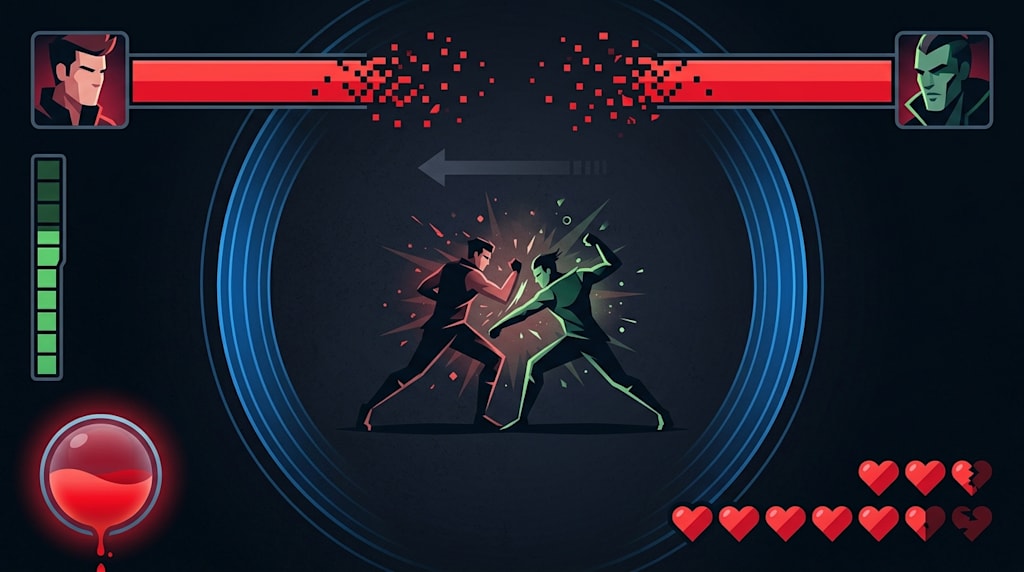
Fighting games push this mirroring to its limit. The UI of Street Fighter II set the standard: Player 1 on the left, Player 2 on the right. Player 1's health bar is in the upper-left, fixed at the left end, decreasing from the right. Player 2's health bar is in the upper-right, fixed at the right end, decreasing from the left. Both bars empty from the side closest to the middle of the screen. The middle is where punches, kicks, fireballs, and dragon punches collide. The health bar disappears from the middle, like a wound tearing open in the center. Player 1's gap extends to the right. Player 2's gap extends to the left. In the end, the two empty bars meet in the middle. Symmetry produces this layout.
MMOs and MOBAs follow a similar rule. In World of Warcraft, the player frame is in the upper-left and the target frame is in the upper-right. The player's health bar is fixed at the left end. The target's health bar is fixed at the right end. When you hit an enemy, the enemy's health bar empties from the left end. When an enemy hits you, your health bar empties from the right end. The empty direction points toward the middle of the screen. The rule is simple: if the information sits on the left, the bar empties from the right. If the information sits on the right, the bar empties from the left.
Reading habits also matter. In cultures that write from left to right, the left end feels like the starting point and the right end like the endpoint. Progress bars grow from left to right. Timelines advance from left to right. A health bar is a remaining resource. At full health, it is 100%. When health is lost, it decreases from 100% downward. The left end is fixed and the right end shortens, like a countdown bar. The starting point does not move. The endpoint retreats. You see the remaining amount still on the left while the right side disappears. Players read it without thinking. When Arabic and Hebrew environments localize UI, they may mirror the entire interface. Health bar direction reverses along with it. Culture and layout decide direction, not physics.
Nonlinear health bars escape the left-right dispute. The health orb in Diablo is round. Health decreases from the top of the orb downward, or from the bottom upward. There is no left end or right end, only a rising or falling liquid level. In EVE Online, shield, armor, and structure are concentric rings. Shield drops first, then armor, then structure last. The rings contract from the outside in. The hearts in The Legend of Zelda are a row of icons. When health is lost, they disappear from right to left, or from the outside in. Every lost heart is a specific loss. The hearts in Minecraft work the same way. Segmented health bars cut life into pieces. That feels more painful than a continuous bar.
Vertical health bars are also common. Fighting game super meters sit at the bottom, growing from left to right and decreasing from right to left. Stamina bars in sports games sit under the character, decreasing from top to bottom or bottom to top. Shield bars in shooters sit at the edge of the screen, decreasing from the outside in. Radial health bars are common in boss fights, with a circular bar contracting from the outer ring to the inner ring. Dual-layer health bars have shield and health. Shield drops first, health second, and the directions may be opposite. Many MMO addons let players reverse the health bar direction, change the fill direction, and place the bar above the head, in the center of the screen, or under the character. Health bar direction is never fixed.
Direction affects how players read loss. When the right end disappears, you still have the left half, but the right half is gone. The bar looks like it is retreating. You feel smaller. When the left end disappears, you still have the right half, but the foundation is gone. You feel pushed forward, forced to the edge. When the middle disappears, both sides' lives collide in the center. The emptied part is a wound, the place where conflict happens. When a ring disappears, life seems to cycle. The health orb drains from bottom to top, like liquid evaporating. The shield ring contracts from outside in, like defense collapsing. When segments disappear, life is cut into pieces. A lost heart, mask, or bar is a specific loss. It lands harder than a continuous bar.
Back to the opening scene. You open Elden Ring and take a hit from a boss. The red bar in the upper-left loses a chunk on the right side. You open League of Legends. The enemy champion's health bar at the top of the screen starts emptying from the left end. You play Street Fighter. Player 1's health bar drains from the right end, and Player 2's drains from the left end. These three health bars do not contradict each other. They have different anchors. A left-anchored health bar decreases from right to left. A right-anchored health bar decreases from left to right. Fighting games put both on the same screen, creating a mirror. MMOs put the player on the left and the enemy on the right, creating symmetry. Ring, segmented, vertical, and radial health bars escape the left-right dispute entirely. A health bar has no permanent direction. It only has an anchor.
About the Creator
Jin
Writer of reamstories
https://reamstories.com/jin
Enjoyed the story? Support the Creator.
Subscribe for free to receive all their stories in your feed. You could also become a paid subscriber, letting them know you appreciate their work.
Comments
There are no comments for this story
Be the first to respond and start the conversation.