
Why Didn’t We See It Before?
Go, AI, and the Illusion of “State of Mind”
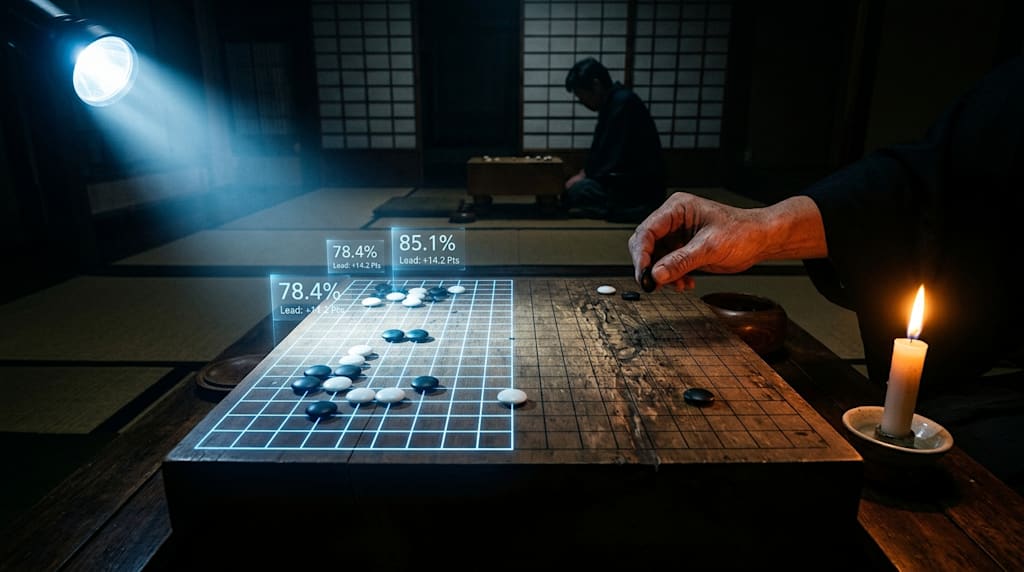
Go, Calculation, and the Human Mind: After AI’s Searchlight
In March 2016, Lee Sedol resigned his final game at the Four Seasons Hotel in Seoul. That moment redefined Go: it became mathematics, probability, win-rate curves – not art, not philosophy.
A young fan’s question soon circulated online: “Go is just calculation. State of mind and cultivation are nonsense. If that’s obvious, why didn’t people before AI see it?”
The question provokes because we have already seen the answer. But turn the clock back to before 2016 – no win-rate bars, no reference graphs, no instant evaluation – and you realise that earlier players were not stupid. They simply had no coordinates.
I. The word “calculation” shifted meaning.
AlphaGo’s “calculation” is millions of position simulations per minute, each move turned into a cold decimal by deep neural networks.
What human players called “calculation” before AI meant local tactical reading – how far ahead you could read a ladder, who would win a capturing race by one liberty. But the board is vast; the middle game has no exhaustive search. Players relied on compressed experience – a kind of “feel” they could not fully put into words.
That “feel” was called “grand vision” or “state of mind.” Think of an experienced driver taking a curve without calculating friction coefficients – they make it because their body has memorised thousands of practice runs. That’s not mysticism; it’s an internalised algorithm they can’t easily describe.
The same applied to Go. Before his jubango matches, Wu Qingyuan never studied his opponents’ game records. He said, “I only look at the board.” Not affectation – his “state of mind” was a rapid pattern‑matching system honed over tens of thousands of hours. He just had no CPU monitor, so he used the language of Eastern philosophy.
II. No referee, everyone was their own judge.
Before AI became the referee, no one could settle why a game was won or lost.
In the 1983 National Championship, Nie Weiping lost to Shao Zhenzhong. During the post‑mortem, they gave opposite readings of the same positions:
Shao thought his opening was slightly inferior; Nie thought Black was overwhelmingly ahead.
Shao thought Black’s 173rd move left White a small advantage; Nie thought Black still led by ten points.
Two top players, total disagreement. The editor of Weiqi Chunqiu wrote to Nie, who replied: “Because players have different styles, different baselines, different skill levels, it is normal for their judgments to differ.”
Without AI, no third party could decide who was right. So everyone rationalised their own system and called it “style” or “state of mind.” Later, hobbyists using KataGo found that Shao’s judgment was closer to the AI’s win‑rate – but that came later. In an era without a measuring stick, calling intuition “state of mind” was not deception; it was cognitive self‑preservation.
III. Cultivation is not chicken soup – it stabilises biological computing power.
Someone might say: “AI doesn’t need cultivation, so cultivation is irrelevant in Go.”
But AI doesn’t eat, doesn’t tremble, doesn’t lose sleep over prize money. Humans are biological.
At sixteen, Lee Chang‑ho was called the “Young Taigong” and later the “Stone Buddha.” His reading ability wasn’t necessarily the strongest among top players, but he could maintain a steady 40‑second rhythm under byo‑yomi. The more his opponents panicked, the steadier he became; their heart rates spiked, his stayed calm. This “ordinary mind” is a computing‑power stabiliser – it blocks fear, greed, and anxiety from consuming brain RAM, so his full capacity could be delivered at 100%.
Wu Qingyuan stressed in his autobiography that in the jubango matches, victory was decided not by technique but by mental strength. All rivals were geniuses; the technical gap was razor‑thin. Whoever stayed clear‑headed when the sword hung over their neck would see the critical move earlier.
During the 1980s Sino‑Japanese Go Supermatches, at the pre‑game banquet, the Japanese player Yamashiro Hiroshi was so nervous facing Nie Weiping that he couldn’t eat. Nie, by contrast, devoured three servings of sashimi – including Yamashiro’s portion. Next day, well‑fed and well‑rested, Nie read the board clearly and won convincingly.
Modern sports science explains: hypoglycemia weakens prefrontal cortex function, directly reducing logical reasoning. What Nie consumed was brain fuel – and he could eat because his “cultivation” kept the pressure from choking him.
In the Honinbo title match between Kobayashi Koichi and Cho Chikun, in the deciding game, Kobayashi had already calculated a clear winning move. But at the instant before placing his stone, he was drawn to another candidate that looked “more beautiful” – and without re‑calculating, he played it on impulse. Cho seized the opening and turned the game around. Kobayashi later regretted it deeply, calling it “the work of a demon in his heart, a failure of cultivation.”
If you examine that moment: his reading ability itself wasn’t faulty. It was intrusive thoughts – craving for aesthetic appeal, desire for a brilliant move – that crowded out his computing channel. The real function of cultivation in that moment was clearing background processes.
IV. Searchlights and candles need not mock each other.
Today, with KataGo on our phones, any amateur can critique the famous games of Nie Weiping or Fujisawa Hideyuki: “This move drops five points – a vulgar move.”
But we can be so arrogant only because Google spent hundreds of millions of dollars and thousands of TPUs to build a super searchlight.
Before that searchlight existed, our predecessors had only candles. They walked into the dead ends of “Great Avalanche,” “Great Slant,” and “Magic Sword,” spending lifetimes on variations that AI now deems losing.
We should not mock them. Because it was the paths they traced, through flesh‑and‑blood exploration, that preserved enough Go data for later AI to learn from. And it is because they explored with their bodies that we today can see the portion of the road that has been illuminated.
Return to the original question: If Go is just calculation, why didn’t people before AI understand?
Two answers.
First – there was no standard answer back then. They were not ignorant; they had no way to verify. They could only name their high‑dimensional intuition as “state of mind.”
Second – even today, in human‑versus‑human matches, cultivation still matters. Its function is not to move oneself emotionally, but to ensure, under extreme pressure, that your limited biological computing power lands on the board without discount.
Calculation has made Go more transparent. Cultivation keeps a trembling warmth in the human game – that tremor comes from the hand and the heartbeat, from that one second when you want to win and fear to lose.
About the Creator
Jin
Writer of reamstories
https://reamstories.com/jin
Enjoyed the story? Support the Creator.
Subscribe for free to receive all their stories in your feed. You could also become a paid subscriber, letting them know you appreciate their work.
Comments
There are no comments for this story
Be the first to respond and start the conversation.