
The Peep That Threw Away a 98.8% Lead
One move. Four seconds. The instant a perfect game turned into the most unforgettable defeat of the year.
Shengzhou, July 30, evening.
Dang Yifei’s index finger hovered three inches above the go bowl and did not descend. The referee glanced sideways at him. He waved his hand and put the stone back into the bowl. On the board, the black stones had formed a solid chain, and the white dragon in the lower left corner had only one liberty left. He resigned.
Ke Jie lifted his head from the byo-yomi countdown. His first words were not celebration, but to the scorekeeper: “Move 163—can you confirm the time for me?”
The scorekeeper replied, “Placed on the eighth second of the countdown.”
He nodded and did not smile.
Before this final, the two paths to reach it could not have been more different.
Ke Jie had played three games in three days, won all three, and advanced directly from the winners’ bracket. He left the venue at half past three each afternoon, went back to the hotel for a nap, and ordered takeout—suan cai yu—for dinner. Dang Yifei had played six games in six days, climbing round after round from the losers’ bracket. Every win meant another game the next day; every loss meant going home. For half of those six days, his dinner was a boxed meal in the players’ lounge—because his next opponent had not yet been decided, and he had to wait.
On the seventh day, they sat across from each other.
They had met eighteen times before. Dang had won seven. Before the game, no reporter asked about “win rates” or similar questions, because everyone assumed that one man was well-rested and the other was battered—this game would end in at most two hundred moves. But the game moved slowly. For the first hundred moves, both probed; the sound of stones hitting the board came at even intervals, like a pendulum swinging back and forth.
On move 103, Ke Jie started a ko fight. He played three ko threats in a row, trying to muddy the position. Dang Yifei sat in silence for two minutes, then chose to resolve the ko, giving up the fight in exchange for outside influence. On the screen, the AI win-rate bar jumped sharply: white (Dang Yifei) at 98.8%.
In the live stream, that win-rate bar became a thin white line, barely visible.
Ke Jie glanced at the clock. He had only one byo-yomi period left—every move had to be played within ten seconds. Dang Yifei still had forty-one minutes. Time, position, opponent—three pincers closing at once. No one thought there was any room for change.
But Ke Jie did not stop. On move 132, he made a forceful probe inside white’s thick shape—like knocking on a wall to hear the echo. This move only pulled the win rate back by less than two percentage points, but Dang Yifei began a long think. He took seven minutes, and when he placed his stone, his fingers paused for a moment above the board.
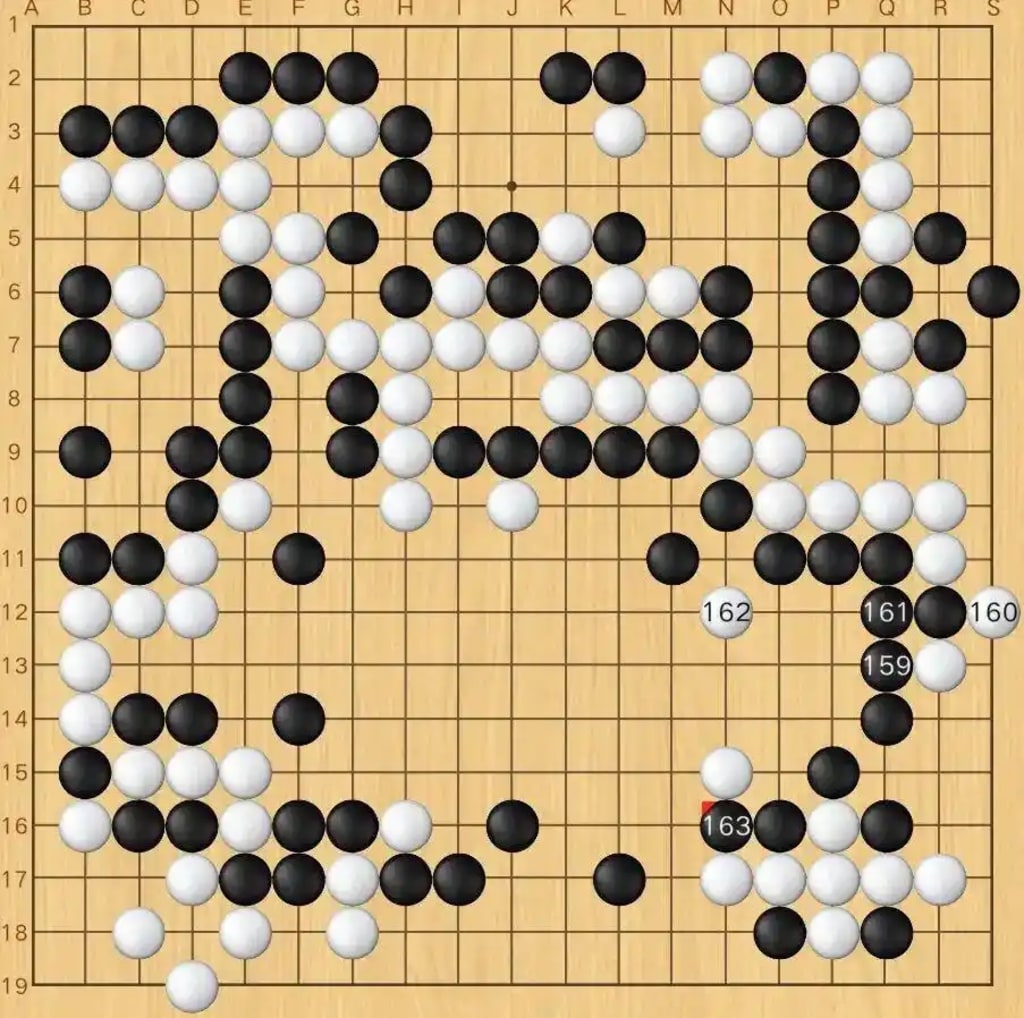
The real crack appeared on move 162.
The AI’s recommendation was extremely simple: connect. Fill the only cut point, make the whole white position solid, and black would have no more room to fight. It was a yose move that even a junior player could see. But Dang did not connect. He played a peep instead, sharper, trying to gain an extra point, wanting to win not just with a margin but with style.
He took four seconds to play it, twice as long as his usual pace.
When the byo-yomi counter hit “8,” Ke Jie’s hand was already on the board. Black 163: push.
This move was not the highest in the AI’s win-rate ranking—in fact, it was third among several options. But Ke Jie played it without hesitation. He later said in the post-game interview: “I didn’t look at the win rate. I looked at his face. When he played that peep, his shoulder lifted slightly—I felt he was afraid I would make life.”
Dang Yifei fell into another long think. He still had plenty of time—thirty-six minutes—but those minutes now became a burden. He began to recalculate the life-and-death of the black group below, running over a dozen variations in his head. The more he calculated, the more the black stones seemed to live—and then again, seemed to die. He picked up his teacup, took a sip, put it down, then picked it up again.
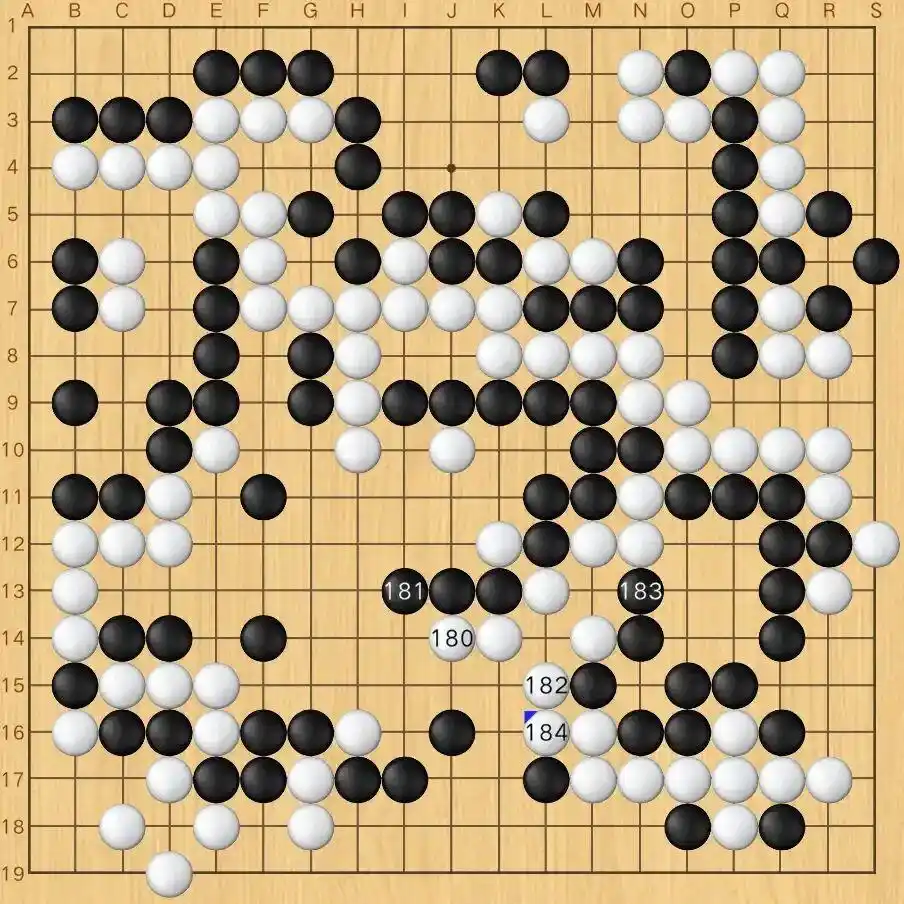
On move 184, he chose to connect.
He thought the four black stones below were dead. After connecting, he raised his cup and took a sip of warm water, then swept his gaze back over the lower left corner. Those four black stones still had two liberties, and Ke Jie could next play block, then clamp. Two clear eyes were forming.
His hand, holding the cup, stopped in midair.
Ke Jie did not look at him. Ke Jie played block on move 185, clamp on 187, and made eyes on 191. Each stone was placed in the last two seconds of the countdown; each move was without excess. When the black group firmly secured two eyes below, Dang Yifei withdrew his right hand from the bowl. Those four black stones were not only alive—they had also eaten into white’s original thickness.
The win-rate bar fell from 98.8% to 34%, then to 7%, then to zero. From move 162 to move 205, forty-three moves in less than twenty minutes.
This was already the second time in this tournament that Ke Jie had come back from a win rate below 2%. In the semifinal against Wang Xinghao, he had overturned a 1.4% deficit in the same way. The common thread in both comebacks was not calculation—in the AI era, everyone can calculate—but the speed of his moves in byo-yomi. In the semifinal, he averaged 7.3 seconds per move in the final phase; in this final, the last forty-three moves averaged 6.9 seconds. While his opponent was deep in thought, he leaned back in his chair with his eyes closed, not resting, but running through every possible mistake his opponent could make.
“I’m not faster at reading than him,” he said afterwards. “I just thought he would make a mistake.”
There was no provocation in those words. He said it while looking down, fiddling with the black stones in the bowl, lining them up one by one, then scattering them.
Where did Dang Yifei lose? Not in technique, but in that impulse for a more perfect win. On move 162, if he had connected, the game would have been over right there. But he wanted more, one more thrust, one more statement, to make this game a signature of his career. In that single thought, he opened a crack in the iron door.
Ke Jie squeezed through.
The award ceremony was brief. Ke Jie accepted the trophy, stood on stage, and said, “I feel a bit surprised,” then added, “Dang Yifei is stronger than me. Today he gave me the chance.”
Someone in the audience laughed, but he did not.
After the ceremony, he stepped down, handed the trophy to his assistant, and walked to the analysis room. Dang Yifei was still there, alone, replaying the game on the board. Ke Jie sat down across from him and reached out to replace the stone at move 184—that white connection.
“What if you connect here?” Ke Jie asked.
Dang did not look up. He moved the stone to the connecting point, then ran through seven variations. After seven moves, white would win by one and a half points.
“I know,” Dang said.
The two of them played through another dozen moves, neither speaking. Outside, the sky had darkened. The venue lights shone on the board, and the stones gave off a faint gleam. Ke Jie stood up, took the white stone from the connecting point, and placed it back at move 162—that peep.
“Better not to play this one,” he said.
Dang nodded.
Ke Jie turned and walked out. At the door, he paused and looked back at the board. The four black stones still sat below, two eyes, cleanly alive.
He said nothing more and pushed the door open. In the hallway outside, staff were packing up the broadcast equipment; the win-rate bar on the screen was already off. On a table sat half a bottle of unfinished mineral water, condensation still beading on the plastic.
He picked up the bottle, unscrewed the cap, took a sip.
Then he walked away.
About the Creator
Jin
Writer of reamstories
https://reamstories.com/jin
Enjoyed the story? Support the Creator.
Subscribe for free to receive all their stories in your feed. You could also become a paid subscriber, letting them know you appreciate their work.
Comments
There are no comments for this story
Be the first to respond and start the conversation.