
The Board is Dead. Long Live the Flesh.
Why AI erased the poetry of Go, but couldn't kill the hunger, the tremors, or the stolen sandwiches that decide the final victor.
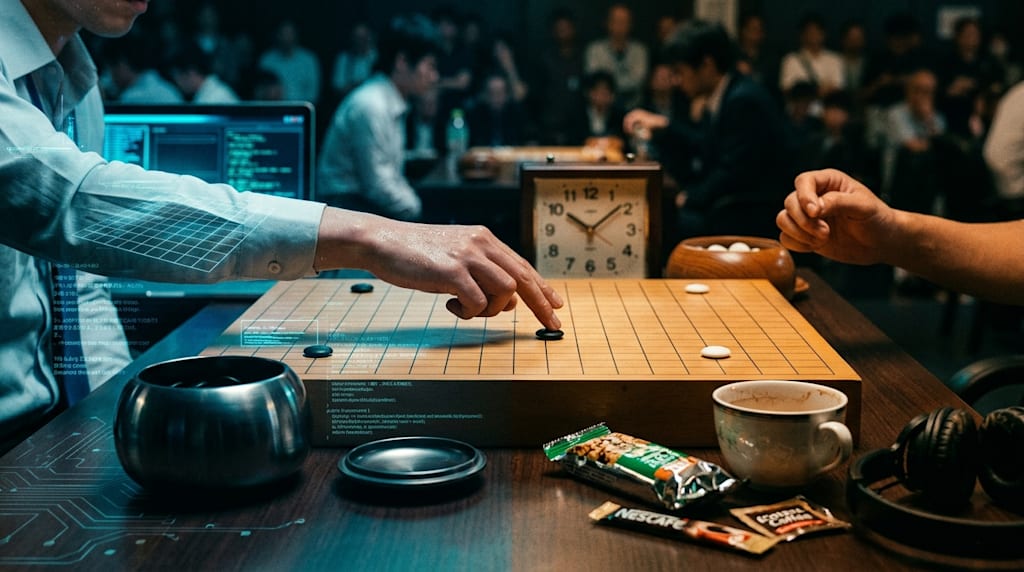
When the Go board ceases to be a dojo
And why “Go is dead” is only half the truth
The day Ke Jie said “Go is dead,” the words travelled far beyond the professional circle. Most people who shared his remark thought they were witnessing a genius admit defeat – the last human champion kneeling before silicon. But Ke Jie was not talking about winning or losing. He was talking about the death of a language.
Go once had a language of its own. Not the technical jargon – san‑san or kosumi – but the personal dialects of its masters. Wu Qingyuan’s flowing style read like a haiku, drifting with an elegance that seemed to float above the board. Takeo Takagawa’s cosmic fuseki were grand Han‑fu poems, sprawling and ambitious, staking a claim on the whole territory. Lee Chang‑ho’s endgame felt like seal‑script carved on oracle bones – precise, ancient, relentless. Every game was a letter written in two private tongues, and you could read the writer’s soul in each stone.
Then AI arrived. In a few short years, every letter was rewritten to a single template: open with san‑san, attach at the star point, memorise the AI’s winning‑percentage library for life‑and‑death problems. The dialects vanished. All the top players began speaking the same translated Mandarin – efficient, correct, and utterly anonymous. You could no longer tell who was writing.
That is what Ke Jie meant by “dead.” Not that humans cannot beat the machine – they cannot, and that is old news. The real death was the erasure of stylistic fingerprints. When every young prodigy studies the identical AI joseki, when a single “wrong” move is punished by a five‑point drop in win probability, creativity becomes a liability. The board no longer invites conversation; it demands recitation.
Xiangqi does not have this problem. Not because it escaped the AI invasion, but because it had already died quietly, much earlier. The xiangqi board is smaller, the pieces fewer, the endgames codified. A top grandmaster who truly wants a draw can force one, even against the world’s number one, because the mathematical space is narrow enough that “optimal” lines are known and sharable. Long before Deep Blue’s cousins tackled xiangqi, human masters had already mapped most of its viable territory. AI simply replaced the abacus with a supercomputer. There was no “divinity” to strip away – xiangqi had always been a calculation puzzle, not a spiritual quest.
Go is different. It has no checkmate, no forced end. The game ends only when one player resigns, when a human decides that hope is exhausted. Until that black stone is placed on the lid of the bowl, the game remains suspended, a quantum cloud of possibilities. You can push your winning probability to 99% in the first hundred moves, but if the opponent’s blood sugar begins to fall, if his brain starts to stutter in the fifth hour, the board turns into a tangled ball of yarn that even the best computers struggle to untangle in real time. The reason Go is not “dead” is precisely that it is not fully calculable, and the source of that incalculability is not mathematics but flesh.
Ke Jie mastered this fleshly battlefield. In the early game, he often makes deliberately “bad” moves – ugly exchanges, wasteful attachments – not to confuse the opponent’s reading, but to drag the game into the fatigue zone. His real weapon is never AI‑like precision; it is waiting. He waits for the rival to lift a cup of cold tea after a thirty‑minute think. He watches for that tiny tremor in the fingers before a stone is placed. This is endurance sport, a survival contest, as far from the ethereal “Way” of Go as a street brawl is from a tea ceremony.
The counterexample is a well‑known female player whom fans affectionately call “Grandmaster Zhan.” Her opening is legendary – some call it a “hand of god” – and she can go toe‑to‑toe with top male pros through the first hundred moves. But once the middle game drags on, once her calculation stamina wanes, her attempts to set traps often backfire spectacularly. Fans have coined a bitter term for these moments: “the eagle’s blunder.” Not because she is stupid, but because a human brain, running on glucose and oxygen, inevitably fractures under prolonged stress. And here is the absurd, almost comic detail: young players now secretly snack on takeout during long adjournments to keep their blood sugar high, literally eating their way through to the endgame, outlasting older rivals who grow dizzy and foggy. A chocolate bar can buy a victory. Go was never a “hand conversation” – it was always a fistfight, we just pretended otherwise.
So “Go is dead” is only half a truth. What died was the classical era – the era that treated Go as mysticism, philosophy, a scholar’s pastime. In that era, every move asked “What is the Way?” and AI answered with cold percentages. But what lives on, and even thrives, is the era of flesh – the era of dripping blood sugar, trembling fingers, and smuggled sandwiches. As long as humans get stomach cramps after five hours of reading, as long as someone can blunder because their glucose crashed, Go will retain the flavour of a true contest. It is no longer sacred, but it has never been more real.
The tragedy of xiangqi is that it was fully mapped, so even a draw feels mechanical. The luck of Go is that it remains messy, incomplete, and anchored to human frailty. Ke Jie might be right: the age of swordsman‑like artistry is over. But the age of greasy takeout, racing heartbeats, and wild blunders – the age where a player wins not because he is smarter, but because he ate a granola bar at the right moment – that age is still breathing, stubbornly, in the twilight of every tournament hall. The board no longer speaks in poems, but it still throbs with pulses. And that, perhaps, is enough.
About the Creator
Jin
Writer of reamstories
https://reamstories.com/jin
Enjoyed the story? Support the Creator.
Subscribe for free to receive all their stories in your feed. You could also become a paid subscriber, letting them know you appreciate their work.
Comments
There are no comments for this story
Be the first to respond and start the conversation.