
I Bought Three Switch 2 Consoles. Only One Survived Nintendo's Ban Hammer.
Here's what the MIG Switch flashcart, edited Zelda saves, and a massive server glitch have in common—and how to tell if your console is next.
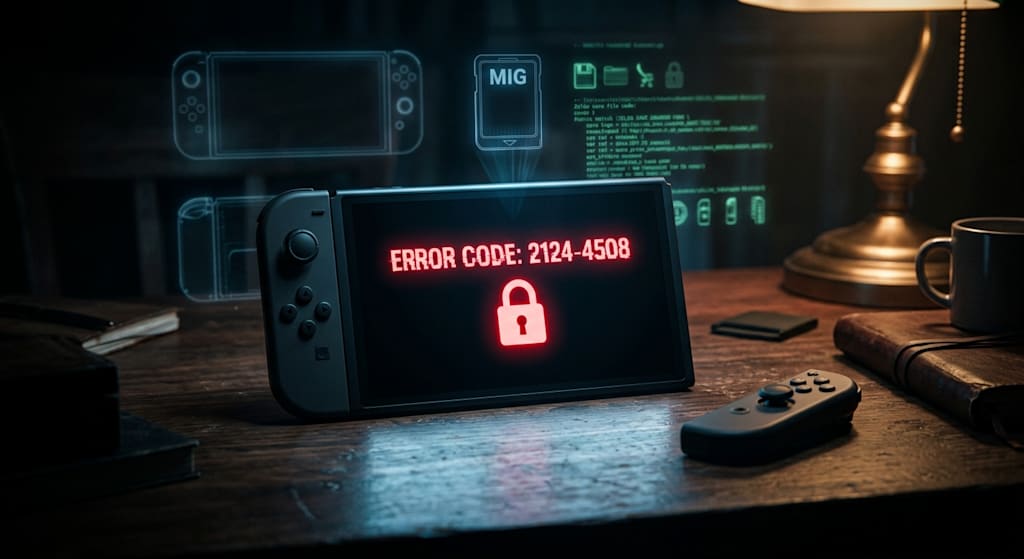
On the evening of September 5, 2026, the gaming world erupted.
Across forums, Discord servers, and social media, players began reporting the same nightmare: their Nintendo Switch 2 consoles, after connecting to the internet, displayed an error code and were permanently cut off from all online services. No eShop, no multiplayer, no cloud saves, not even system updates.
A $300 gaming device had, overnight, become an expensive offline‑only cartridge player.
The hashtag #Switch2Ban went viral within hours. Panic, anger, and confusion swept through the community. Some pointed fingers at the MIG Switch flashcart, calling this Nintendo’s long‑awaited “final solution” against piracy. Others, insisting they were innocent “green players” (legitimate users), cried foul and accused Nintendo of a massive false‑positive wave.
Three days later, the truth began to surface. But it was far from simple—it turned out to be a messy blend of historical debt‑collecting and systemic technical failure.
The Reckoning: Nintendo’s Patience Had Run Out
To understand this ban wave, you need to understand how Nintendo enforces its rules.
Nintendo is not a company that acts immediately. It behaves like a silent bookkeeper: every time you perform an unauthorised action, it makes a note. It doesn’t warn you, it doesn’t pop up a reminder—until one day, when it decides the time is right, it collects all the debts at once.
This strategy was repeatedly validated during the Switch 1 era: pirating users were banned months after the fact; save‑editors found their accounts disabled the day after syncing cloud data. Nintendo never gives advance notice and never accepts “I didn’t know” as an excuse.
Now, it was the Switch 2’s turn.
The MIG Switch Flashcart: The Biggest Target
The MIG Switch is a flashcart that appeared in 2024. It looks like a regular Switch cartridge but can run backup game data via a microSD card. Its arrival was hailed by the modding scene as “Nintendo’s doomsday,” because it bypassed traditional hacking—no disassembly, no soldering, no custom firmware—just the cart and a card reader.
But Nintendo didn’t sit idle.
Technically, there is a critical difference between a legitimate cartridge and the MIG Switch: every official cartridge has a unique header ID, written during manufacture, which is verified against Nintendo’s servers when the console is online. The MIG Switch can spoof these headers, but each game requires a different header, and the act of switching headers is detectable server‑side.
Nintendo spent nearly two years gathering data and building a “fingerprint” system targeting MIG Switch. When a Switch 2 console had ever inserted the flashcart and gone online, that interaction was logged. Even if the user later removed the cart, even if they formatted the system—that record never disappeared.
On the night of September 5, Nintendo finally pressed the button.
Save Editing: The Zelda Players’ Nightmare
If MIG Switch users were the obvious targets, another group seemed more “unlucky”—those who merely edited their game saves.
Community feedback showed that the heaviest ban‑hit games were The Legend of Zelda: Breath of the Wild and Tears of the Kingdom. The reason is straightforward: the demand for save editing in these games is huge. Infinite stamina, full hearts, max equipment, all Korok seeds—things that take hundreds of hours in normal play can be achieved in minutes with a save editor.
But the problem lies in the provenance of the save.
In Nintendo’s detection logic, a legitimate save file should come exclusively from an unmodified Switch console and a genuine copy of the game. If a save is flagged with an “anomalous path”—for example, if it was modified on a hacked Switch 1 and then synced to the Switch 2 via cloud save—that anomaly is recorded.
Even more fatal: many players assumed that “deleting the account from the hacked console after editing” would evade detection. But Nintendo records the triple association of console ID, account ID, and save‑file hash. Deleting the account does not erase the already‑uploaded server records.
So when these players logged in on their Switch 2 and synced cloud saves, the system performed a background validation check—and then, ban.
Historical Baggage: A Lesson from the PS3 Era
An interesting observation emerged in discussion threads: many banned players seemed utterly unaware of the concept of “delayed enforcement.”
One veteran from the PS3 era wrote: “Anyone who went through the PS3 hack era knows how ruthless Sony was. Even if you fully formatted your console, reinstalled the system, and registered a new account, if that console had ever been hacked, Sony could still detect it. The second‑hand market had a term: ‘trophy consoles’ – machines that had never been hacked and were safe to log in with. I thought this was common knowledge. Apparently, many Switch players have no idea.”
This hit on a crucial point: many Switch players are new users drawn in by Nintendo’s “blue ocean” strategy. They are unfamiliar with the console industry’s long‑standing zero‑tolerance stance toward piracy and hacking.
Nintendo’s official response after the event explicitly stated: “The use of unauthorised hardware or software, or unauthorised modification of game data, may result in the console being prohibited from accessing network services.” Many interpreted this as official confirmation that the bans were primarily targeting consoles with a history of violations.
The So‑Called “False Positives”: When a Glitch Collides with a Ban Wave
If the story ended here, the conclusion would be simple: Nintendo cleaned house, and that was that.
But what made the incident truly messy—and threw countless “green players” into panic—was the large number of false‑positive cases mixed in.
The Cries of the Innocent
Starting September 6, users who claimed they had never performed any unauthorised actions began reporting bans. Their common traits:
Consoles purchased from official or reputable sources (Tmall Global, JD.com self‑operated, Pinduoduo’s subsidy program, etc.)
Accounts never logged into a hacked console
Only played legitimate cartridges or digital games
Never used any external devices (including MIG Switch)
Never edited any save files
In other words, they were “perfect victims.”
One user posted: “I bought a Japanese‑region console from Tmall Global in June. I only played Tears of the Kingdom and Mario Kart 8, both legitimate cartridges, with a newly registered account. Yesterday, I booted up, got an error code, and was banned. I called Nintendo customer service; they said ‘unauthorised activity detected’ but couldn’t specify what.”
That thread received over 2,000 replies, many echoing “same here.”
Nintendo’s Embarrassment
On the afternoon of September 7, Nintendo issued a brief statement, acknowledging that some of the bans were due to a “server‑side error.” They apologised to affected users and promised that consoles falsely flagged would be restored within 24‑48 hours.
The statement triggered mixed reactions:
Falsely banned “green players” breathed a sigh of relief, but their trust in Nintendo’s technical competence was shaken.
Genuine offenders watched warily – “Is my console truly banned, or was it a misjudgment?”
And a larger group began questioning a deeper issue: Was the ‘brand‑new’ console I bought really brand‑new?
The Lie of “Sealed” Consoles
As the incident unfolded, a previously overlooked problem surfaced: “new” Switch 2 consoles from unofficial channels might not actually be new.
Insiders revealed that some distributors engage in “refurbishing‑as‑new” practices—taking returned or problematic consoles (possibly previously used for unauthorised activities), cleaning them superficially, repackaging, and selling them as “sealed, never opened.” These consoles already carried Nintendo’s blacklist before their new owners ever touched them.
This explained why some “green players” who bought from platforms like Pinduoduo were banned—they had unknowingly purchased a console that had been “dirty” from its previous owner.
Guilty vs. Innocent – A Clear Breakdown
Based on current community data, banned users fall into several distinct categories.
At one end are those who knowingly used a MIG Switch flashcart. Nintendo’s hardware detection leaves little room for doubt: once the console connects online with that device inserted, the fingerprint is logged. Appeal success for this group is extremely low.
Next are players who edited saves on a hacked Switch 1 and then synced those saves to the Switch 2 via the cloud. The server records the anomalous save provenance, and again, appeals rarely succeed because the evidence is stored permanently.
A third group consists of users whose accounts were previously logged into a hacked console—even if they later moved to a completely new, legitimate machine. The account itself carries a historical linkage, and the detection system flags the new console as associated with that compromised account. Success here is also unlikely.
Then there are buyers who unknowingly purchased a refurbished “dirty” console—a machine that had been returned, repackaged, and sold as new. These owners never violated any rule themselves, but the console’s previous owner did. In some cases, if they can provide solid proof of purchase, they may have a chance to appeal, but it is handled case‑by‑case.
Finally, there were those caught in the server‑side error—purely false positives. For this group, Nintendo has officially acknowledged the mistake and is actively restoring access. Their appeal success rate is high.
Several other suspected causes have been ruled out by analysis. Hong Kong region black‑card purchases (stolen credit cards) typically result in account bans, not console bans. Amiibo cards use one‑way NFC communication, so Nintendo cannot distinguish official from third‑party ones. Account renting usually only gets the rented account suspended, not the host machine. Used cartridges are dumped in ways that strip or alter their physical IDs, making traceability unlikely. And “zero‑dollar” digital sharing schemes mostly affect US‑region accounts, while this ban wave was dominated by Hong Kong and Japanese consoles.
What to Do – Advice for Different Users
If you are a genuine “green player” – one who has never used any unauthorised hardware, never modified a save, and never logged into a hacked console – your first step is to file an appeal with Nintendo support immediately. Submit a ticket through the official website, attaching your console serial number and proof of purchase.
If Nintendo replies with a “confirmed violation” and you are certain you’ve done nothing wrong, contact your retailer right away and demand a refund. Under consumer protection laws in most regions, selling a “dirty” console as new constitutes fraud. Keep monitoring official updates, as some cases may be automatically restored after backend fixes.
If you were previously an offender – whether you used a flashcart, edited saves, or logged into a hacked system – the hard truth is that appeal success is extremely low. Nintendo has already collected its evidence, and “I didn’t know” or “I stopped doing it” will not erase that record. Your console has effectively lost online functionality permanently. Your remaining options are to use it as an offline‑only single‑player machine or to sell it to a buyer who is fully aware of its status (and you must disclose honestly).
If you are considering buying a Switch 2 – now or in the future – prioritise official channels or major e‑commerce platforms’ self‑operated stores. Prices may be slightly higher, but you significantly reduce the risk of getting a “dirty” console. When buying second‑hand, always test network functionality on the spot: log in with your own Nintendo account and confirm you can access the eShop. And keep all purchase receipts – order screenshots, invoices, even the serial‑number sticker from the box. These are your most important evidence if you ever need to prove you bought a legitimate unit.
Epilogue: A Self‑Cleansing of the Gaming Ecosystem
On the surface, this Switch 2 ban incident was a mix of anti‑piracy action and system failure. But looked at more deeply, it reflects a nearly unsolvable dilemma for the console industry.
Platform holders must balance convenience for users with maintaining order, and every enforcement action—no matter how precise—will inevitably catch some innocent users in its net.
Nintendo’s reckoning was not without justification. The MIG Switch and save editing do damage developers’ revenue and undermine fair play. But the server‑side error that led to false positives exposed the ageing and fragility of its technical infrastructure. A company that prides itself on “gameplay first” couldn’t even reliably distinguish the guilty from the innocent when executing a digital crackdown.
The incident will eventually fade. False‑banned consoles will be restored. Truly violated consoles will remain permanently offline. The community’s attention will shift to the next hot topic. But the lingering questions will remain.
When our game saves, purchase histories, and console IDs become data that platform holders can access and judge at will, are we still players—or are we merely managed data nodes?
That question might be more worth pondering than “why was my console banned?”
About the Creator
Jin
Writer of reamstories
https://reamstories.com/jin
Enjoyed the story? Support the Creator.
Subscribe for free to receive all their stories in your feed. You could also become a paid subscriber, letting them know you appreciate their work.
Comments
There are no comments for this story
Be the first to respond and start the conversation.