
AI Can Rebuild an Old Game in Hours. It Still Cannot Make It Playable.
The browser-port boom looks like a piracy story. Underneath, cheap production is running ahead of expensive verification.
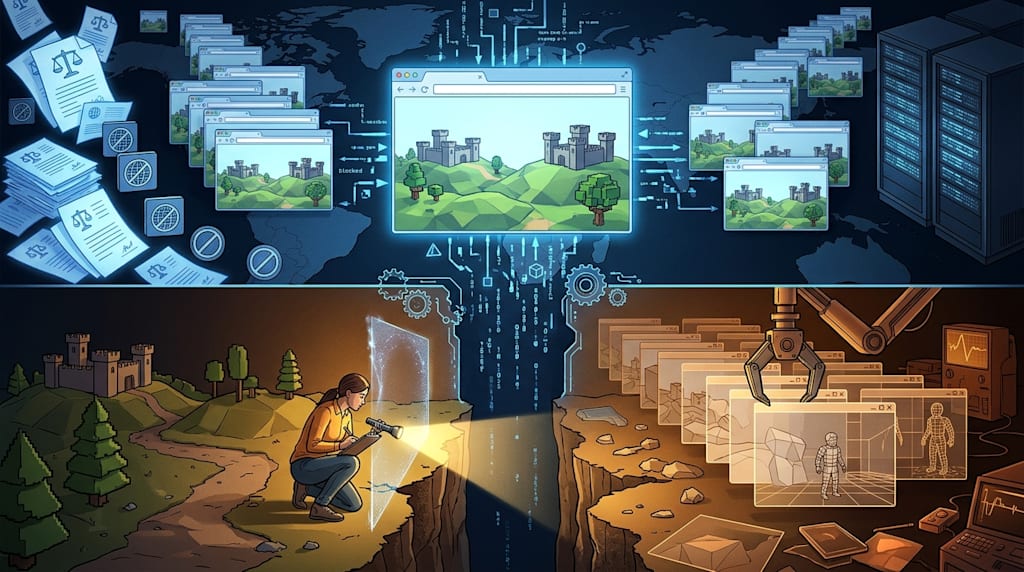
Recently, several AAA classics have been decompiled with AI tools and ported to the browser. Rights holders send takedown notices. The projects move to a new domain and return. Players praise the speed and complain about bugs. The surface story is copyright. The deeper story is a cost split: production is getting cheap, verification is not.
1. Companies play whack-a-mole. AI rolls out a carpet.
When a browser port appears, copyright holders send DMCA notices. Activision, Bethesda, Rockstar, and others have targeted web ports of Modern Warfare 2, Fallout, GTA 5, and similar titles. The legal position is clear. These IPs belong to the companies. Unauthorized decompilation and distribution infringe.
The legal tool is point-to-point. AI production is area-wide. A domain goes down; the project moves to a new top-level domain. A repository is deleted; the code can be regenerated. A server is seized; hosting moves to a jurisdiction with higher enforcement costs. Old piracy required packaging, uploading, distribution, maintenance, and evasion. AI porting is closer to pressing a button and bringing the game back in a browser. Legal teams chase one target at a time. The flood is distributed and renewable.
That does not make legal action useless. DMCA notices draw a boundary. They do not solve the supply problem. Chasing every port costs more than regenerating one. Whack-a-mole still works, but the molehills have become a carpet.
The commercial damage shows up in legacy IP. Companies sell remasters, re-releases, subscriptions, and backward compatibility. Players pay for convenience, legality, stability, achievements, multiplayer, and support. A free browser version that looks close enough erodes the convenience premium. It will not kill official remasters. It changes what players will pay for one. If the free version runs, why pay this much for the version that runs reliably?
Some companies are shifting from blocking to co-opting. Microsoft set up Xbox Labs to explore AI-driven retro porting and plans to open the tools to the industry. The message is practical: if the flood cannot be stopped, define the official version first. Future competition may not be about stopping AI ports. It may be about offering what AI ports cannot.
2. The colder risk is that new games become afraid to be tested.
Old games are one loss. Projects still in development are a bigger risk. AI vibe-coding can now be used to clone a game before release.
Digital Sun, the Spanish studio behind Moonlighter, canceled the large public test for its new game ReVamp. The studio feared that a test build could be decompiled and cloned with AI, then sold cheaply before the 2027 launch. It cut the test from tens of thousands of players to a few hundred on Discord and required NDAs.
The case matters beyond one studio. It shows a chilling effect. When developers fear showing a game, the feedback loop breaks. Public tests, demos, and trial versions expose balance problems, crash paths, onboarding flaws, and multiplayer sync errors. Many of those problems only appear when real players mess around. If a public build can be cloned and preemptively sold, rational developers will test less, test later, or test behind closed doors.
Players pay for that. AI was supposed to speed development and increase iteration. Under cloning fear, studios may close testing instead. Technology raises production speed and lowers the willingness to verify in public. The industry becomes more defensive.
3. AI can write code. It cannot be professionally stupid on the player’s behalf.
The ceiling on this shift sits in QA. People outside games often assume design, art, or programming is the hard part. In large AAA projects, testing is enormous. A common split for a feature is 30 percent design, 30 percent development, and 40 percent testing. Open-world games make that worse. Players jump, climb, drive, shoot, trigger scripts, combine items, exploit terrain, and abuse state sync. QA does not run the standard path once. It simulates odd player behavior and checks boundary cases.
One classic example: if the player can jump, how do you stop them from jumping into a place they cannot leave? How do you stop them from reaching a spot that breaks the level flow? AI struggles with that today. Even when it can do it, the cost is high. Every requirement differs. The skill is hard to generalize. You can ask AI to play the game, but the run may cost more than a human tester. Its advantage is that it can run overnight.
This is where games differ from internet software. Software flows are fixed. Apps worry about server load; clients rarely produce severe bugs. Open-world games have huge test loads. A AAA team of several hundred developers often needs several hundred testers. Testing is usually outsourced or centralized because it is light early and heavy late.
AI can reproduce core gameplay and 3C: character, controls, camera. It cannot do the QA job of being professionally stupid. A former Fallout 4 QA tester put it well: finding bugs often requires professional-level stupidity, meaning someone deliberately breaks the system in ways AI would not try. Open-world complexity is exponential. Automated testing still struggles with physics failures, state sync errors, and script deadlocks.
So AI ports look plausible and play badly. They run. They are not playable. They reach the main menu. They cannot finish the game. They reproduce the core loop. They fail boundary cases. Humans still fix those problems.
4. The production barrier fell. The quality barrier did not.
AI has cut the barrier to putting an old game in a browser from months of team engineering to days or hours for one person with a model. The production barrier fell. The quality barrier did not.
A playable browser port needs rendering compatibility, input mapping, audio sync, saves, performance, memory, browser security rules, device support, and fixes for bugs in the original. AI can generate a version that looks like it runs. It cannot prove that version survives thousands of player actions.
The partial shutdown of decomp.dev shows the pattern. Speculators used AI to mass-produce half-baked ports and drowned out the community’s research tone. AI lowers the cost of making something. It does not lower the cost of making it stable. When production floods and verification stays with a few hands, half-finished work piles up. Repair costs move upstream to players and human QA.
A three-layer market is forming. At the bottom, free AI ports with high bug rates circulate in gray zones and satisfy nostalgia. In the middle, official AI-assisted remasters compete on stability, legality, and support. At the top, AAA new games still rely on human QA for nonstandard boundary cases that require creative error-making.
AI cuts design and coding time. Verification gets harder as games grow more complex. The idea that AI makes games as simple as web pages is wrong. Web verification is manageable. Open-world verification is exponential. AI can write code. It cannot absorb the infinite ways players will break it.
5. Who gets hit, who gets revalued.
The result is not the end of games. It is a split with different survival rules.
Bottom layer: vibe ports and gray markets. Free AI ports with bugs and fast iteration will persist. They satisfy curiosity. They cannot offer a stable experience. Companies cannot remove them all. They can enforce selectively. This layer keeps lowering the price players expect for old games.
Middle layer: official remasters. Companies use AI for official ports, remasters, and subscription fill. The selling point is not that it runs. It is that it runs stably, legally, with support, achievements, multiplayer, and community. Xbox Labs style work turns AI from an infringement tool into an official efficiency tool. Compliant supply competes with gray supply. This is the ground companies should fight for. It is the only channel that turns gray-market pressure into new supply for legacy IP.
Top layer: human QA for AAA. Big new games still need human QA for boundary cases. AI can raise automated coverage. It cannot replace professional stupidity. The more open, physical, and multiplayer a game is, the more QA value gets revalued. This layer is the last quality gate.
The durable response is not to win whack-a-mole. It is to accept cheap portability as normal for legacy IP and move the moat to things that cannot be decompiled: live online experiences, strong communities, user-generated content, accounts, cross-platform services, official mod systems, and the stable quality that only human QA can protect.
6. Four moves.
First, keep legal action and stop treating it as the whole answer. DMCA notices set the boundary. Enforcement alone creates an endless cost sink. Reduce friction around official options. Cheaper, easier, and more stable official remasters shrink gray markets better than bans alone. Players will not pay for legality by itself. They will pay for easier legality.
Second, put AI in official porting pipelines. AI decompilation is not the problem by itself. The questions are who uses it, how, and whether the output is compliant. Companies can use AI for old code analysis, asset conversion, compatibility layers, and regression testing. That makes remasters that were too expensive to justify economical. The first studio to build an industrial AI-assisted remaster pipeline can turn gray-market pressure into new supply.
Third, treat QA as a moat. When development gets cheaper, making the game stops being scarce. Making it stable becomes scarce. QA is not a cost center. It is a quality gate. Open-world and live-service games depend on human QA’s ability to break things creatively. Studios should move QA from an outsourced tail to a core function beside design and development. Invest in AI test tools so human QA can focus on high-value boundary work. The several-hundred-developer and several-hundred-tester structure will not vanish. The tester role shifts from running cases to designing disruption.
Fourth, layer testing for projects in development. Public tests give feedback and invite cloning. Balance the two with tiered tests, watermark tracking, version differences, NDA closed tests, and community reputation systems. Dropping public tests is overreaction. Ignoring cloning risk is denial. Digital Sun’s retreat to Discord is not a model for everyone. It is a reminder that test openness should match a project’s cloning value.
7. Code is getting cheaper. What is getting more expensive?
The visible impact of AI decompilation is copyright and piracy. The deeper impact is the cost split. Production collapsed. Verification did not. AI can revive old games cheaply. It cannot guarantee at the same price that they stay alive.
Legal containment will continue. Gray ports will split into layers. Official remasters will co-opt the tools. Projects in development will enter a new round of bargaining over secrecy and testing. The industry has to accept that code and assets are easier to copy. Stable experience, living communities, legal service, and creative QA are scarcer.
When making a game gets cheaper, what becomes valuable? The answer is not in the code. It sits where code cannot self-verify: in odd player behavior, in QA boundary tests, in official communities, and in the gap between runs and playable that still needs humans.
A browser port can get you to the GTA 5 main menu. It cannot promise that when you drive into a certain alley, you will not get stuck inside a wall. That wall is the limit of this shift.
About the Creator
Jin
Writer of reamstories
https://reamstories.com/jin
Enjoyed the story? Support the Creator.
Subscribe for free to receive all their stories in your feed. You could also become a paid subscriber, letting them know you appreciate their work.
Comments
There are no comments for this story
Be the first to respond and start the conversation.