
AI Built Half This Game. One Human Built the Part That Mattered.
A twenty-year gamer with no coding or art skills made a wuxia roguelike with AI. It says more about the future of game jobs than any studio keynote.
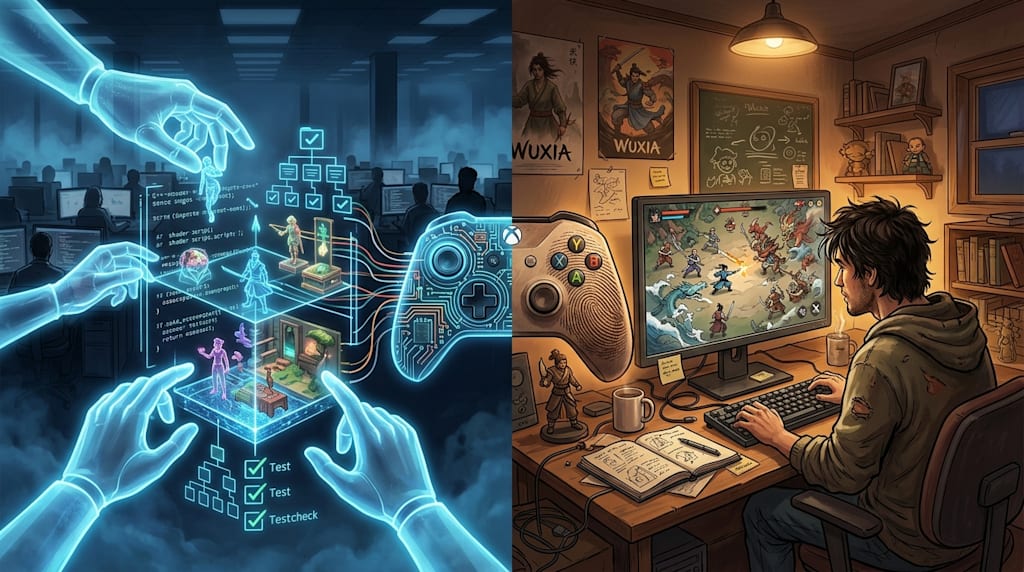
Three days ago I played Qunxia Zhuan: Survivors.
The opening cutscene is AI-made. Anyone who has used AI image or video tools will recognize the look. The voice acting is AI too. It sounds oddly familiar, and not in a good way. The action is the weakest part. Poses work. Fights do not.
I played two or three rounds anyway. That night I wrote down a few wuxia story ideas.
The creator has played games for over twenty years. He cannot code. He has no art or music training. He used AI to cover those gaps. He took the loop from Vampire Survivors and Brotato, then set it during the six sects' siege of Bright Peak. The sects and characters have new names to avoid copyright. You combine external arts, internal arts, fists, swords, qimen, and hidden weapons. The game is free on Steam. It has one map and an endless mode. The balance is rough.
It is not polished. It is fun.
That game is a postcard from a future that is already here. AI is no longer just a chat toy.
Unity Tuanjie Engine 2.0 puts AI into code, scene building, and testing. TapTap Manufacturing says it will make game creation unimaginably easy. Producers now say the AI's work still has to be done by people.
So: if AI can handle half of production, does the industry still need as many people?
No panic. But there will be a reshuffle. I use AI. I do not give it final say over the creative core.
What AI Can and Cannot Do
AI can handle the repeatable, batchable, testable parts of production. Boilerplate code. Tool scripts. Test cases. Documentation drafts. Concept sketches. Placeholder assets. Regression tests. Copy variants. Localization drafts. Those tasks used to take weeks. Now a prototype can run in days. Someone who cannot draw, compose, or code can still build something and test an idea.
AI cannot handle the other half.
It cannot decide whether a mechanic stays. It cannot explain why a character moves people. It cannot feel what a player should feel at minute seven of a level. It cannot judge whether a bug should be fixed or turned into a feature. It cannot decide why a game is worth playing. It can give you a hundred options. It cannot choose the right one. It can copy a style. It cannot take responsibility for taste.
Tools get stronger. Execution gets cheaper. Judgment gets more expensive.
Who Gets Squeezed
The talent structure will split.
On one side: small teams and solo creators. AI lowers the barrier. One person can build a playable prototype. A team of three to five can make what used to require dozens. More Qunxia Zhuan: Survivors cases will appear. People who develop at night after a day job will not have to disappear for months and get a "not recommended" review. AI helps them shorten cycles, fill gaps, and keep updating.
On the other side: big studios. They have money, IP, publishing, and channels. AI will push them further into industrial production. If they use AI to lay people off, that is a money choice, not a tech requirement. They have the budget to hire. They should not spend millions on development and then cut the people who make it. AI efficiency should fund new work, not cover layoffs.
The middle is dangerous. People who only execute and cannot judge will be squeezed by AI and by younger people who use AI well. The fear is not that AI writes code. The fear is that you only write code. If you only draw, or only run tests, you are in the same spot.
AI is a tool. A tool does not create direction. It multiplies whatever direction you already have. People who use it can do the work of a small team. People who do not will be replaced by people who do.
Why Qunxia Zhuan: Survivors Matters
The game has AI smell. It is still fun.
AI filled what the creator lacked: code, art, music, voice. The creator filled what AI lacked: twenty years of play, an understanding of survivor roguelikes, a breakdown of wuxia sect moves, a system for combining external and internal arts, and a cultural frame like the six sects' siege of Bright Peak.
AI lowered the production barrier. It did not lower the fun barrier.
Players will accept an AI cutscene. They will tolerate AI voices. They will forgive weak action if the game is fun. A game has to be fun, just as a film has to look good. Otherwise the dreams, the passion, and the values do not matter.
Overseas players are hostile to AI. They see it and leave a comment: "If it has AI, I won't play it." China is more open. That is not a free pass. Label AI use. Follow the rules. Polish the work. Do not let AI smell be the first impression.
Players do not hate AI. They hate laziness. "I can tell it's AI" can erase a creator's effort. Commercial projects still face reality: when AI generation is cheap, trust and taste become expensive. Lower barriers do not mean lower standards. Equal tools do not mean equal results.
What I Do
I use AI. The more I use it, the less I panic. The boundaries become clear.
I use it for boilerplate code, tool scripts, test cases, doc drafts, concept sketches, placeholder assets, copy variants, localization drafts, regression tests, edge cases, and rapid prototypes. I spend the saved time on gameplay validation, balance, pacing, feel, narrative integration, and player feedback.
I do not let AI decide whether a mechanic stays, why a character matters, what a level should make the player feel at minute seven, whether a bug is a feature, or who the game is for.
When a producer says "the AI's work still has to be done by us," that is not a rejection of AI. It is a boundary. AI executes. People judge, integrate, choose, and take responsibility. AI can help you make a game. It cannot decide why the game is worth playing.
Panic or Use It?
Use the tools. Then worry about sameness.
AI is a tool. Tools widen gaps. People who use them can do the work of a small team. People who do not will be replaced by people who do.
Does the industry still need people? Yes. It needs fewer hands and more people who can judge. Small teams can use AI to shorten production and fill gaps. Big companies should hire. Independent developers can use AI to finish a dream, but they should not let AI sign their soul. Players can accept AI in production if you respect their trust.
I use AI. The more I use it, the less I panic. AI can handle half of production. The other half is the game.
AI can help you make the game. It cannot decide why it is worth playing.
Does the industry need so many people? It needs people who take responsibility for fun.
I will keep using AI. I will take responsibility for fun.
About the Creator
Jin
Writer of reamstories
https://reamstories.com/jin
Enjoyed the story? Support the Creator.
Subscribe for free to receive all their stories in your feed. You could also become a paid subscriber, letting them know you appreciate their work.
Comments
There are no comments for this story
Be the first to respond and start the conversation.