
Why the World Calls China “China” — Not “Zhongguo”
It has nothing to do with porcelain. The name traveled from an ancient state called Qin, through Sanskrit, Greek, Latin, and Old French, before it ever reached English.
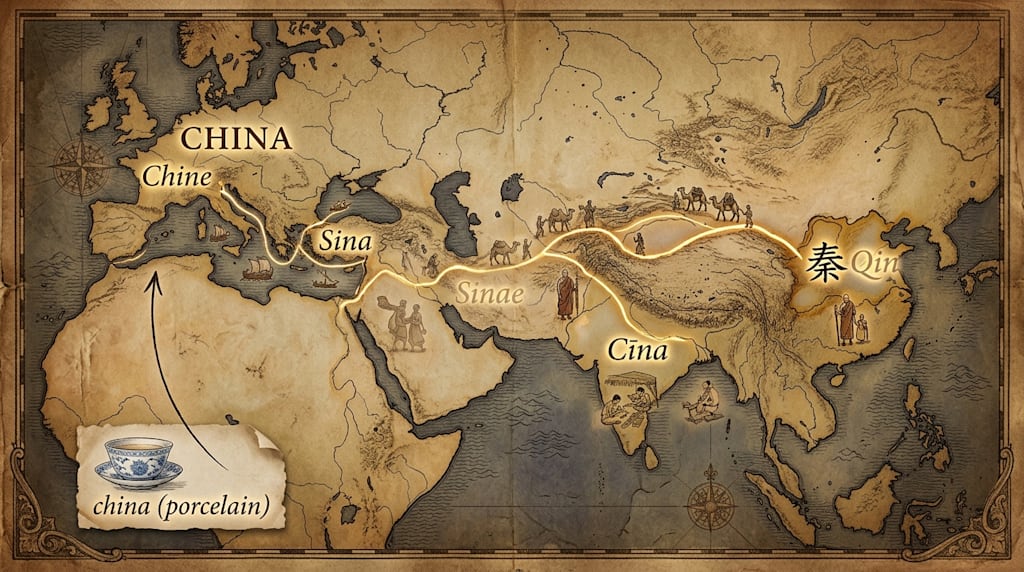
English does not call China Zhongguo because the name reached Europe through a chain that started with Qin. Zhongguo is an internal term. For centuries it described the central states or the central kingdom. It was not the name traders carried west. The name they carried came from Qin.
Qin was a state before it became a dynasty. It sat in the northwest. That position gave it access to routes toward Central Asia and South Asia. Merchants moved goods and names along those routes. Indian scribes wrote the name as Cīna. That Sanskrit form is the earliest widely accepted foreign written form behind China.
Old Chinese pronunciation is reconstructed, not recorded on tape. Linguists rebuild it from rhyme tables, dialect evidence, and earlier transcriptions. Qin is often reconstructed with an initial consonant cluster and a final nasal, something like dzin or zin. Indian writers rendered that sound as Cīna. Chinese Buddhist translators later turned Cīna back into Chinese. They wrote Zhīnà. They also used Zhèndàn, from Sanskrit Cīnasthāna, the land of Cina. These forms appear in Buddhist texts and geographical descriptions. They show the name moving across Asia long before Europe had a stable word for China.
From India the name went west. It passed through Central Asia, Persia, and the eastern Mediterranean. Greek and Roman geographers wrote Sinae and Thinae. Latin authors wrote Sina and related forms. The chain was not a single straight line. Each language reshaped the sound. In the Romance languages the name often gained a final -a. Old French had Chine. English took the name from Old French and wrote it China. By the time English became a global language, China was already fixed.
Zhongguo arrived late in the international naming game. It became the standard formal name for China in international usage in the late nineteenth and early twentieth centuries. By then European languages had called the country China for centuries. A name embedded in maps, treaties, books, and daily speech does not change easily. The first-contact name won.
A common claim says porcelain gave China its English name. That reverses the order. The country name came first. Porcelain came later. When Chinese porcelain arrived in Europe in large quantities, buyers admired its hardness, whiteness, and translucence. They called it "china ware," meaning ware from China. The phrase shortened to "china." The lowercase china for porcelain comes from the uppercase China for the country. The pottery took its name from the country.
Other names came from other routes. Greek and Roman writers spoke of the Seres, the people of silk. Seres is often traced to the Chinese word for silk, si. The land was called Serica, the land of silk. For the ancient Mediterranean, China was less a political entity than the source of a fabric. Silk was light and strong. It cost a fortune. The name Seres recorded that trade.
In the Middle Ages, another name became common in Europe: Cathay. It came from the Khitan, who founded the Liao dynasty in northern China. The Khitan were powerful and known across Central Asia. Their name became a label for northern China in many languages. Marco Polo used Cathay for the lands he described. The name survives today. Russian calls China Kitay. Turkish calls it Kıtay. Mongolian and some Central Asian languages have similar forms. These names come from the Khitan, not from Qin.
For centuries a traveler could say Seres, Cathay, or China and mean different things depending on route and era. Seres pointed to silk. Cathay pointed to the Khitan and the northern overland world. China pointed to the name that traveled from Sanskrit Cīna through Persian, Greek, and Latin into Western European languages. They came from different routes and different periods.
Today English says China. Russian says Kitay. Greek once said Seres. Each word records a different first encounter. English records the route that began with Qin. Russian records the route that began with the Khitan. Greek records the route that began with silk. None is a translation of Zhongguo. They are records of trade, travel, and the habit of naming a distant land after the first thing one hears about it.
The name China is a foreign record. It tells us who reached China first, what they heard, and how the word changed as it passed from language to language. Nations often do not choose the names outsiders use. Roads, ships, merchants, and scribes choose them. China is the name the world gave to China before China called itself Zhongguo in the modern international sense. That is why English says China, not Zhongguo.
About the Creator
Jin
Writer of reamstories
https://reamstories.com/jin
Enjoyed the story? Support the Creator.
Subscribe for free to receive all their stories in your feed. You could also become a paid subscriber, letting them know you appreciate their work.
Comments
There are no comments for this story
Be the first to respond and start the conversation.