
Why Men Aren’t YY: The Chromosome Truth That Changes Everything
One X keeps the embryo alive. One Y flips the testis switch. Remove the X, and development stops.
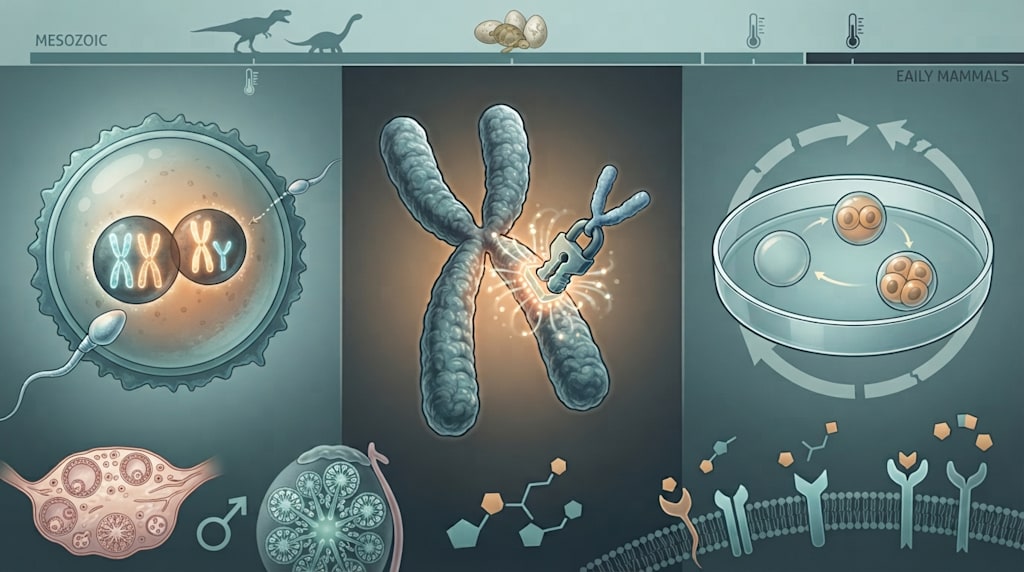
In ordinary human fertilization, the egg contributes one sex chromosome: X. The sperm contributes either X or Y. The zygote therefore has two standard combinations: XX or XY.
For a YY zygote to form, the egg would have to contribute no X. Human eggs normally carry an X after meiosis. An egg without an X cannot produce a normal embryo. Polyspermy, where two sperm enter one egg, does not change this. The egg still brings its X. If both sperm carry Y, the result is XYY, not YY. In the normal pathway, YY does not arise.
A laboratory-made YY cell faces the same problem. The X chromosome carries roughly 800 to 900 protein-coding genes. These genes control the cell cycle, protein synthesis, neural development, muscle function, immune regulation, and metabolism. Both sexes need them. A male has only one X, but he has at least one. A YY cell has none.
Human embryos implant around day 5 or 6. Before that, the embryonic genome has already switched on. Without X-linked gene expression, the cell cycle stalls. Many embryos without an X stop dividing before implantation. Development does not reach the stages where miscarriage or stillbirth would apply.
The Y chromosome carries SRY, the key gene for testis determination. SRY encodes a transcription factor. During a critical window of gonadal development, it turns on SOX9. SOX9 pushes the bipotential gonad toward a testis.
Once a testis forms, Sertoli cells secrete anti-Müllerian hormone. This suppresses the Müllerian ducts, which would otherwise form the uterus and fallopian tubes. Leydig cells secrete testosterone. Testosterone drives the epididymis, vas deferens, and seminal vesicles. Dihydrotestosterone drives masculinization of the external genitalia.
The Y chromosome does not provide a complete plan for a male body. It provides a trigger. The X chromosome provides the basic genes needed for survival. XY works because one X keeps the organism alive, and one Y supplies the trigger.
The Y chromosome is small and gene-poor. It carries fewer than 100 protein-coding genes, compared with hundreds on the X. Many of its genes have counterparts on the X, but SRY does not. SRY is the switch that sets off testis development.
In typical development, the presence of SRY sends the gonad down the testis path. Without SRY, the gonad follows the ovarian path. This is not a simple on-off for every cell. It is a developmental cascade.
The X chromosome is not an inactive partner. It carries genes that are active in both sexes. In females, one X is largely inactivated in each cell, but not completely. Some genes escape inactivation and remain active from both X chromosomes. In males, the single X is active.
SRY arose from a gene duplication. The leading hypothesis: about 180 million years ago, an ancestral mammal had a duplication of SOX3. SOX3 sits on the X chromosome. It belongs to the SOX family and is involved in neural and gonadal development. After duplication, one copy continued its original job. The other copy accumulated mutations and became SRY.
SRY and SOX3 are highly similar. SRY is on the Y; SOX3 is on the X. Molecular clocks give a rough time range, not an exact date. Mutation rates depend on generation time and population history. The figure of 180 million years places the event in the Mesozoic, when dinosaurs dominated.
Before SRY, sex may have been determined by temperature. Turtles, crocodiles, and some lizards still use temperature-dependent sex determination, or TSD. Incubation temperature influences the sex of the offspring. Large temperature swings can skew the sex ratio. Long-lived species that breed many times have chances to correct. Short-lived species that breed once or twice can lose population size fast if the sex ratio collapses.
After SRY appeared, sex determination became Mendelian. The sex ratio became more stable. Combined with viviparity and the placenta, early mammals survived while dinosaurs dominated and expanded in the Cenozoic.
Karyotype is not the same as sex. Clinically, there is a group of conditions called disorders or differences of sex development, DSD. The older term “hermaphroditism” is no longer preferred.
46,XX ovotesticular DSD: The individual has both ovarian and testicular tissue, or an ovotestis. Some cases involve translocation of SRY from the sperm’s Y to an X. The zygote is 46,XX but carries SRY, so part of the gonad starts down the testis pathway. Not all cases have SRY translocation. Many involve other gene pathways.
46,XY complete androgen insensitivity syndrome: The karyotype is XY. There is SRY and there are testes. The androgen receptor is mutated, so the body does not respond to androgens. The external genitalia appear female. Anti-Müllerian hormone still works, so the Müllerian ducts regress. There is usually no uterus. At puberty, testosterone can be converted to estrogen, and breast development may occur.
46,XX congenital adrenal hyperplasia: The karyotype is XX. There are ovaries. The adrenal glands overproduce androgens. The external genitalia become masculinized during fetal development. The clitoris may be enlarged, and the labia may be partly fused. The child may be raised as a boy. The gonads are still ovaries, and a uterus is usually present.
Chromosomes, gonads, hormones, external genitalia, and gender identity are separate parts of development. They usually align. They do not always align.
YY is not a more masculine version of XY. YY is a combination without an X. Without an X, the embryo lacks a large set of essential genes. Development stops early.
XY works because one X maintains survival, and one Y provides the trigger. Maleness is not defined by Y alone. It is shaped by X, Y, SRY, hormones, receptors, and the developmental environment.
In a culture dish, a YY cell divides a few times and stops. Without an X, the cell cycle cannot proceed.
About the Creator
Jin
Writer of reamstories
https://reamstories.com/jin
Enjoyed the story? Support the Creator.
Subscribe for free to receive all their stories in your feed. You could also become a paid subscriber, letting them know you appreciate their work.
Comments
There are no comments for this story
Be the first to respond and start the conversation.