
Why Ancient China Called the Moon “Guanghan” Without Ever Measuring Its Temperature
A summer-night story, a Daoist frozen palace, and the cosmological logic that made the moon cold.
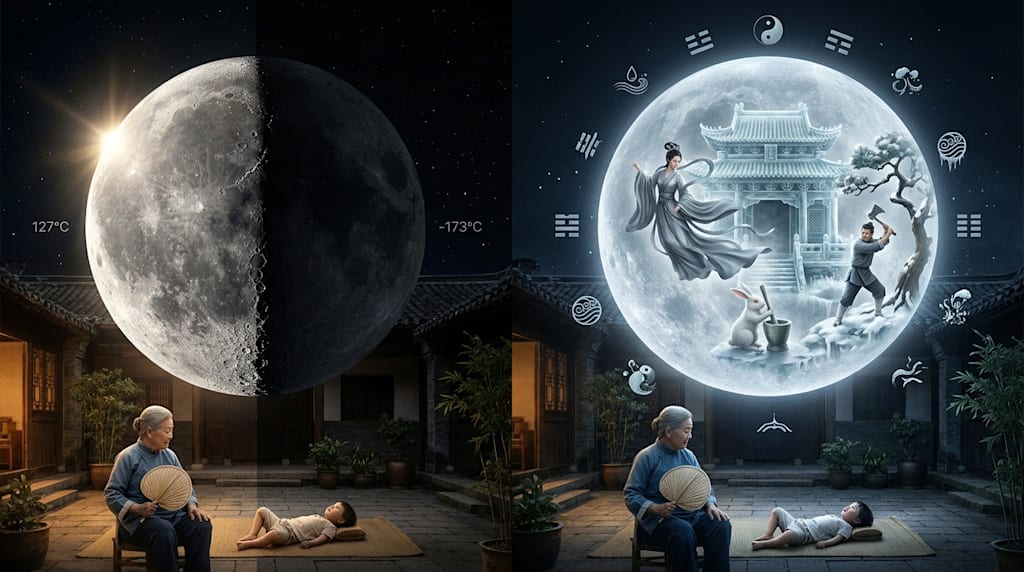
When I was little, on summer nights I lay in the courtyard. Grandma waved a palm-leaf fan and said the moon was very cold. Chang’e wore too little, she said, and could not sleep night after night.
I wondered how she knew. Grandma had never ridden a rocket.
Later I understood. She did not know. She believed. Not in science, but in a cosmology older than science. In that world, the moon was cold by nature. The cold came from yin-yang and the Five Phases, from trigram directions, from Daoist palaces. No thermometer was involved.
The answer is simpler than it looks. The ancients did not use temperature to understand the moon. They used Taiyin. They used the north. They used water, winter, Kan, cold. Then they gave the moon a palace: Guanghan.
The moon is not simply cold. It is a world of absurd extremes. No dense atmosphere. No oceans. No clouds. Heat cannot stay. At noon on the equator, the surface can reach about 127°C. At night, it can fall to about -173°C. Permanently shadowed polar regions get colder still.
The first reliable measurement of the lunar surface came in 1927. Pettit and Nicholson at Mount Wilson Observatory used ground-based infrared radiation. In a 1930 paper, they reported a maximum temperature at the subsolar point of about 407 K, or 134°C. In 2009, the infrared radiometer on NASA’s Lunar Reconnaissance Orbiter measured about 400 K, or 127°C, at the lunar equator at noon.
For comparison, the highest natural surface temperature on Earth is in Iran’s Lut Desert. In 2005, a satellite measured 70.7°C.
If Chang’e really lived on the lunar surface, she would not lie awake from cold every night. She would lie awake from heat during the day and from cold at night. A habitable Guanghan Palace would need air conditioning that cools by day and heats by night. The outdoor unit would have nowhere to go.
But the “Guanghan” the ancients meant is not that kind of cold.
The ancients had no infrared telescopes, no probes, no thermal radiometers. They could not have known about 127°C at the subsolar point or -173°C at night. Yet they still called the moon cold. They still named its palace Guanghan. This was not meteorology. It was cultural naming.
Science asks how many degrees the moon is. Culture asks what the moon is like. The ancients answered: the moon is like Taiyin, like the north, like water, like winter, like cold. So Guanghan Palace appeared.
Many people assume Guanghan Palace has always been another name for the moon. It has not.
“Guanghan” began as a Daoist term. It first referred to a northern immortal palace, or an immortal mountain. It was not the moon.
The earliest appearance may be in the Yellow Court Scripture: Inner Landscape. The text was probably composed during the Wei-Jin period. One line reads:
If one can cultivate it and ascend, one climbs to Guanghan.
In the Tang dynasty, Liang Qiuzi annotated that line:
Guanghan is the name of a northern immortal palace. It is also called a mountain name, and also called Guangxia. The Dongzhen Scripture says: “On the day of the winter solstice, the moon hides in the palace of Guanghan; at that time it nurtures the lunar soul in the pool of Guanghan, and heavenly beings gather branches of the green-flower forest to brush the light of the sun and moon.”
This annotation matters. Guanghan was originally a northern immortal palace. It could also mean a mountain. It was also called Guangxia. It was a Daoist space, not a temperature description. More important is the line from the Dongzhen Scripture: “On the day of the winter solstice, the moon hides in the palace of Guanghan.”
Note the wording. The moon hides in the palace of Guanghan. The text does not say the Guanghan Palace is the moon palace. In early Daoist imagination, Guanghan Palace was an immortal palace in the north. On the winter solstice, the moon entered it and nurtured the lunar soul in the Guanghan Pool.
It is like an immortal cave dwelling. The moon comes to stay every winter solstice. Over time, the whole palace became the moon’s own.
Why did this binding happen? North, winter solstice, and moon form one set in Daoist cosmology.
North corresponds to water among the Five Phases. Water governs winter. Winter governs cold. The winter solstice is the time of utmost yin. Yin qi is fullest then, and yang qi first begins to grow. The moon is the essence of Taiyin, the representative of yin. So north, water, winter, cold, Taiyin, and moon link together automatically.
Guanghan was already a northern immortal palace. The north was already cold. The moon was already Taiyin. At the winter solstice, the moon hid in the palace of Guanghan. Those three ideas overlapped, and the relation between the moon and Guanghan was planted.
There is also a Record of the Ten Continents, formerly attributed to Dongfang Shuo and now generally considered a Six Dynasties pseudepigraphon. It contains a line often quoted:
After the winter solstice, the moon nurtures its soul in the Guanghan Palace.
The textual history is complicated. The current text does not necessarily contain this line, so cite it with care. Even so, Liang Qiuzi’s annotation to the Yellow Court Scripture shows that between the Six Dynasties and the Tang, “Guanghan” and the moon had already grown close.
The Tang dynasty fixed “Guanghan Palace” onto the moon.
Daoism flourished in the Tang. Emperor Xuanzong revered Daoism and kept close company with Daoist priests. A famous story appeared: Emperor Ming of Tang visits the moon palace.
In Liu Zongyuan’s Dragon City Record: Emperor Ming’s Dream Visit to Guanghan Palace, the emperor travels to the moon in the sixth year of the Kaiyuan era. A Daoist master performs rituals, and he rides the clouds upward. When he arrives, he sees a great palace. On its plaque:
The Palace of Vast Cold and Pure Emptiness.
Miscellaneous Records of Emperor Ming tells a similar story. By the Five Dynasties, Wang Renyu’s Anecdotes of the Kaiyuan and Tianbao Eras repeated it:
Emperor Ming visited the moon palace and saw on the plaque: The Palace of Vast Cold and Pure Emptiness.
Literati such as Zhu Xi suspected that the Dragon City Record was not written by Liu Zongyuan. Its date can only be placed no later than the Northern Song. Whoever wrote it, the story spread widely after the Tang.
More importantly, the mid-to-late Tang poet Bao Rong had already written in “Staying at the Water Pavilion”:
Deep in the night, stars and moon accompany the lotus; it is as if I were lodging in the Guanghan Palace.
By the mid-to-late Tang at the latest, “Guanghan Palace” was a common literary name for the moon palace. It was not one person’s fancy. It was an established cultural image.
The six characters “Guanghan Qingxu zhi Fu” bound together the Daoist immortal palace, the moon, and an aesthetic of purity and emptiness. Later it shortened to “Guanghan Palace.” Later still, Chang’e, the Jade Rabbit, the cassia tree, and Wu Gang moved in.
Guanghan Palace is not an astronomical name. It is a Daoist name, a literary name, a moon palace imagined collectively by Tang-dynasty people.
The ancient Chinese had no infrared telescopes. They had another telescope: yin-yang and the Five Phases.
In the cosmology of the I Ching, the sun is Taiyang and the moon is Taiyin. The sun is fire. The moon is water. The moon corresponds to water among the Five Phases, to the Kan trigram, to the north, to winter among the four seasons, and to cold in temperament.
This was not random. It was a complete symbolic system.
The sun is day, light, heat, life, yang. The moon is night, darkness, cold, stillness, yin. The sun governs birth and growth. The moon governs storage and retreat. The sun is in the south. The moon is in the north. The sun is in summer. The moon is in winter. The sun is fire. The moon is water.
When the Chinese said the moon was cold, they were not measuring. They were deducing. This was not an experimental conclusion. It was a cosmological conclusion.
The ancients said, “The sun and moon move, and cold and heat arise.” The sun and moon are not two stone balls. They are two kinds of qi, two forces, two symbols. Their movement brings cold and heat, day and night, the four seasons, and the birth and killing of all things.
In this system, the moon cannot be anything but cold. If it were not cold, the entire system of yin-yang and the Five Phases would fall into disorder.
So “Guanghan” is not temperature. It is temperament. Not cold, but coldness. Not meteorology, but the image of the Dao.
In one sentence: the ancient Chinese observed heaven with Daoist eyes and named it by trigram images. Hence, Guanghan.
The cold of Guanghan is not only coldness. It is linked to purity, emptiness, stillness, distance, solitude, height, and cleanness.
The full name of Guanghan Palace is “The Palace of Vast Cold and Pure Emptiness.” Pure emptiness is a crucial state in Daoist cultivation. A pure heart and few desires. Emptiness and stillness without action. When cold joins purity and emptiness, it becomes a spiritual quality.
The moon in the night sky is silver-white, clear and cold, quiet, distant. It is not ardent like the sun. It does not scorch like flame. It shines on you without disturbing you. It makes you think of home, of old friends, of time, of loneliness.
Guanghan Palace became the most famous cold palace in Chinese literature. Its cold is not the cold of a refrigerator. It is clear cold. Not the chill of a freezer. It is lonely cold. Not low temperature. It is a high state.
Chang’e lives there: lonely, long-lived, beautiful, desolate. The Jade Rabbit pounds medicine. Wu Gang chops the cassia. The cassia does not die. The moon does not die. Li Bai raises his head to look at the bright moon and lowers it to think of home. Zhang Ruoxu asks: Who by the river first saw the moon? When did the moon by the river first shine on people? Su Shi says: When did the bright moon appear? I raise my cup and ask the blue sky. And he also says: I only wish we may long endure, and share the moonlight though a thousand miles apart.
In these poems, the moon is not a celestial body. It is a spiritual space. Guanghan Palace is the palace of that space.
The moon in science is a dead rocky sphere. The moon in culture is the pure and empty Guanghan Palace. The two do not contradict. One asks, “What is it?” The other asks, “What does it mean?”
The answer is that the ancients did not know.
They did not know the moon was cold. They recognized the moon as the embodiment of cold.
They used yin-yang and the Five Phases to define the moon as Taiyin. They used the eight trigrams to place it in Kan. They used the Five Phases to place it in water. They used the four seasons to place it in winter. They used direction to place it in the north. North is cold. Winter is cold. Water is cold. Taiyin is cold. So the moon became cold.
Then Daoism provided a ready-made name: Guanghan. Guanghan was originally a northern immortal palace. The north was cold by nature. On the winter solstice, the moon hides in the palace of Guanghan. Emperor Ming of Tang visited the moon palace and saw on the plaque: The Palace of Vast Cold and Pure Emptiness. Mid-to-late Tang poets wrote, “as if lodging in the Guanghan Palace.” From then on, Guanghan Palace was the moon palace.
This is not a scientific discovery. It is a cultural naming. This is not temperature measurement. It is symbolic construction. The ancients did not “know long ago.” They “understood it this way long ago.”
Grandma did not know 127°C. She did not know -173°C. But she knew the moon was Taiyin, and Taiyin should be cold. She knew Chang’e wore too little and could not sleep night after night from cold. She was telling a story, not data. Stories entered the human heart earlier than data.
Now we know the moon is as hot as 127°C by day and as cold as -173°C at night. If the Guanghan Palace really existed, it would probably have to be called the Palace of Vast Cold and Vast Heat. But the name “Guanghan” is still beautiful.
It is not only saying the moon is cold. It is saying that beyond the noisy human world, there is still a clear, cold, quiet, distant place. No smoke and fire. No clamor. No fame and gain. No right and wrong. Only moonlight. Only the cassia tree. Only a rabbit, a Wu Gang chopping wood, and a Chang’e who cannot sleep.
Science lets us know what the moon is. Culture lets us know why the moon is beautiful.
The summer night is still that summer night. The palm-leaf fan is still that palm-leaf fan. Grandma may no longer be here. The moon is still here.
You look up at it. It is still silver-white, clear and cold, quiet. But you know: its cold is not temperature. It is naming. Its coldness is not data. It is imagination.
Guanghan Palace is not on the moon. Guanghan Palace is in the glance with which you look at the moon.
About the Creator
Jin
Writer of reamstories
https://reamstories.com/jin
Enjoyed the story? Support the Creator.
Subscribe for free to receive all their stories in your feed. You could also become a paid subscriber, letting them know you appreciate their work.
Comments
There are no comments for this story
Be the first to respond and start the conversation.