
What Actually Happens Before You Hit 'Donate'
The quiet infrastructure that keeps online giving honest

I never used to think twice about donating online. Find the cause, click the button, type in your card details, done. It felt about as complicated as buying a book.
Then I started looking into how fundraising platforms actually work — not the donor-facing side, but the back end — and it turns out there's a whole layer of work that happens before a charity ever gets to put a donate button in front of you.
Most people never see it. That's kind of the point.
The trust problem
When you donate through a platform, you're not just trusting the charity. You're trusting that the platform checked whether the charity is real. That's a different thing, and it matters more than most donors realize.
The early days of online fundraising were messier. Some platforms let organizations sign up with minimal checks, and a handful of bad actors — fake charities, impersonators, organizations that had quietly lost their legal standing — slipped through. The damage wasn't just financial. Once donors heard that a platform had hosted a fraudulent campaign, suspicion spread to every campaign on that platform. That skepticism can linger for years.
So serious platforms started doing real verification. Not just as an ethical stance, but because their entire business depends on donors believing them.
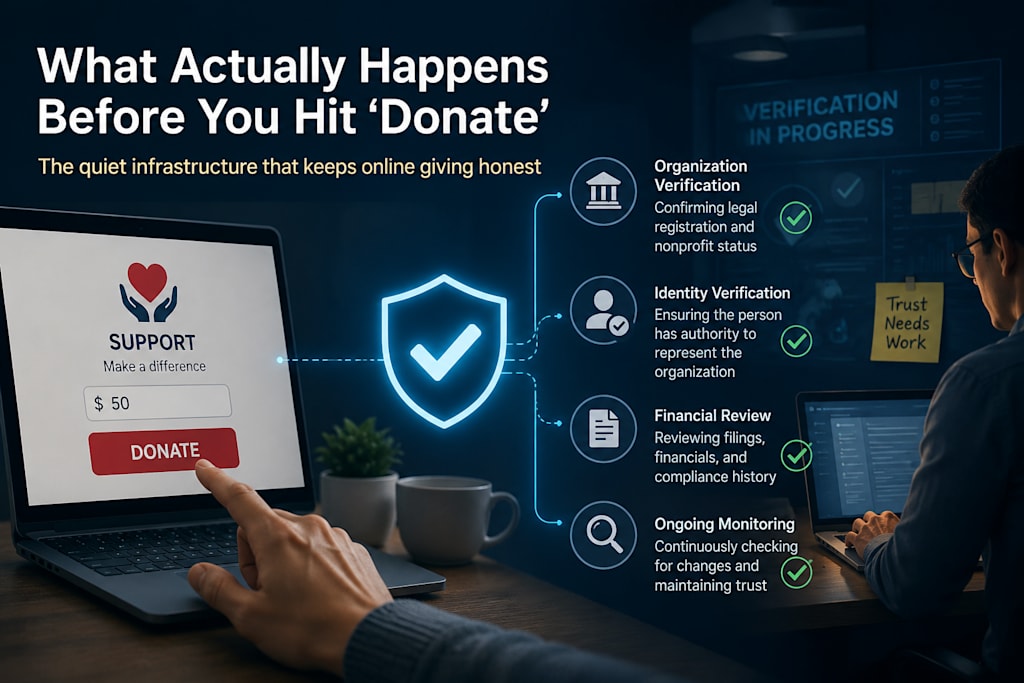
Step one: Does this organization actually exist?
This sounds like the easiest check in the world, but it's more involved than a quick Google. A nonprofit needs a valid EIN, current IRS tax-exempt status, proper state registration, and the right tax classification. And organizations are moving targets — they change names, merge, spin off new programs, operate under a name that doesn't match their official filings.
None of that is automatically suspicious. It just means you can't do a five-second search and call it done.
As application volumes grew, platforms started pulling in external databases and verification tools to help reviewers work faster without cutting corners. The goal isn't to replace human judgment — it's to make sure reviewers aren't starting from scratch on every single application.
Being registered isn't enough
Here's what surprised me: confirming that a nonprofit is legally registered is just the baseline. It's necessary, but it doesn't tell you much on its own. An organization can be properly registered and still be effectively dormant, financially troubled, or spending money in ways that have nothing to do with its stated mission.
So responsible platforms dig further. They look at annual filings, financial disclosures, governance history. The questions aren't hostile — they're just practical. Is this organization still active? Are its filings current? Does what it spends money on match what it says it does? Has it had any compliance issues?
Most nonprofits are doing exactly what they say they're doing. The additional scrutiny exists for the minority that aren't, and for the cases where something just doesn't quite add up.
The impersonation angle
This was the part I hadn't anticipated at all.
Nonprofit registration data is mostly public. Anyone can look up an EIN, find an organization's address, pull its filing history. That information is available precisely so donors can do their own research — but it also means someone running a scam can use a real organization's identity to set up a fake fundraising account.
Donations come in, none of them reach the actual charity, and by the time anyone figures it out, the damage is done.
This is why platforms have to verify not just whether an organization exists, but whether the specific person creating the account actually has the authority to represent it. That means checking contact details, confirming their role, cross-referencing their identity against the organization's own records. Organizational verification and identity verification are two separate things, and you need both.
Verification isn't a one-time thing
A lot of people assume verification works like a gate — you pass the check once, you're in, and that's the end of it.
It isn't.
Organizations change over time. Leadership turns over. Tax-exempt status gets revoked. Financial problems that weren't visible during the initial review surface later. An organization that looked completely straightforward three years ago might look quite different today.
Good platforms build ongoing monitoring into their process. They run periodic reviews of active accounts, flag changes in public records, and have actual procedures for handling concerns that come up after an organization has already been approved. The initial check matters, but so does everything that comes after.
Automation and human judgment
There's a real tension in this kind of work. Manual review is thorough but slow. Automated checks are fast but they miss context.
The platforms that do it well have figured out where each approach actually belongs. Databases and APIs handle the volume work — pulling registration status, cross-referencing filings, flagging inconsistencies in structured data. Human reviewers take over where judgment is required: organizational histories that are technically clean but feel off, application timing that's suspicious without triggering any specific rule, edge cases that don't fit neatly into a checklist.
An experienced reviewer can catch things software won't. A nonprofit whose stated mission doesn't match where its money actually goes. An application where every individual data point checks out, but the overall picture doesn't. Those calls still need people.
Why you don't see any of this
Most donors never think about verification, and honestly, that's fine. It's infrastructure. It's supposed to be invisible.
But it's there. When you give to an organization through a reputable platform, someone already checked whether that organization is real, whether it's in good standing, and whether the person who set up the account actually works there. That work was done before you ever arrived at the donate page.
Online giving has become as routine as it is partly because platforms made it trustworthy enough to be routine. That trust gets built through work that never makes headlines — compliance checks, database reviews, monitoring systems that run quietly in the background. When they work, nobody notices. When they fail, a lot of people get hurt.
I didn't think much about any of this before I started looking into it. Most people don't. That button looks simple because someone made it that way.
About the Creator
Muhammad Talha Mohsin
Talha writes about technology, innovation, and the systems shaping our online world. Interested in digital platforms, emerging tools, and real-world tech stories, he enjoys creating content that informs, educates, and sparks curiosity.
Enjoyed the story? Support the Creator.
Subscribe for free to receive all their stories in your feed.
Comments
There are no comments for this story
Be the first to respond and start the conversation.