
The Role of Custom Itineraries in the Modern Luxury Charter Experience
How Personalization Has Redefined What Clients Expect — and What Operators Must Deliver

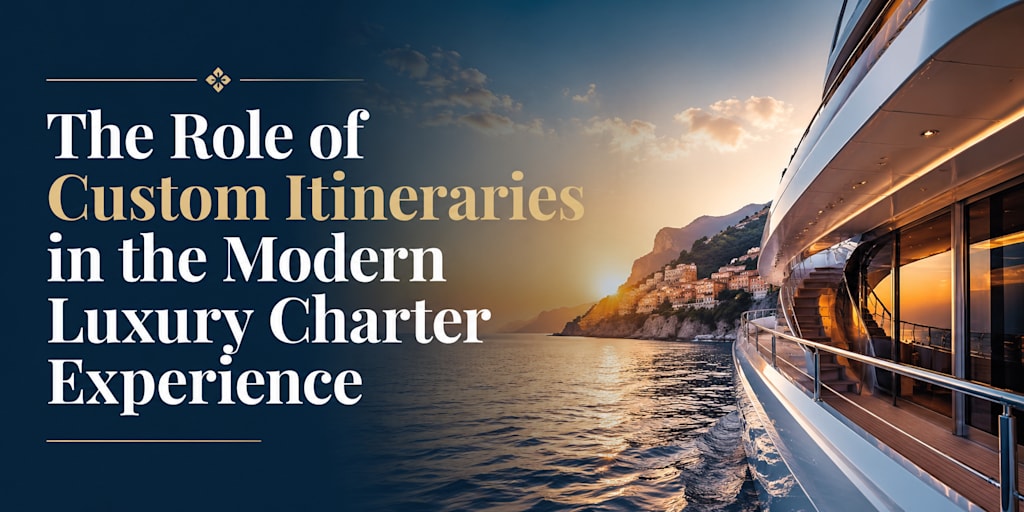
There was a time when chartering a yacht was, by definition, a luxury experience. The vessel itself was the product. The fact of being on the water, away from the shore, with a professional crew attending to basic needs — that was the offer, and for most clients, it was enough. That dynamic has shifted considerably. Today, at the upper end of the private yacht charter in Miami market, the vessel is understood as the setting rather than the experience itself. What increasingly defines the quality of a charter is the degree to which every element of it has been shaped around the specific preferences, rhythms, and expectations of the people on board.
Custom itineraries sit at the centre of this shift. In Miami's charter market — one of the most active and competitive in the world — personalization has moved from a premium add-on to a baseline expectation among discerning clients. Understanding what that actually means in practice, what can and cannot be customized, and how itinerary planning affects the overall quality of a charter, matters both for clients evaluating their options and for anyone seeking to understand how the luxury end of this industry operates.
What a Custom Itinerary Actually Encompasses
The phrase "custom itinerary" is used loosely across the charter industry, and the gap between what different operators mean by it is substantial. At its most superficial, customization might simply mean allowing a client to choose their departure time or select from a short list of pre-determined routes. At the luxury level, the concept is considerably more comprehensive.
A genuinely customized charter itinerary begins with a detailed intake process — a conversation, sometimes several, between the client and either the charter operator or a dedicated concierge. This process covers the purpose of the outing, the composition of the guest group, the desired pace and mood, any specific destinations or experiences the client has in mind, dietary requirements and preferences, entertainment preferences, and any occasions being marked. A milestone birthday celebration for twelve guests has a fundamentally different itinerary logic than a corporate client entertaining six business contacts or a couple seeking a private afternoon on the water.
From that baseline, a well-constructed itinerary maps out the route in relation to Miami's waterways and points of interest — the movement from Biscayne Bay toward the barrier islands, anchor points near Bimini or the Bahamas for extended charters, sandbar stops, waterway passages, or open-ocean stretches depending on the vessel and the client's preferences. Timing is calibrated to the experience: a sunset departure with a specific horizon position in mind requires different departure planning than a midday outing oriented around swimming and leisure.
The hospitality dimension is equally part of the itinerary. Catering menus are built around the guest profile, not taken from a fixed list. Bar programmes reflect the occasion and the preferences communicated in advance. If entertainment is involved — live music, a DJ, specific audiovisual requirements — that is coordinated as part of the itinerary structure rather than handled as an afterthought. At the highest tier of charter service, every touchpoint is accounted for before the lines are cast off.
Miami's Geography as a Canvas for Itinerary Design
One of the reasons Miami functions so well as a luxury charter market is that its geography offers genuine variety within relatively short distances. A skilled charter operator building a custom itinerary in this city is not working with a single, fixed landscape — they are working with a layered environment that can be shaped in meaningfully different ways depending on what a client is looking for.
Biscayne Bay, which stretches along the eastern edge of Miami and its barrier islands, is the primary working environment for most day charters. Its protected waters make it suitable for a wide range of vessel sizes and guest comfort levels, and it offers access to the residential waterways of Miami Beach, the open vista of the bay itself, and the more secluded areas around Stiltsville and the outer edge of the bay where anchorage is possible. The visual contrast between the city skyline and the open water is a reliable element in any itinerary that includes guests unfamiliar with the area — it remains one of the more striking waterfront environments in the Western Hemisphere.
The Intracoastal Waterway extends the charter geography northward, offering a different visual register: the residential canals and dockside properties of Fort Lauderdale's waterfront, quieter and more residential in character than the bay proper. For clients who want a more contemplative or intimate charter experience, or for those specifically interested in the waterfront real estate and architecture of South Florida's affluent communities, the Intracoastal can be a strong itinerary foundation.
For overnight or extended charters, the proximity of the Bahamas changes the proposition entirely. At charter speeds, Bimini is reachable within a few hours from Miami, and Nassau within a day's transit. The ability to integrate an international destination — a different country's waters, a different pace of life, the specific aesthetic of the Bahamian islands — into what begins as a Miami charter is a genuine differentiator that few other major port cities in the United States can offer.
The Logistics Behind Personalization at Scale
There is a practical complexity behind delivering genuinely customized charter experiences that clients rarely see and operators rarely discuss publicly. The logistics of personalization at the luxury level require a level of coordination that extends well beyond the vessel itself.
Provisioning for a customized catering programme, for instance, involves sourcing decisions that must be made well in advance — sometimes days ahead, depending on the specificity of the request. A client who prefers a specific wine label, a particular species of fish prepared in a specific way, or dietary accommodations that require separate preparation workflows is creating coordination requirements that need to be built into the itinerary timeline, not resolved on the morning of departure. Operators who deliver on this consistently have established supplier relationships and provisioning systems that function reliably, not simply the intention to accommodate requests.
Crew briefing is another element that goes unseen but profoundly shapes the experience. Before a charter departs, a well-run operation will brief the crew on the guest profile, the occasion, the specific preferences communicated during intake, and any sensitivities relevant to the group. A crew that knows a guest is celebrating a significant personal milestone will behave differently than one operating in a generic hospitality mode. This is not a minor detail — the difference between a crew that is technically proficient and one that is also contextually aware is the difference between a service that is functional and one that feels genuinely personal.
Route flexibility also requires operational readiness. A custom itinerary may include preferred anchor points, but weather, sea state, and waterway conditions on the day of charter can require real-time adjustment. The best luxury operators have the experience and local knowledge to recalibrate an itinerary on short notice without the client experiencing the adjustment as a disruption — pivoting to an equally suitable alternative that preserves the intended experience even if the specific geography changes.
Where Customization Has Real Limits
Transparency on this point matters, because the luxury market is not always served well by operators who overstate what is genuinely achievable. Customization operates within real constraints, and clients who understand those constraints are better positioned to plan effectively and evaluate their options with clarity.
Vessel capability is the most fundamental boundary. A motor yacht with a top speed of eighteen knots operates within a different itinerary radius than a high-performance vessel capable of twice that. The number of guests and the weight of provisioning affects range and fuel consumption. Certain anchorage points require specific draft clearance. These are not failures of service — they are the physical parameters within which any itinerary is designed, and a reputable operator will communicate them clearly rather than promising what the vessel cannot deliver.
Regulatory considerations also apply. International water crossings to the Bahamas, for instance, involve customs and immigration procedures for all guests, and these cannot be bypassed regardless of the vessel or the client. Planning an extended charter that crosses international waters requires compliance with clearance protocols that need to be arranged in advance. Operators experienced in this kind of itinerary will manage these requirements seamlessly as part of the planning process, but clients should understand they exist.
Lead time is a practical constraint that is often underestimated. A genuinely customized luxury charter — with personalized catering, specific provisioning, coordinated entertainment, and a route built around the client's preferences — requires meaningful planning time. The charter market in Miami operates at high demand during peak periods, and the operators with the vessels, crews, and service infrastructure to deliver at the highest level are often booked weeks or months in advance. Attempting to arrange a fully customized experience with a few days' notice is possible in some circumstances, but it consistently produces compromised results compared to charters planned with adequate lead time.
Why Personalization Has Become the Standard Rather Than the Exception
The broader shift toward custom itineraries in luxury charter reflects something larger happening across the high-end hospitality and experiential industries. For individuals who can access virtually any venue, any hotel, any table — the transaction itself carries diminishing meaning. What carries meaning is the degree to which an experience reflects genuine attention to the specific person it is designed for.
In this context, a yacht charter that arrives at the same anchorage in the same sequence at the same time as every other charter that week is not, in any meaningful sense, a luxury experience regardless of the quality of the vessel. The luxury is the specificity. It is the itinerary that accounts for the fact that one of the guests has a particular interest in marine wildlife and the route has been adjusted to pass through an area where seasonal dolphin activity is likely. It is the catering programme that reflects a preference communicated in passing during an intake call three weeks prior. It is the crew that knows, without being asked twice, how the host prefers to manage the pace of the afternoon.
These are not grand gestures. They are the texture of an experience that has been built around a real person rather than a generic client profile, and in Miami's competitive luxury yacht charter market, they are increasingly what separates operators who retain clients from those who do not.
For clients evaluating charter options, the quality of the itinerary planning process — how operators ask questions, how thoroughly they listen, and how clearly that listening is reflected in what they propose — is one of the most reliable signals of what the experience itself will deliver.
About the Creator
Miami Boat Charter
Miami Boat Charters offers the largest and newest selection of fully crewed Boat Charters, Party Boats, & Luxury Yacht Rentals in Miami Beach.
Enjoyed the story? Support the Creator.
Subscribe for free to receive all their stories in your feed.
Comments
There are no comments for this story
Be the first to respond and start the conversation.