
The New York Times & Daily Newspapers
Case study in journalism


I have just finished teaching an online media literacy course and used The New York Times as an illustration of historical trends and modern challenges in journalism. I'm putting this here for anyone who might be interested.
The New York Times is the newspaper of record in the United States founded in 1850. It performs an important function of not only keeping the record of historical events (first draft of history) but, more importantly, informing its readers about events, policies, and issues that may affect their lives. Thus, it contributes to creating informed citizenry capable of making good decisions.
Provider of news and information services intended to help people understand the world. The company utilizes a diversified digital ecosystem to provide independent journalism, sports media, culinary recipes, and interactive games, enabling individual subscribers to access expert-reported content, product recommendations, and educational tools across multiple digital and print platforms.
PitchBook
Economic profile (PitchBook)
The graph below visualizes print circulation and paid subscriptions historically.
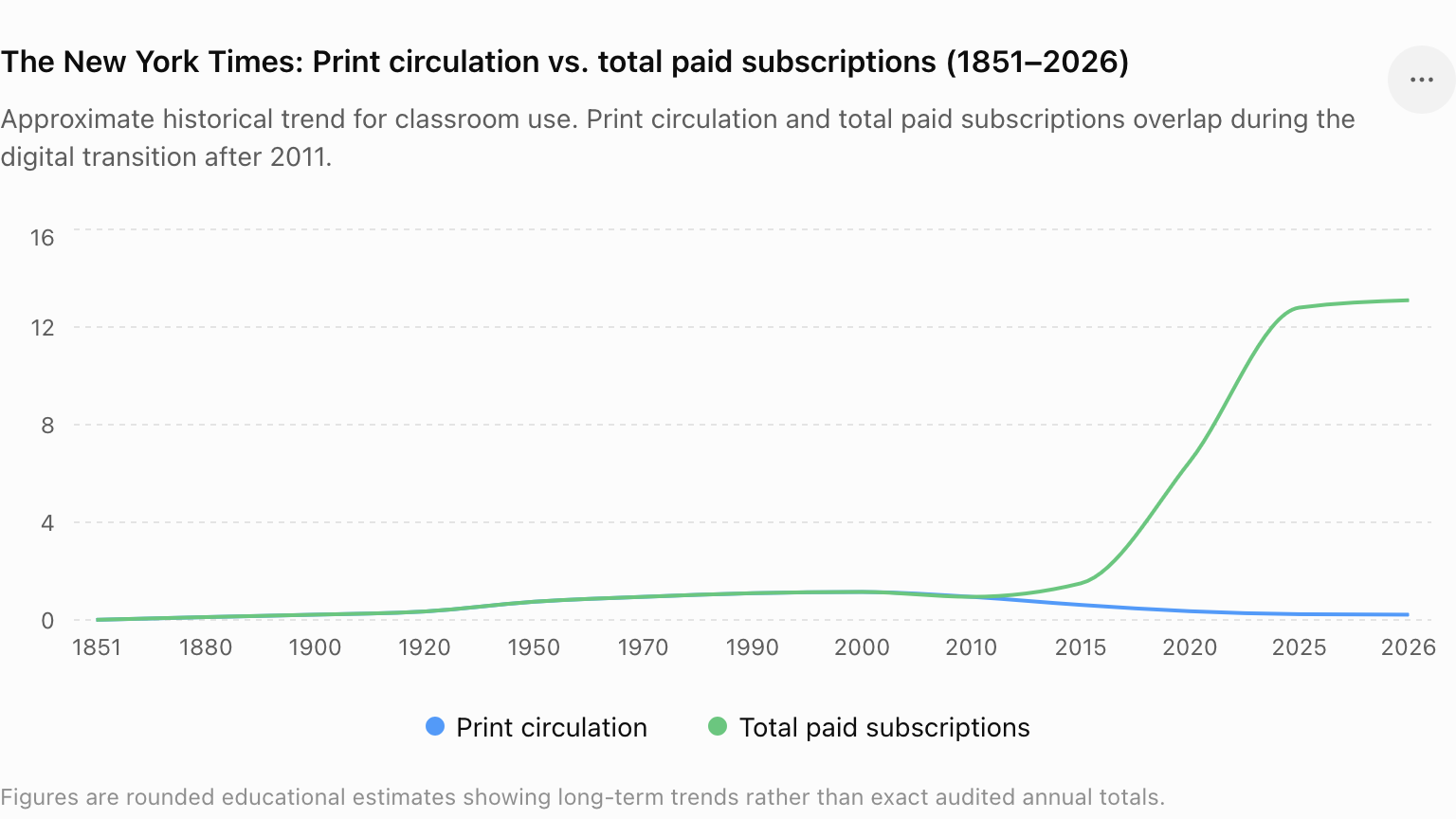
Print circulation is the number of copies that are actually sold through subscriptions and sales at kiosks, news stands, etc. It is different from and smaller than the print run - the number of copies produced at a print shop.
Factors and technologies that affected the NYT newspaper historically:
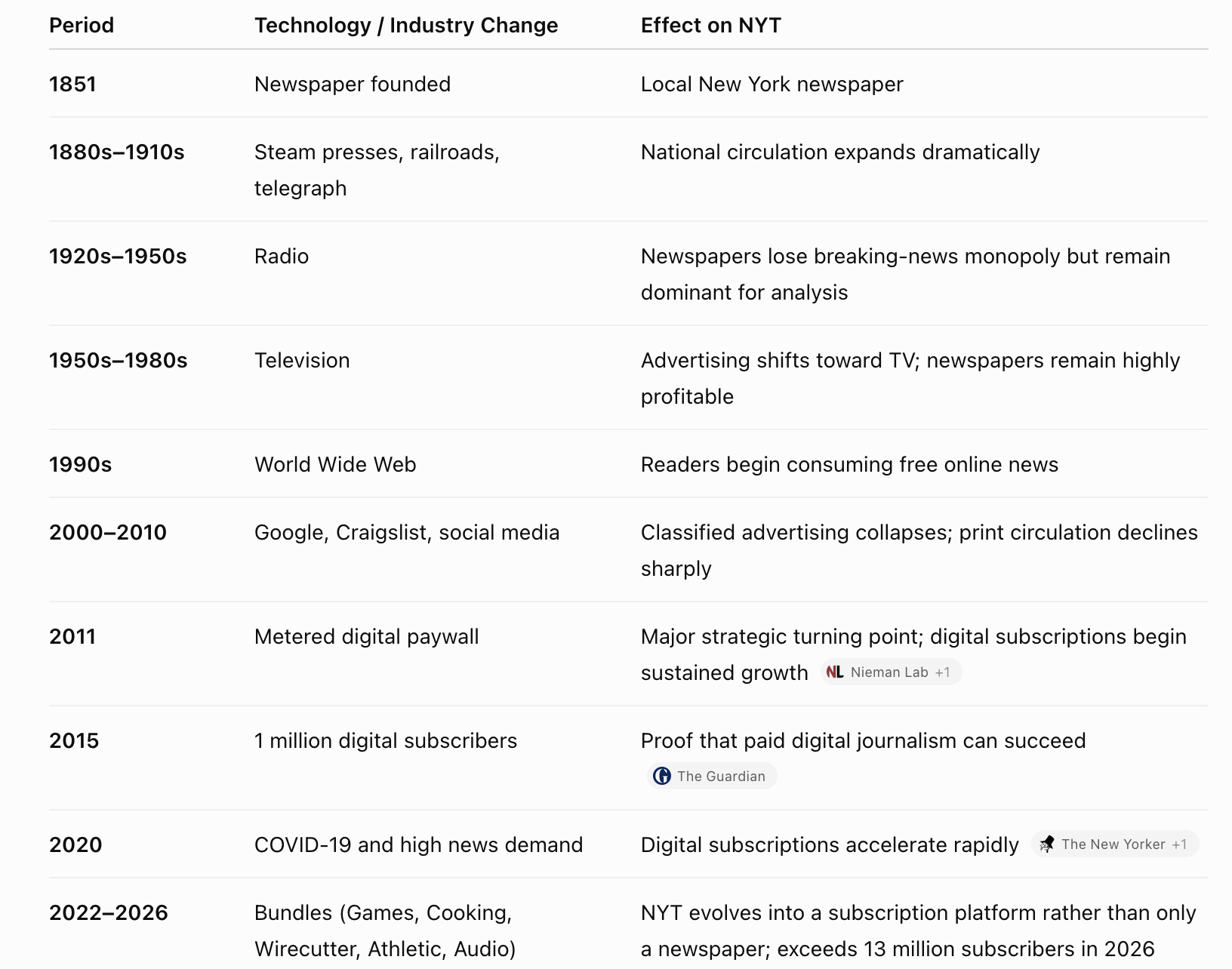
Other changes that affect the newspaper(s) in the 21st century are
Social media effects: SM users disassociate the actual news from its source and think all news comes from social media;
AI technologies are both beneficial (processing of large volumes of data, performing routine tasks and freeing journalists from them) and harmful (still low quality of writing and verification of data);
The New York Times is its own corporation, many other newspapers are usually part of larger media corporate entity.
In the 21st century, The NYT experienced a bifurcation in digital and print subscriptions. Print copy will eventually phase out as the subscribers (Baby Boomers and GenX) die.
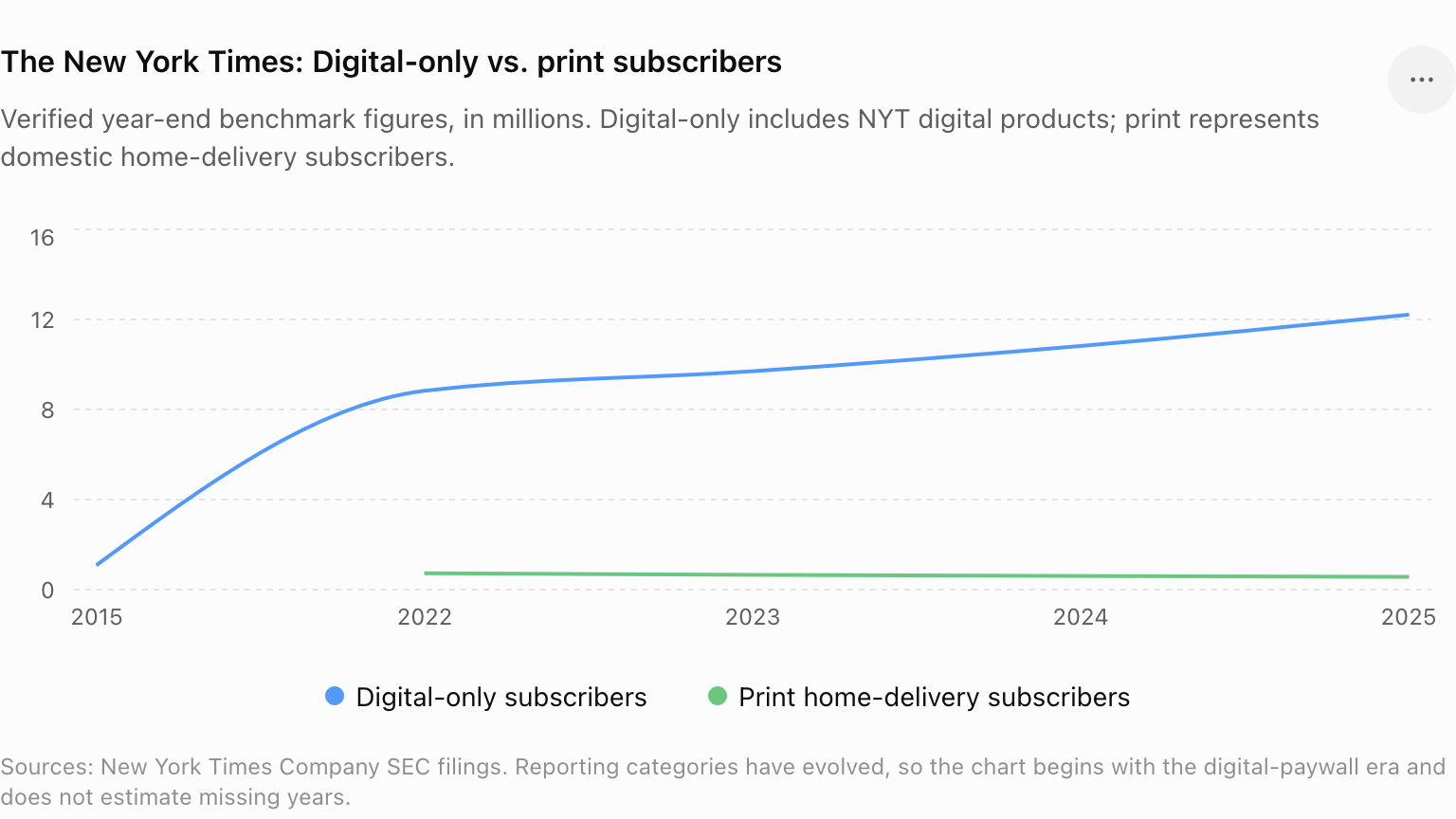
Verified actual statistics in the table above:

Notes on the graph:
This graph plots paying subscribers, not total readership. Millions of non-subscribers may encounter NYT journalism through search, social media, libraries, shared accounts, and syndicated material.
The digital line increasingly includes subscriptions to products such as Games, Cooking, Wirecutter, Audio, and The Athletic (sports news) — not only readers paying for the news report. The company’s definitions and product portfolio therefore changed over time.
The NYT is a model of how to survive and adapt to the new realities and challenges. Pioneering the paywall, it turned around the online users’ habit of consuming news online for free and by “bundling” other digital services (games, sports, cooking, etc) it diversified its sources of revenue and increased profitability.
However, many other newspapers have failed to adapt, and were either absorbed/consolidated or went out of business. The number of American daily newspapers is constantly declining.
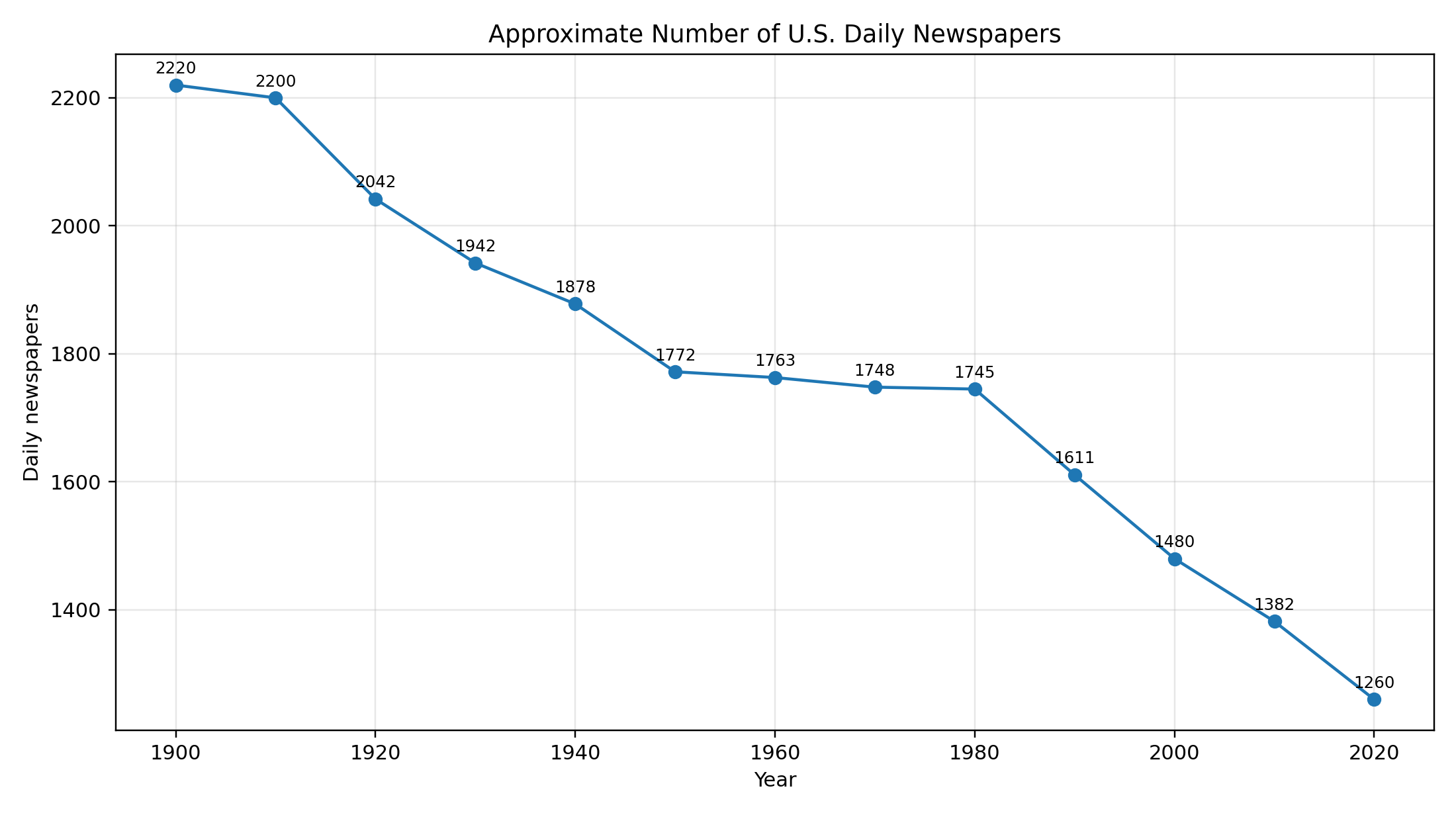
A few milestones help explain the downward trend:
1900–1920: The U.S. reached its historical peak of roughly 2,200 daily newspapers as nearly every city had multiple competing dailies. Print was the uncontested king in journalism.
1920–1940: Radio and the Great Depression accelerated consolidation, reducing the number from about 2,042 to under 1,900.
1950–1980: The total number remained surprisingly stable (around 1,750), although many cities lost afternoon papers while surviving papers became monopolies. Surviving newspapers capitalized on non-fleeting nature (compared to broadcast TV and radio) and detail/complexity of journalism they provided.
1980–2000: Cable television competition (CNN with the 24/7 model of news coverage from all over the world), suburbanization, and media consolidation produced a noticeable decline. Many local newspapers went out of business.
2000–2020: The internet caused the steepest sustained decline in U.S. newspaper history. Pew reports 1,457 weekday daily newspapers in 2004, 1,387 in 2009, and 1,331 in 2014, showing the rapid pace of closures during the digital era.
Media literacy takeaways:
Newspapers are still reliable sources of high-quality news, essential for us to stay informed about events and issues of the world.
As advanced media literate people, we need to always pay attention to where news comes from on social media and educate others about it to reduce the disassociation gap.
We should support newspapers as much as we can, especially local newspapers that are struggling, and respect journalists for what they do.
About the Creator
Lana V Lynx
Avid reader and occasional writer of satire and short fiction. For my own sanity and security, I write under a pen name. My books: Moscow Calling - 2017 and President & Psychiatrist
@lanalynx.bsky.social
Enjoyed the story? Support the Creator.
Subscribe for free to receive all their stories in your feed. You could also become a paid subscriber, letting them know you appreciate their work.
Comments
There are no comments for this story
Be the first to respond and start the conversation.