
The 26 Yuan Lie: What a Croissant Taught Me About the Cost of Convenience
A quiet evening, a bakery, and the moment I realized my tap‑to‑buy habit was slowly closing the doors I never thought I’d lose.
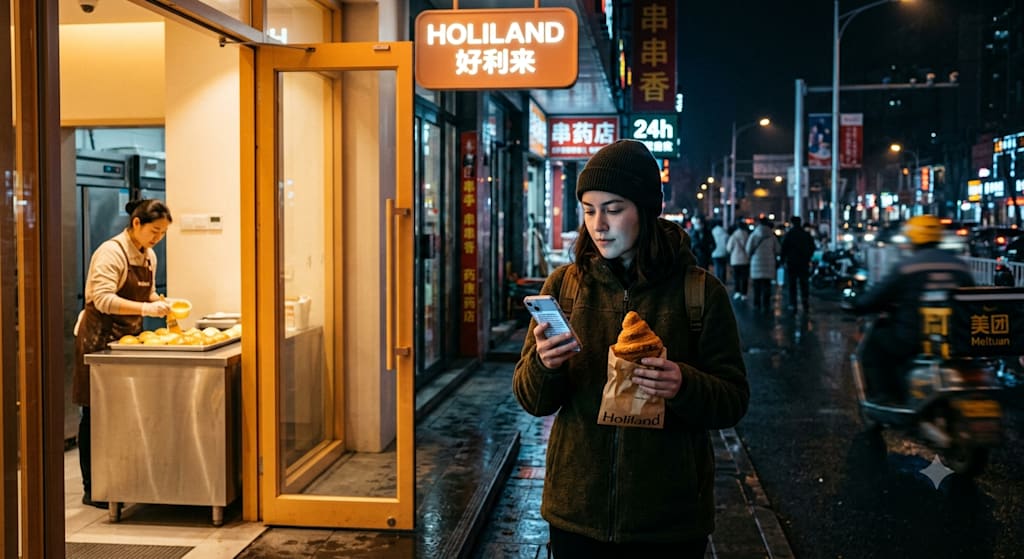
The Warm Yellow Light That Evening Was the First Trap.
It spilled out through the glass doors of the Holiland bakery, carrying the scent of freshly baked caramel and wheat flour that had been thoroughly heated through, the kind of smell that stops you mid‑step. You were only passing by, but that aroma landed on your forearm like a hand — not tugging, just resting there lightly, the kind of touch you know you could shake off anytime. You shook it off three times. On the fourth, you pushed the door open.
The doorbell gave a single crisp ring. The clerk looked up at you for a second, then went back to brushing egg wash over another tray of pastries. Two rows of just‑baked croissants sat in the display case, their surfaces still slowly collapsing, warm air seeping out through the cracks in the flaky crust. You pointed and said you’d take those two. She picked them up with tongs, placed them in a brown kraft paper bag stamped with the logo, and sealed the top with a gold sticker. The scanner beeped. A number flashed on the screen: 58 yuan.
As you stepped out of the store, the warmth of the bag was still traveling through the paper into your palm. You did a quick mental calculation: you’d come out and bought them yourself, no delivery fee, so you’d saved the courier charge. That meant the bread had effectively cost you four yuan less. You even murmured the conclusion out loud: “I’m such a money‑saving whiz.” The tone carried a hint of self‑mockery, but the pride was real.
And then, for reasons you couldn’t quite explain, you opened Meituan.
Your location hadn’t changed. It was the same store. You switched from “in‑store purchase” to the delivery page and added those two croissants to your cart again. Three coupons popped up on the screen: one was a platform member discount, one was a repeat‑customer offer, and one simply said “free delivery.” Your thumb hovered above the screen — you didn’t tap immediately, because the final total had already appeared: 32 yuan.
You stopped walking. Pedestrians swerved around you on the sidewalk because you were just standing there in the middle of the path, your left hand holding the real 58‑yuan bread, your right hand holding a 32‑yuan phantom version on your phone. Two numbers coexisted in the same moment, separated by 26 yuan, by the width of a sidewalk, and by something else you hadn’t yet put words to.
You kept walking. The croissants in the bag were still warm, but you no longer felt they were worth that 58 yuan.
Holiland sits at the southeast corner of the intersection, across from a chain pharmacy and next to a clothing store that had long since shut its doors, its rolling shutter plastered with a “Prime Location for Rent” sign that had been there for two years. Holiland was still open, but did you know how much its rent was? You’d asked the clerk brushing egg wash, and she said she didn’t know — she just baked the bread. But you did know how much these street‑level storefronts cost per square meter per day, because last year you’d helped a friend look at spaces. Part of that croissant’s price went to the landlord, part went to the hands of that clerk brushing egg wash, and part went to the royalty fees for the anonymous jazz tune looping in the background, from ten in the morning until ten at night, twelve hours a day, billed monthly.
And inside that 32‑yuan price: the platform had subsidized a slice, the merchant had trimmed another slice to boost their review rankings, and the courier’s delivery fee had been compressed by the algorithm down to three‑fifty. The 32 yuan you paid wasn’t the price of the bread. It was the discount you received for agreeing to let this transaction arrive an hour later.
That evening, a push notification appeared on your phone: the same Holiland was live‑streaming. The host was the same clerk from the afternoon (she’d changed her mask), and she was saying to the camera, “Folks, order from the livestream today and it’s twenty yuan cheaper than in‑store.” A screenful of “ordered” comments scrolled past. You watched her behind the lens, her hands moving exactly as they had that afternoon — picking up bread with tongs, bagging it, sealing it with the gold sticker. Except that afternoon, that bread had been handed to you. This one was handed to a delivery rider.
You thought back to your father ten years ago, making his weekly supermarket trips. Every Saturday morning he’d write a list on the back of a cigarette pack, his handwriting slanted. Ten jin of rice, a jug of cooking oil, a tray of eggs, two bottles of soy sauce. He’d go to the store and load each item into the cart, then onto the checkout counter, then into the trunk, then carry it all up five flights of stairs. By the time he got home, his shoulders were uneven: his right hand hung two centimeters lower than his left, and he’d need a moment before he could straighten up. He never complained, because that was simply what “going shopping” looked like. You’d never asked him why he didn’t get delivery — because back then, nobody delivered, or if they did, they charged an extra five yuan at the door, and he figured five yuan was worth his own sweat.
The pressure you apply now when you tap “Pay Now” is so light you can barely feel your thumb exerting any force at all. You could even finish another task in the forty‑five minutes while you wait for the bread to arrive. You are no longer the person who carries their own supplies. You sit still and let three different people perform three different actions on your behalf — “go over there,” “pick it up,” “bring it back.” You’re only responsible for “one tap.”
This isn’t laziness. This is what happens when the division of labor crosses a certain threshold, the only rational choice a person can make.
But that afternoon, when you’d stopped on the sidewalk, you’d actually noticed something else.
You saw a middle‑aged woman walk into the shop next door — the one that sold e‑cigarettes now, in the spot where that clothing store used to be. She paused in front of the glass door. Not because she was about to go in, but because she hadn’t yet gotten used to the change. She glanced at the “E‑Cigarettes” sign, then walked away. Her steps were quick, as if she were trying to shake off the mistake of having looked.
Later, you deliberately circled back to check. That clothing store was indeed gone. You remembered its name, “Wheatfield,” and that it sold linen‑cotton shirts. There was always a real pot of pothos in the window, and the clerk was a girl with a ponytail who, every time you passed, would be sitting behind the cash register reading a book, turning pages very slowly. You didn’t know when she’d left. You didn’t know where that pothos had gone either.
Now that doorway sold e‑cigarettes. The glass door was brighter — so bright it was reflective, and standing in front of it you could see your own face. No scent drifted out from inside.
And then it struck you: what about Holiland’s door? What if one day it closed too? Not just a sign change, but gone entirely. That clerk with the egg wash would move somewhere else to brush egg wash, or she wouldn’t brush it anymore. Those two rows of croissants would only exist in some space between a factory’s frozen dough and a courier’s insulated bag. You would never again push open a door whose bell rings, never again smell that freshly baked, still‑evolving aroma with its hint of humidity, because what you buy online will always be a “finished product” that has long since cooled down and been sealed in plastic. It won’t collapse slowly in front of you. Its crust won’t flake off on the tongs as the clerk picks it up.
Right now, you think the “quiet emptiness” doesn’t bother you, because you still have a door you can push open. You push it open less and less, but it’s still there. When you place an order on your phone, you even feel a faint satisfaction: see, the physical store still exists. I have a place to go and smell things, but I choose not to. That’s my freedom.
But this “freedom” comes with an invisible bill. Every time you replace 58 yuan with 32 yuan, you blow a breath toward that door. So light that you don’t even feel it yourself. But doors sway. Sway long enough, and the hinges loosen. Loosen to the point where, one day, it’s no longer a door. It becomes a wall. And on that wall, a new logo will be pasted, selling something else.
Late that night, you tore open the croissant. Golden crust, honeycombed cross‑section, the taste of butter melting on your tongue. The sound of flaky crust breaking between your teeth — very soft.
Just like the 32‑yuan one. Exactly the same.
You suddenly recalled the clerk from that afternoon. When you’d paid, she’d said, “Take care now,” in a flat tone, neither warm nor cold, just the kind of line that gets repeated dozens of times every day. You hadn’t responded at the time, because you were calculating the four yuan you’d saved on delivery. You hadn’t even looked her in the eyes.
Next time you pass by, you might push the door open, buy one croissant, scan and pay 58 yuan, and then, when she hands you the bag, say “thank you” while looking directly at her.
Not because 58 yuan is the “right” price. But because you still want to smell that scent.
It’s not that physical stores deserve to survive. It’s that you don’t want to walk by one day and realize that the option of “pushing the door open” no longer exists for you.
You don’t know if the doorbell will ring again. You don’t know if that clerk with the egg wash will still be there next year.
But at least you know this: that croissant, in your hand, is warm.
That’s enough.
About the Creator
Jin
Writer of reamstories
https://reamstories.com/jin
Enjoyed the story? Support the Creator.
Subscribe for free to receive all their stories in your feed. You could also become a paid subscriber, letting them know you appreciate their work.
Comments
There are no comments for this story
Be the first to respond and start the conversation.