Historical
Inside the CIA’s Bizarre Secrets
Beneath the surface of global politics, in sealed vaults and redacted files, lie the shadows of the CIA’s strangest operations. These aren’t the sleek espionage tales of James Bond. No, these are stories so outlandish, so surreal, they read more like pulp fiction—except they’re terrifyingly real.
By Kristen Orkoshneliabout a year ago in FYI
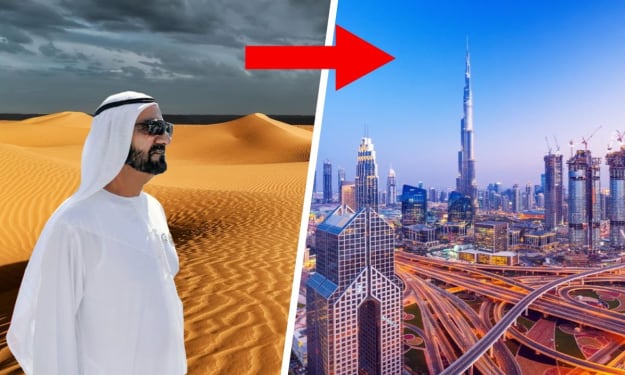
How Dubai Ruler built Dubai in a Desert
Before 1980, Dubai was just a barren desert town, a forgotten face on the map of the Middle East. Life was simple, infrastructure was limited, and the world hardly noticed it. But in just four decades, something extraordinary happened. Under the visionary leadership of Sheikh Mohammed bin Rashid Al Maktoum, Dubai transformed itself from a lifeless stretch of sand into one of the most dazzling and futuristic cities on Earth. It was a transformation so dramatic, it left the world in awe.
By Chronicle of Powerabout a year ago in FYI
Shemar Stewart: The Next Defensive Giant You Need to Know
From Miami Dreams to SEC Reality, Shemar Stewart Is Carving His Own Legacy In the world of college football, hype can come fast and fade even faster. But every now and then, a player emerges who doesn’t just meet expectations—they break through them like a linebacker in full sprint. That player right now? Shemar Stewart.
By Saboor Brohi about a year ago in FYI
North Korea: 34 Rules That’ll Scare You
A child is born in North Korea. But from the moment he enters the world, he's branded a traitor—not because of anything he’s done, but because of something his grandfather once believed. In North Korea, your bloodline is your destiny, and if someone in your family once opposed the regime, you carry that punishment across generations.
By Chronicle of Powerabout a year ago in FYI
Preventing Prediabetes from Progressing to Type 2 Diabetes: A Complete Guide
Note: This report is about prediabetes, which is the stage that comes before type 2 diabetes. It includes information and advice about rapid weight loss, which may be distressing for some readers. Therefore, please follow this guidance only under the supervision and advice of a doctor or medical expert.
By Ikram Ullahabout a year ago in FYI
The Long Walk Back
In August 2018, a 37-year-old freelance photographer named John Mallory set out on what he believed would be a routine journey. He was in the Mojave Desert, seeking to capture the haunting beauty of an abandoned mining town for a personal photo essay. But what unfolded over the next three days would turn into the most terrifying and transformative experience of his life. John had rented a Jeep Wrangler in Barstow, California, and packed lightly—perhaps too lightly. With one gallon of water, a printed satellite map, and a couple of granola bars, he figured he could make the 90-mile round trip without issue. The temperature outside was over 110°F. Locals warned him against going alone. He waved them off with a confident smile. He had done solo trips before. This, he thought, would be no different. As he drove through narrow dirt paths, the road became less like a road and more like a battlefield of rocks and deep cracks. Twenty miles in, the Jeep hit a sharp ridge and the axle snapped. The vehicle wouldn’t move. With no cell signal, no backup gear, and the sun already past its peak, John knew he had to walk. He left a note in the windshield: “Heading west to find help – J.M.” He began walking toward where he assumed the nearest road would be. At first, he tried to pace himself. He’d done long hikes before, but this was different. The sun burned down like fire, the air was bone-dry, and each step on the cracked ground sucked more energy from his body. After three hours, he’d only covered five miles. His water was half gone. By nightfall, temperatures dropped rapidly, offering some relief. But his problems were far from over. Coyotes howled in the distance, and unfamiliar rustles in the brush kept him on edge. He wrapped himself in a thin emergency blanket and tried to rest behind a rock formation. Day two brought new horrors. His mouth was completely dry, his tongue swollen. His face was blistering. His last sip of water was gone by sunrise. Hallucinations began. He imagined seeing a truck parked on the horizon. He stumbled toward it, only to realize it was a mirage. At one point, he knelt in the sand and wept. “I thought I was dying. I didn’t want to die like that—alone and stupid.” He began recording short messages into his camera in case someone found it. “To my sister Rachel: I’m sorry. I should have called more. Tell Mom I love her. Tell Dad… he was right. I should’ve planned better.” He started crawling by the second afternoon. The heat burned his knees through his jeans. He tried chewing desert plants, hoping for moisture, but it only made him more nauseous. By evening, he could barely lift his arms. He wrote a message in his notebook and stuck it inside his boot: > “My name is John Mallory. I got lost. I tried. Please find my family.” He passed out that night beneath a ridge. On the third day, he awoke with insects crawling across his hands. He could barely see. Every muscle hurt. But he heard something—an engine. A group of ATV riders had taken a different trail and one of them noticed something shiny: John’s camera lens reflecting light. They stopped. One of the riders, a retired paramedic, found John unconscious but alive. They used a two-way radio to contact authorities. A rescue helicopter arrived within 45 minutes. John was flown to a trauma center in Las Vegas with severe dehydration, sun poisoning, and kidney damage. Doctors estimated he had less than two hours to live when they found him. He spent two months recovering. But the John Mallory who left the hospital wasn’t the same man who entered the desert. He gave up high-risk photojournalism. He moved to Oregon, started writing a blog called Desert Lessons, and began mentoring young photographers about risk, responsibility, and preparation. In a TEDx talk he gave later that year, he said: > “I went into the desert looking for forgotten stories. I didn’t know mine would become one of them. But that walk—those endless hours with nothing but heat and regret—gave me a new beginning. I was ready to quit on myself. The desert didn’t let me.” Today, John is married with one daughter. He still hikes—but never alone. He carries a satellite phone, extra food, flares, and a reminder note in his wallet that reads: “Survival is about humility, not bravery.”
By Muhammad Usamaabout a year ago in FYI
The Vanishing Hour: The True Story Behind the Cold Lake Disappearance
Cold Lake, Alberta, is the kind of place where people leave their doors unlocked and greet each other with a nod. Tucked away near the edge of a sprawling forest, the lake glistens like a hidden gem, peaceful and pristine. Nothing ever happened there—until the spring of 2016, when Jeremy Cole disappeared without a trace. Jeremy was 34, a quiet, lanky mechanic known for his love of fishing, plaid shirts, and beat-up red Ford pickup. He lived in a log cabin by the water’s edge, inherited from his grandfather. He wasn't flashy, didn’t have many enemies, and mostly kept to himself. On April 9th, 2016, Jeremy texted his sister Rachel: “Heading out to the lake. Might be late.” That was the last time anyone heard from him. When he didn’t show up for work the next morning at the auto shop, no one panicked. Jeremy was known to go off-grid for a night or two. But when Monday came and went with no calls, no texts, and no posts on his usually active Instagram, Rachel got worried. She drove to the lake, found his truck parked near his favorite fishing spot—keys still in the ignition, phone left inside. His tackle box was open, one fishing rod propped up and forgotten. It looked like he had just stepped away. But Jeremy was gone. --- The local police launched a search within 24 hours. Volunteers combed through the forest. Drones scanned the lake. Divers spent three days in the frigid waters. Nothing. No signs of struggle. No signs of life. Until Tanya Sharp, a nearby cabin owner, came forward. She claimed that around 3:00 AM on the night Jeremy disappeared, she heard shouting coming from the woods. She thought it was teenagers messing around until she saw headlights flashing between the trees. But by the time she stepped outside, everything had gone still. At the time, the report didn’t lead anywhere. Tanya hadn’t seen a vehicle or a person—just lights. And Cold Lake was often a quiet playground for late-night partiers. Still, it lingered in the background. --- Two months later, a hiker found Jeremy’s fishing knife two kilometers into the dense forest. It was wiped clean, no blood, no prints. Just lying on a mossy log as if someone had placed it there. The RCMP reclassified the case from a missing person to a possible homicide. Jeremy’s cabin was re-searched, and his life scrutinized. What they found shocked even his closest friends. A man named Kyle Jensen—Jeremy’s former coworker—had a bitter falling out with him a year before. The two had co-owned the auto shop briefly until Kyle was allegedly forced out due to mismanaged funds. Friends reported several heated arguments and even a restraining order filed but later dropped. Kyle had a rock-solid alibi: he was in Edmonton attending a wedding with 100 guests and dozens of photos as evidence. Still, the rumors spread like wildfire. Rachel, however, wasn’t convinced. She started her own investigation. She found Jeremy’s journal, hidden in a toolbox beneath the cabin’s floorboards. In it were scribbled pages of paranoia: > “I feel watched. Not just at night—always. I know it’s him. I just can’t prove it.” > “If anything happens to me, don’t let them say it was an accident.” He never mentioned Kyle by name—but it was clear something had spooked him. --- By 2017, the case had gone cold. But Rachel kept the memory alive. She contacted podcasts, bloggers, and Reddit communities. One particular Reddit thread titled “Cold Lake: The Disappearance of Jeremy Cole” gained traction. The community uncovered something shocking: A user, claiming to be from the Cold Lake area, posted anonymously: > “I saw a man screaming near the trees that night. I was camping nearby. I thought he was drunk. I didn’t know until now.” The user never posted again. The account was deleted within hours. Still, the story made headlines. A true-crime documentary, “Frozen Echoes,” aired in 2020, recounting the timeline and introducing the public to Jeremy’s case. That’s when the police got a tip that changed everything. A former poacher named Brad Lang claimed to have seen a confrontation near the lake in early April 2016. He described a man in a gray hoodie arguing with another near a parked truck. Brad didn’t report it then—he had illegal traps nearby and feared prosecution. When shown photos, he identified Jeremy. He hesitated over the second man but thought it looked “a lot like Kyle.” Kyle was brought in again. No charges were filed. But public suspicion had returned. --- In 2023, another strange clue surfaced. A local girl, 11-year-old Emma, found a burned journal in the forest while on a school trip. Pages were mostly gone—but one remained intact: > “He won’t stop. I’ve seen the truck twice this week. Same place, same time. I’m afraid.” Handwriting analysts confirmed it matched Jeremy’s. --- Still, no body. No murder weapon. No confession. Today, the story haunts the residents of Cold Lake. Tourists ask about it. Locals speak in hushed tones. Rachel still visits the lake every April, placing a bouquet near the log where Jeremy’s knife was found. She swears she still hears him in the wind. She keeps a voice mail he left her two days before he vanished: > “You’re all I’ve got. Promise you won’t forget me, okay?” And she hasn’t.
By Muhammad Usamaabout a year ago in FYI