Historical
Fish Fossils Reveal Extraordinary Story of Rapid Evolution
A recent study examining fish fossils from East Africa's Lake Victoria has uncovered a captivating tale of rapid evolution. Contrary to the longstanding assumption that early colonizers have an advantage in diversifying into new species, a team of researchers has discovered that it takes more than just timing to win the speciation race. The study, published in Nature, focuses on the cichlids that colonized Lake Victoria and underwent a remarkable burst of diversification, resulting in the emergence of 500 new species in less than 17,000 years.
By Mohammad Nurrizal Putra3 years ago in FYI
Preserving Tradition: The Endurance of Kushti, India's Ancient Mud Wrestling
In the heart of rural India, a centuries-old tradition thrives, hidden beneath the layers of history and modernity. Kushti, a traditional form of Indian wrestling, has been practiced for over 2500 years, but its resilience and relevance persist in the face of changing times. In this article, we delve into the world of Kushti, uncovering the discipline, culture, and challenges that define this ancient sport.
By Anu Preethi Danila D3 years ago in FYI
The Pythagorean Musical Scale: The Math Behind Its Importance and Imperfection
Pythagoras was a philosopher, mathematician, musician, and cult leader in 6th century Ancient Greece. Known as the father of math and music, many important discoveries are attributed to him including the Pythagorean Tuning System and what we know in Western music as the harmonic series. However, “the concept of harmonics is found in many cultures around the world, and it is possible that Pythagoras was influenced by earlier thinkers.” In fact, he is hardly the only great mind that discovered the physics and math behind musical intervals. On our journey to the truth, we will explore the history of Pythagorean tuning, the mathematics behind music, the fascinating applications musical intervals inspired, and the legend of the blacksmith’s hammer that started it all.
By Kaneene Pineda3 years ago in FYI
"The evolution of international single-seater racing: FORMULA 1"
Formula 1, often abbreviated as F1, is a highly prestigious and popular type of car racing worldwide. In Formula 1, drivers pilot specially designed racing cars known as "monopostos" or "single-seaters." Here are some key points to remember: Formula cars: These are ultra-fast and technologically advanced racing cars designed to be lightweight, aerodynamic, and powerful. Formula 1 teams invest significant amounts of money to make their cars as fast as possible. Drivers: Formula 1 drivers are among the best in the world. They are highly skilled, brave, and competitive. F1 attracts some of the most renowned athletes. Races: Formula 1 organizes a series of races throughout the year, called Grand Prix, on special circuits around the world. These races take place on tracks ranging from city circuits to traditional racetracks. Speed: Formula 1 cars can reach incredibly high speeds, well beyond what you'll see on the road. They are capable of exceeding 300 km/h (186 mph). Competition: Formula 1 is highly competitive. Teams compete to win the World Constructors' Championship, while drivers vie for the World Drivers' Championship. Technology: F1 serves as an innovation laboratory for the automotive industry. Many technologies developed in F1 end up being used in everyday cars. In summary, Formula 1 is a high-level motorsport where talented drivers pilot ultra-fast racing cars in exciting races on circuits around the world. It's a sport that blends cutting-edge technology, speed, and intense competition. The concept of single-seater car racing dates back to the early decades of the 20th century (1900-1940). However, these races were often unregulated and dangerous. During this period, car manufacturers and drivers participated in various single-seater races, but there was no official world championship. After World War II (1940-1950), there was growing interest in creating a global-level single-seater racing championship. In 1950, the Fédération Internationale de l'Automobile (FIA) organized the first Formula 1 World Championship, consisting of seven races. Italian driver Giuseppe Farina won the inaugural championship, and Alfa Romeo was crowned the World Constructors' Champion. The 1950s and 1960s were marked by legendary drivers like Juan Manuel Fangio and Stirling Moss. The cars were powered by powerful naturally aspirated internal combustion engines. It was a dangerous era with many fatal accidents. The transitional years (1970s-1980s) saw technological advancements with the introduction of turbocharged engines and more advanced aerodynamics. Iconic drivers like Niki Lauda, James Hunt, and Ayrton Senna became Formula 1 legends. The modern era (1990s-present): The 1990s saw the rise of Michael Schumacher, one of the greatest drivers of all time. Cars continued to evolve with increasing automation and improved safety. In the 21st century, drivers like Lewis Hamilton and Sebastian Vettel have dominated the sport. Technological aspect: Formula 1 has become a hub of innovation for the automotive industry, with technological developments such as Kinetic Energy Recovery Systems (KERS) and turbocharged hybrid power units (PU). Global broadcast: Formula 1 races are broadcast worldwide, making it one of the most popular sports. Teams are supported by significant sponsors and investors. Competition: Formula 1 remains one of the most competitive sports in the world, with teams competing for the World Constructors' Championship and drivers for the World Drivers' Championship. Today, Formula 1 stands at the forefront of automotive technology, with incredibly fast cars and talented drivers, while continuing to be a global sport followed by millions of fans worldwide. Furthermore, Formula 1 is considered the highest class of international single-seater racing for several reasons: Advanced Technology: Formula 1 cars are among the most technologically advanced in the world, with constant innovations in engines, aerodynamics, electronics, and materials. This attracts the attention of engineers and technology enthusiasts. Top Drivers: Formula 1 brings together some of the best racing drivers in the world. F1 drivers are highly skilled, competitive, and often regarded as elite athletes. Global Visibility: Formula 1 is followed by millions of fans worldwide. Races are broadcast in many countries, making it a major media platform for sponsors and teams. History and Tradition: Formula 1 has a long and rich history dating back to the 1950s. Iconic Grand Prix races like Monaco, Silverstone, and Monza are part of the sport's heritage. Significant Investments: Formula 1 teams benefit from substantial budgets, allowing them to develop cutting-edge cars and hire top-level drivers. International Competition: Formula 1 is truly international, with teams, drivers, and races from various countries. This creates a unique global competition. These factors contribute to making Formula 1 the highest class of single-seater racing and one of the most prestigious sports disciplines in the world.
By Mingué Gueye3 years ago in FYI
Philosophy made easier
I have always wondered how philosophical terms were invented and used in human history. Vocal has been my partner in sharing my scattered thoughts and whatever I'm up to. I have decided to write a series of articles on philosophical terms that are complex at first sight, but when you get the etymology, they remain forever in your mind. So here's the first chapter. To make it easier yet memorable for you, I'm gonna add just 8 terms in each chapter.
By Ayesha Mughal3 years ago in FYI
Why Many Consider Bruce Lee Super Human
10. The One-Inch Punch: The one-inch punch stands as one of Bruce Lee's most renowned accomplishments, and its awe-inspiring nature is undeniable. With astonishing power, Lee could knock over a fully grown adult male from a distance of less than an inch. This feat left scientist intrigued, leading them to delve into the minds of martial artists to comprehend the mechanics behind it. Additionally, Lee used this incredible skill to educate and inspire the next generation.
By Joseph Mwaniki3 years ago in FYI
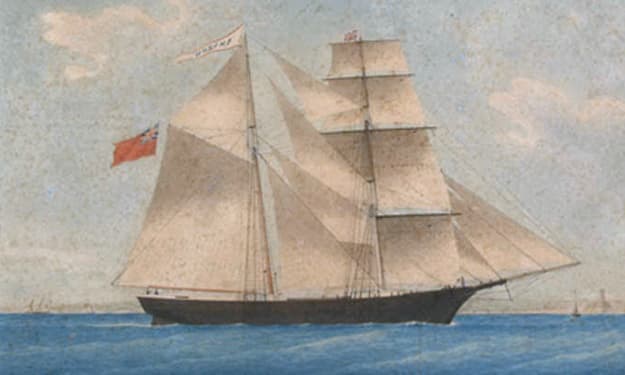
The Mary Celeste: Ghost Ship of the Atlantic
The story of the ship Mary Celeste has been passed down from generation to generation for more than a century, and it is always presented in the context of the vast and unforgiving expanse of the Atlantic Ocean. The narrative is replete with enigmas and shady dealings in the sea. This spectral ship, which was discovered drifting in the ocean in the year 1872 with its crew mysteriously disappearing, is still considered to be one of the most perplexing maritime riddles of all time by many people. In this article, we set sail into the past to study the intriguing story of the ship Mary Celeste, its missing crew, and the various theories that have been given to explain this age-old nautical conundrum. Throughout our journey, we come across a number of hypotheses that have been proposed to explain this mystery.
By Stephen Keith B. Labto3 years ago in FYI